
EmpCo Takes Effect: The EU Hands the Burden of Proof for Green Claims Back to Business
EmpCo moves the burden of proof for green claims to before publication, which makes verification capability the price of entry to the EU consumer market. For Taiwanese companies, the only environmental claims that will still hold are those backed by independently verified data from the product’s own value chain; carbon offsets and non-EU government labels can no longer vouch for a product on the EU market.
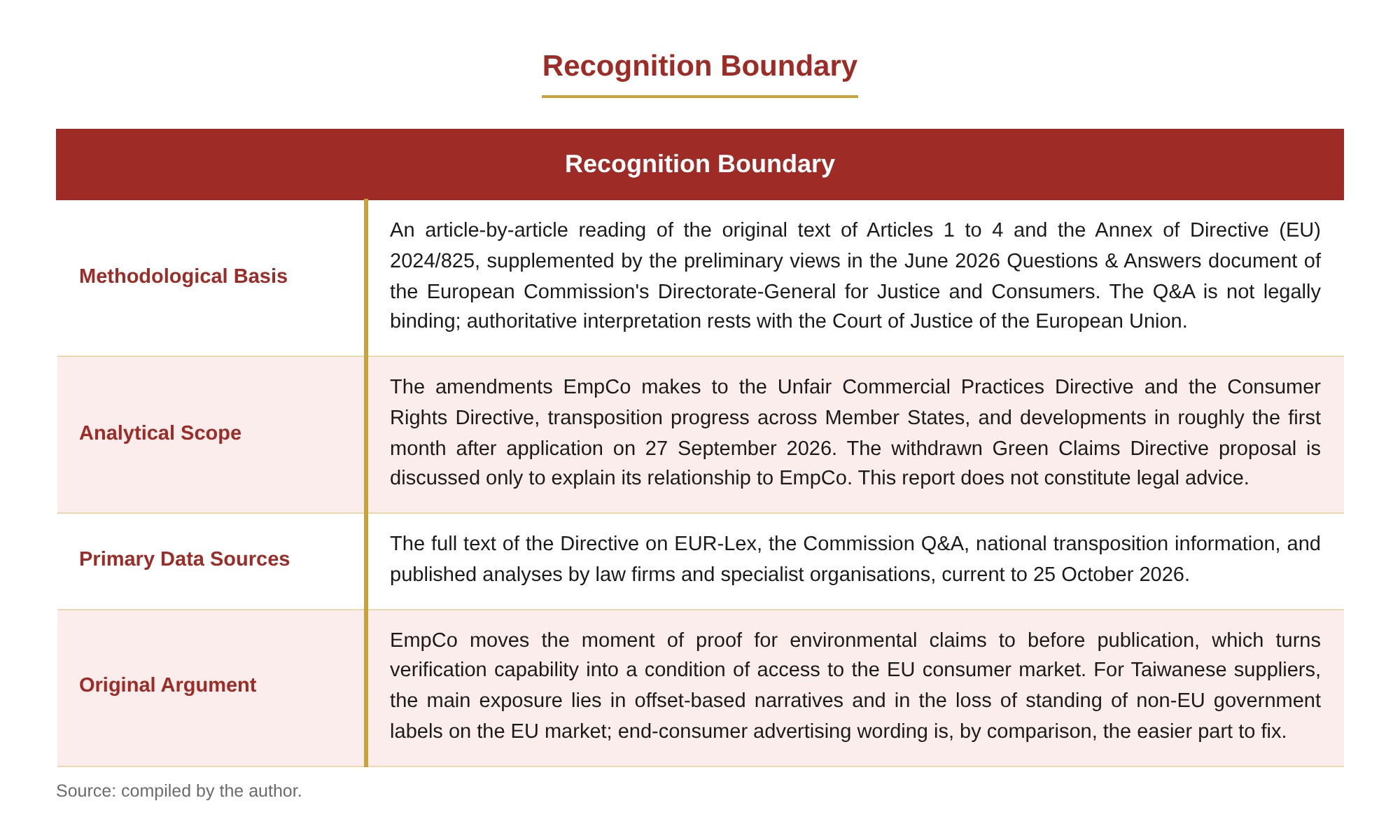
I. Core Claim
The EU Directive on Empowering Consumers for the Green Transition (EmpCo, Directive (EU) 2024/825), applicable since 27 September 2026, has shifted the EU’s approach to green claims from correcting them after the fact to requiring proof before they are made. Generic environmental wording, self-created labels without third-party certification, and product carbon-neutrality claims based on offsetting are now all on a blacklist of practices banned in all circumstances, so enforcers no longer need to show that consumers were misled, and companies get no grace period for existing stock. Although the Directive formally governs only business-to-consumer communication, its effect will travel up the supply chain through brand owners’ compliance reviews. For Taiwanese companies, which export mainly as contract manufacturers and component suppliers, what will decide whether they can keep supporting their EU customers’ environmental claims is their ability to supply data that covers the product’s own life cycle and has been verified by an independent third party; the communication value of carbon offsets and of Taiwanese government labels in the EU consumer market will shrink markedly.
II. Legislative Background and Legal Status
1. Origins
EmpCo grew out of findings the European Commission could not ignore: more than half of the environmental claims made by companies in the EU were vague or misleading, and around 40 percent had no supporting evidence at all (Verso, 2026). Under the New Consumer Agenda and the Circular Economy Action Plan, the Commission tabled the draft Directive in March 2022 with two aims: to stop greenwashing and to tackle the early obsolescence of products.
The Directive was adopted on 28 February 2024, published in the Official Journal on 6 March 2024, and entered into force on 26 March 2024, giving Member States two years to transpose it plus a further six months before application. It goes by three names in English-language sources. Consultants and marketers tend to say EmpCo, Commission documents use ECGT, and lawyers cite the number 2024/825, but all three refer to the same law (Projet Celsius, 2026b).
2. Legal Status: A Safety Net Built Into Existing Directives
EmpCo is not a standalone regulation. It amends two existing directives: the Unfair Commercial Practices Directive (Directive 2005/29/EC, the UCPD) and the Consumer Rights Directive (Directive 2011/83/EU, the CRD). The Commission describes this as a horizontal “consumer protection safety net” that operates as general law; where sector-specific law exists, such as the rules on organic food labelling, the sectoral rules take precedence (European Commission, 2026).
Its scope is strictly limited to business-to-consumer (B2C) commercial practices. Business-to-business dealings fall outside the harmonised EU framework, although Member States may extend protection to B2B relations nationally. Sustainability reports prepared under the CSRD, which are mandatory and aimed mainly at investors, are usually outside its scope as well; once a company uses that content in voluntary advertising aimed at consumers, however, the communication falls under EmpCo (European Commission, 2026).
3. Key Dates
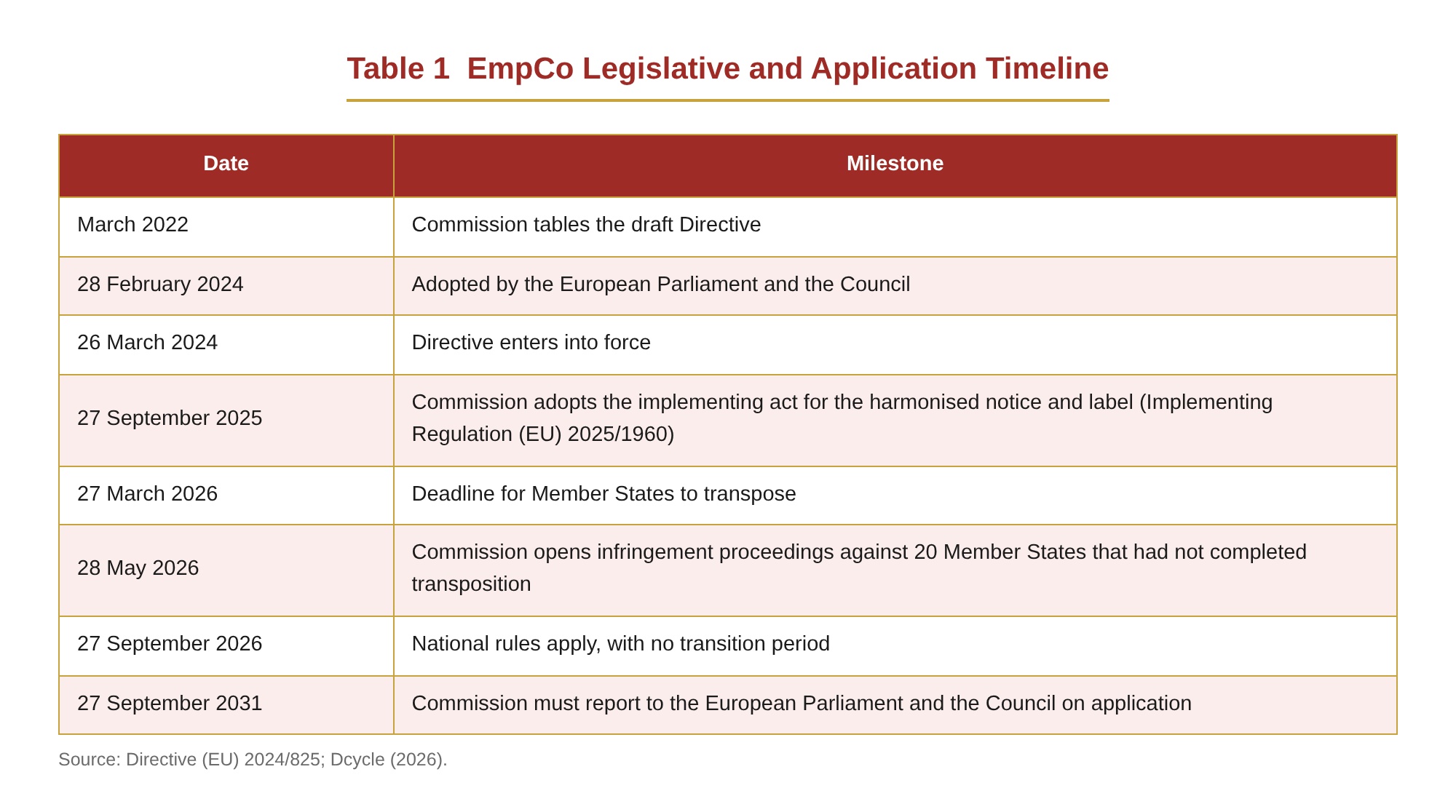
4. A Three-Layer Structure
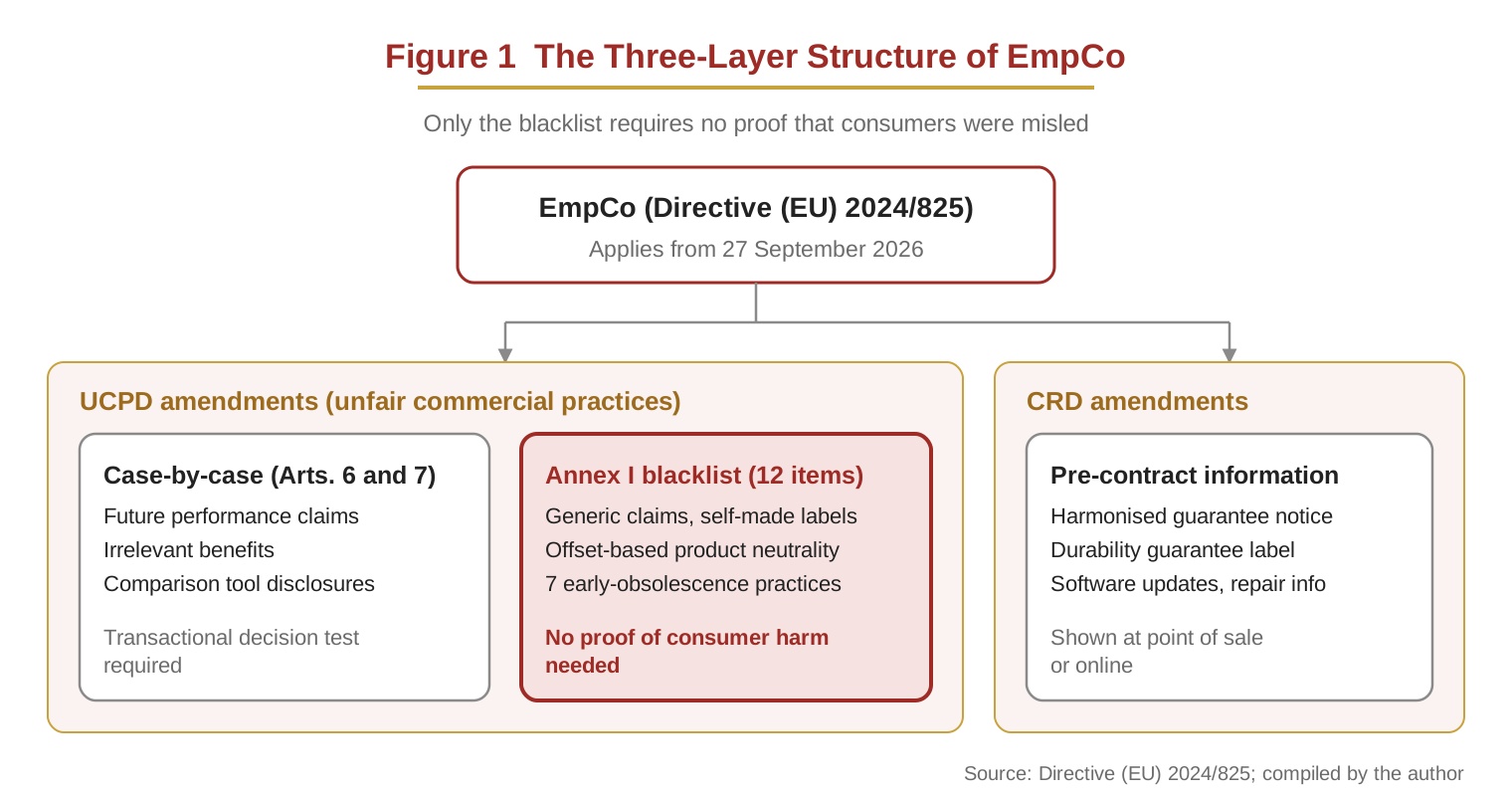
EmpCo’s amendments fall into three layers. The first is the case-by-case regime in Articles 6 and 7 of the UCPD, where enforcement requires a “transactional decision test”, meaning proof that the practice is likely to cause the average consumer to take a decision they would not otherwise have taken. The second is the blacklist in Annex I of the UCPD, whose entries are unfair in all circumstances with no need to show any effect on consumers. The third is the set of information duties in the CRD, which require guarantee, durability and repair information at the point of sale. How these layers divide the work determines whether a company faces a grey zone open to argument or a red line with no defence.
III. Core Definitions
EmpCo adds points (o) to (w) to Article 2 of the UCPD. These few terms set the boundaries of every prohibition in the Directive, so understanding them is the same as understanding where the red lines are drawn.
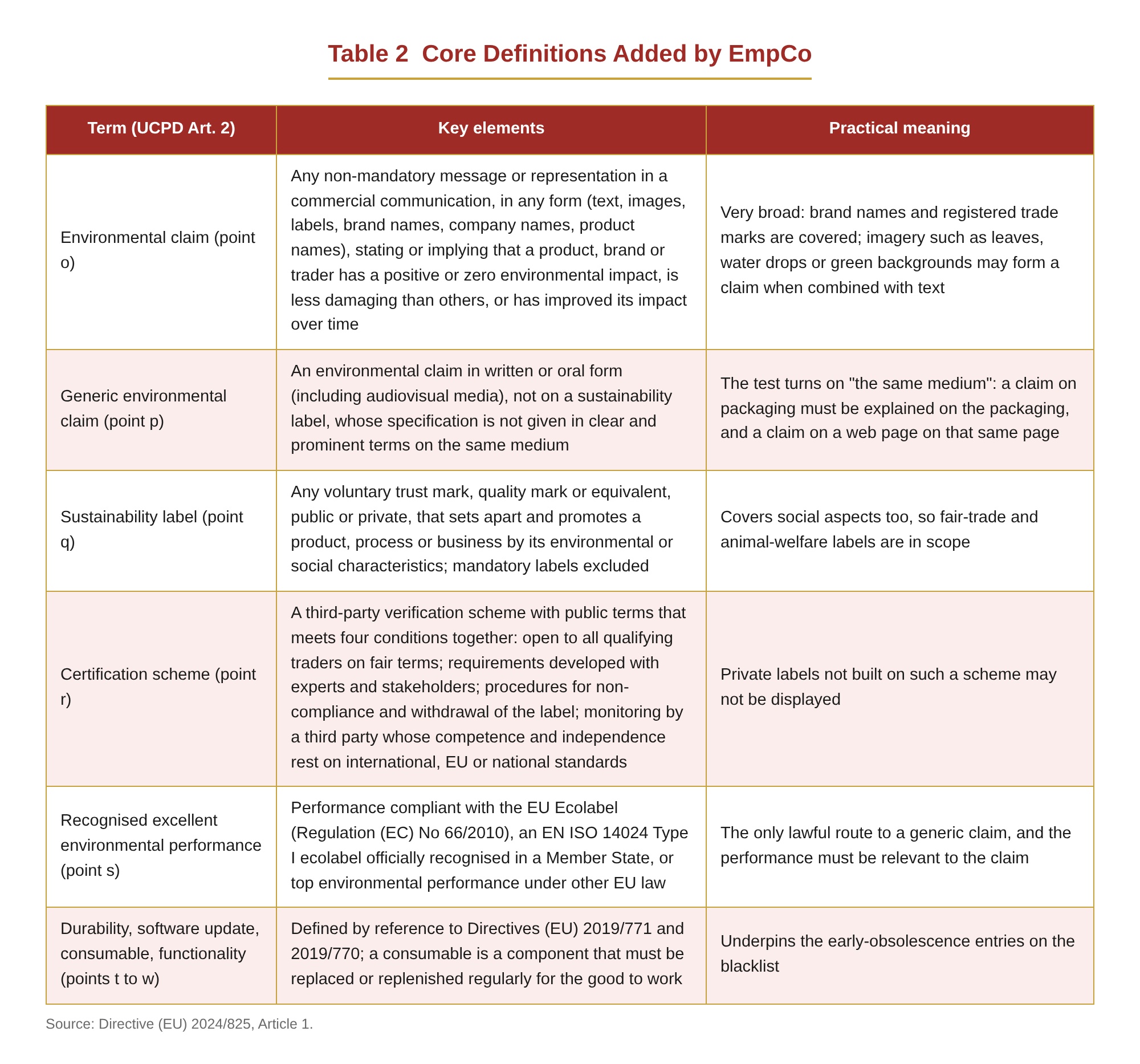
The Commission Q&A gives a clear pair of examples for the line between generic and specific claims. “Climate-friendly packaging” with no further explanation is a generic claim. “100% of the energy used to produce this packaging comes from renewable sources” is a specific claim and is not caught by the ban on generic claims, though it still needs evidence and must comply with the rest of the UCPD. Where packaging or a billboard has no room for an explanation, the Commission’s position is blunt: the claim should generally not be made (European Commission, 2026).
Brand names are an area many companies overlook. Trade-mark protection does not exempt a name from EmpCo. If words such as “Green”, “Eco”, “Natural” or “Climate Neutral” in a name are likely to create an environmental association for the average consumer, the name is an environmental claim, and the company must specify it on the same medium or show recognised excellent environmental performance. Member States may even refuse registration of such marks, or declare existing ones invalid, under the Trade Marks Directive (European Commission, 2026).
IV. The Annex I Blacklist: Practices Banned in All Circumstances
EmpCo adds 12 practices to Annex I of the UCPD: 5 related to greenwashing and 7 aimed at early obsolescence. Any blacklisted practice is an unfair commercial practice in all circumstances. Enforcers need no case-by-case assessment of the effect on consumers, and companies cannot cure the breach with disclaimers or footnotes.
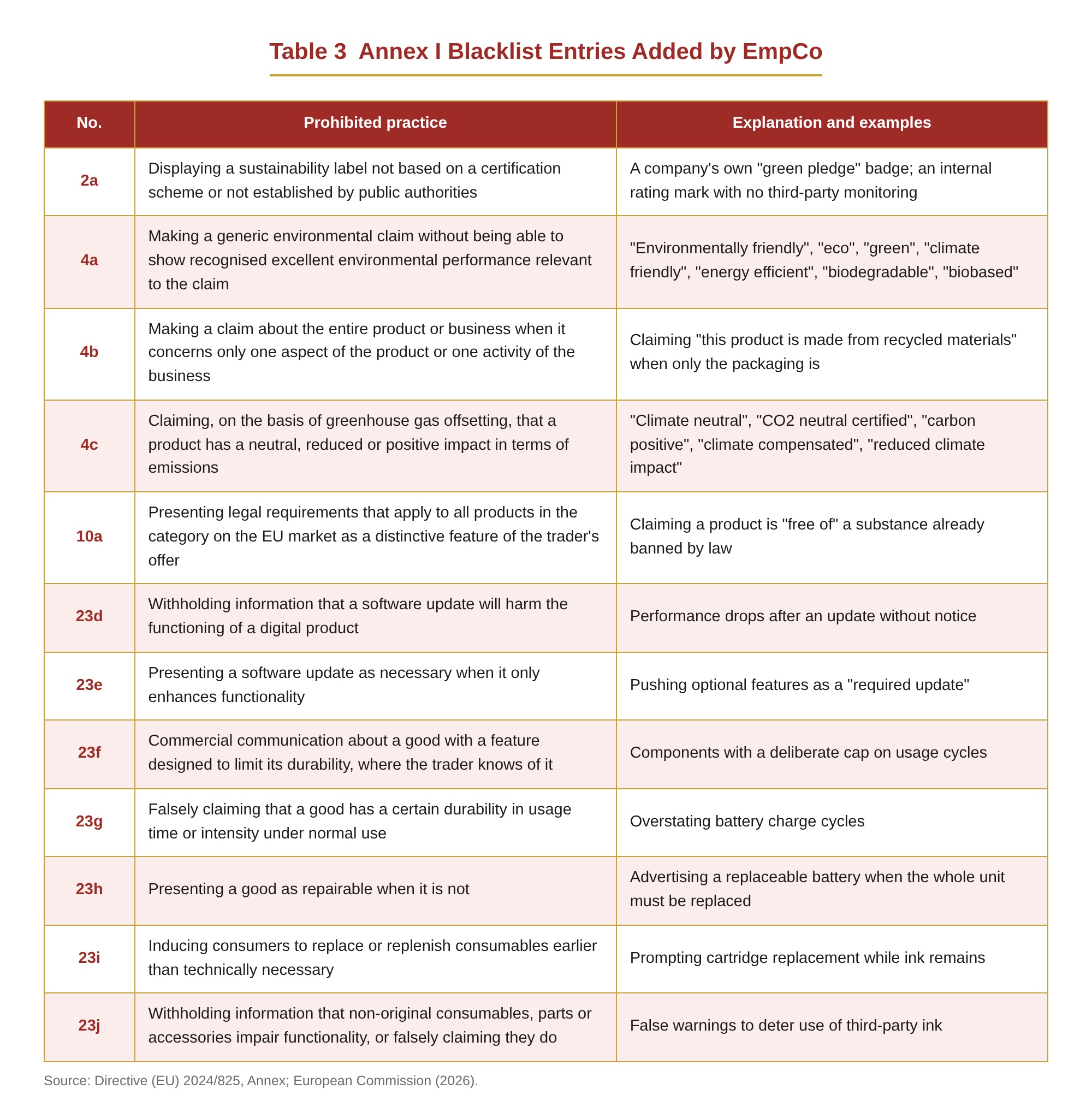
1. Three Lawful Routes for Generic Claims (4a)
According to the Commission, there are only three ways to use a generic claim lawfully: hold the EU Ecolabel; hold an EN ISO 14024 Type I ecolabel officially recognised in a Member State, such as the Nordic Swan, the Blue Angel, the Austrian Ecolabel or the Dutch Milieukeur; or achieve top performance for a specific environmental characteristic under other EU law, for example top energy efficiency under the Energy Labelling Regulation, which supports an “energy efficient” claim (European Commission, 2026).
The limit here is relevance. A product holding the EU Ecolabel may use overall wording such as “environmentally friendly” or “ecological”, because the label assesses the entire life cycle. But if the Ecolabel criteria for that product group contain no biodegradability requirement, the label cannot support a “biodegradable” claim. Words such as “sustainable” or “responsible” also touch on social aspects, so environmental performance alone cannot fully support them (Morgan Lewis, 2024). Mixtures such as detergents, cosmetics and paints face additional limits under the CLP Regulation: even with an ecolabel, their packaging may not carry words such as “ecological” that imply the product is harmless.
2. The Boundaries of Offset-Based Claims (4c)
Point 4c is the entry with the most direct impact on Taiwanese companies. It bans the use of carbon offsets from outside the value chain to support product-level claims of neutrality, reduction or positive impact, because consumers would believe the product itself has no climate impact when that impact has merely been compensated for elsewhere. The Commission’s typical example is an airline describing a flight as climate neutral because it invests in a tropical rainforest reforestation project (European Commission, 2026).
Three boundaries of this ban are worth knowing. First, a claim based on the actual life-cycle emissions within the product’s own value chain is not caught by 4c; some bio-based products, for instance, can show through life-cycle assessment that they store more carbon dioxide than they emit. A claim of “reduced CO2 impact” is also allowed, provided it is specified on the same medium and rests on real improvements in production. Second, 4c applies only to products. Company-level claims based on offsetting fall outside it, though they remain subject to the rest of the UCPD, and generic wording such as “carbon neutral” is separately caught by 4a. Third, companies may still publicise their investment in carbon credit projects or other environmental initiatives, so long as they do so transparently and without misleading consumers; this is what the market calls a “contribution claim” (European Commission, 2026).
3. Sustainability Labels (2a) and Certification Schemes
A label may be displayed lawfully only if it was established by a public authority or rests on a certification scheme that meets the four conditions in Table 2. The Commission Q&A settles several practical questions. The scheme owner and the trader displaying the label may be the same entity, provided the scheme is open on fair terms to every qualifying trader; the third party that monitors compliance, however, must be a legally separate entity from the scheme owner. Existing labels that do not meet these conditions had to be adapted by 27 September 2026 or removed from commercial communication (European Commission, 2026).
More important for Taiwanese companies is what counts as a “public authority”. The Commission’s preliminary view is that the Directive refers mainly to authorities of EU Member States. A label set up by a public authority outside the EU therefore breaches 2a when displayed in the EU, unless it is itself based on a certification scheme that meets the conditions (European Commission, 2026).
V. Misleading Practices Assessed Case by Case
Beyond the blacklist, EmpCo also amends Article 6 (misleading actions) and Article 7 (misleading omissions) of the UCPD. These provisions require the transactional decision test, so enforcers must argue that the practice is likely to change the average consumer’s purchasing decision. The Commission notes, however, that the “average consumer” is a normative concept: authorities and courts may judge presumed consumer expectations themselves without necessarily commissioning surveys or expert reports (European Commission, 2026).
1. Wider Main Characteristics (Article 6(1)(b))
The list of “main characteristics” about which a practice can mislead now includes environmental and social characteristics, along with circularity aspects such as durability, reparability and recyclability. Social characteristics are broad. Recital 3 lists wages and social protection, workplace safety, human rights, gender equality, inclusion and diversity, contributions to social initiatives, and even animal welfare (European Commission, 2026). Misleading social claims can therefore be pursued just as environmental ones can, and companies must be able to prove their accuracy under Article 12 of the UCPD.
2. Claims About Future Environmental Performance (Article 6(2)(d))
Commitments such as “net zero by 2040” or “fully recyclable packaging by 2030” may be found misleading unless all of the following are in place:
- The commitments are clear, objective, publicly available and verifiable.
- They are set out in a detailed and realistic implementation plan with measurable, time-bound targets and the resources needed to deliver them.
- They are verified regularly by an independent third-party expert whose findings are made available to consumers.
The Commission adds that the expert must be independent of the company, free of conflicts of interest and experienced in environmental matters; private verification bodies or consultancies may take the role. “Regularly” has no set frequency, but best practice is an annual or biennial review, with additional checks after significant changes. The plan and the findings do not have to appear on the same medium as the claim; a QR code on the packaging that leads to the company’s website is enough (European Commission, 2026).
3. Advertising Irrelevant Benefits (Article 6(2)(e))
Advertising a benefit that is irrelevant to consumers and does not result from any feature of the product or business may be misleading, and both conditions must be met. Recital 5 gives the examples of bottled water advertised as “gluten-free” and paper advertised as “plastic-free”, since every product in those categories is already so. By contrast, where some jewellery on the market does contain nickel, a “nickel-free” claim is a relevant benefit and may be used lawfully (European Commission, 2026).
4. Disclosures by Comparison Services (Article 7(7))
Traders that run comparison services and inform consumers about environmental or social characteristics or circularity aspects must disclose the comparison method, the products and suppliers compared, and the measures used to keep the information up to date; this is treated as material information. The Commission stresses that the method must be explained well enough for the average consumer to understand it fully (European Commission, 2026). “Green filter” functions on e-commerce platforms and sustainability rating sites will be tested against this provision.
VI. Consumer Rights Directive Amendments: Guarantees, Durability and Repair Information
The CRD amendments deal with a different problem: at the moment of purchase, consumers cannot tell how long a product will last or whether it can be repaired. After the amendments, the seller (the party contracting directly with the consumer) must provide the information in Table 4 before the contract is concluded.
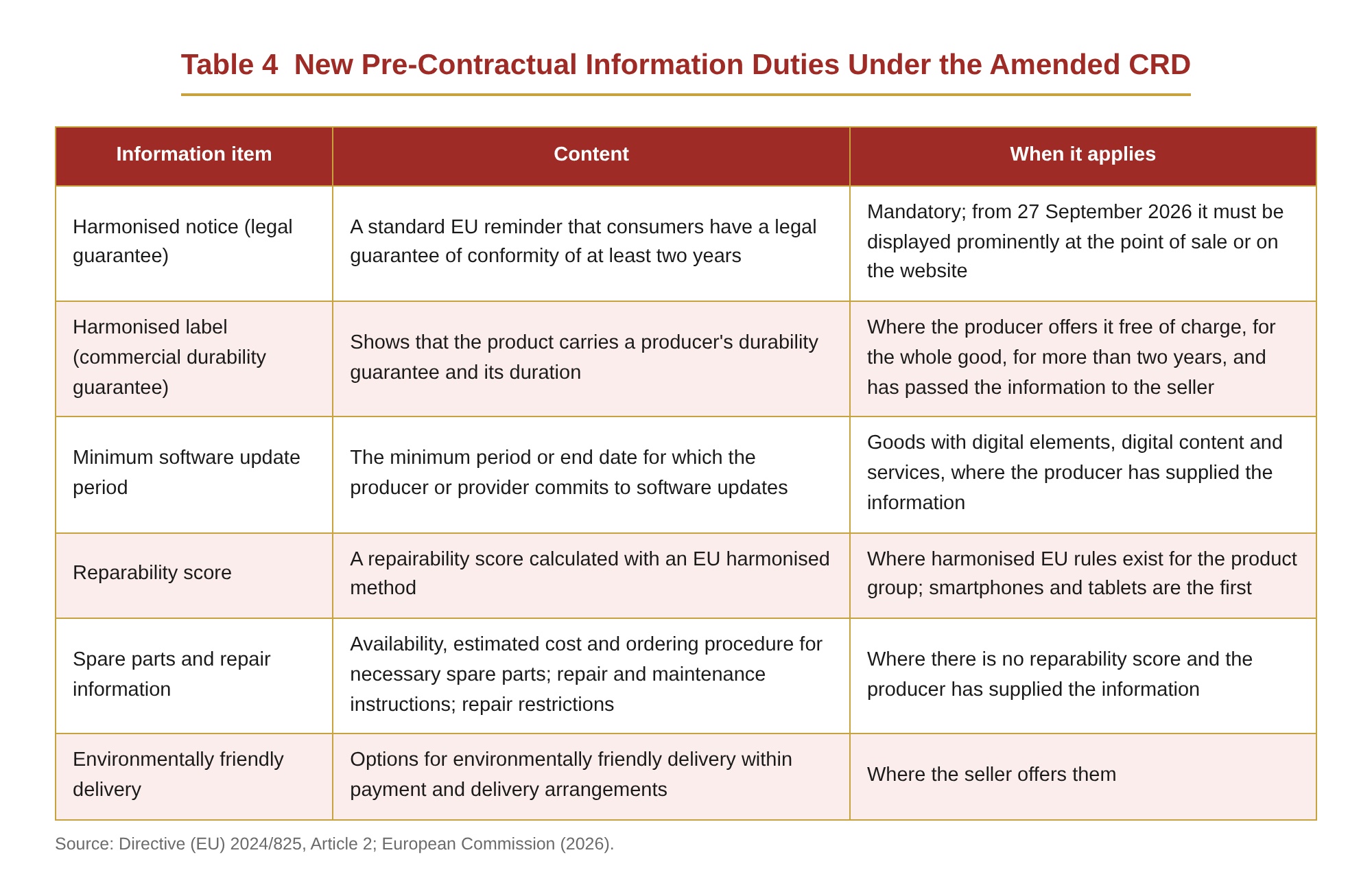
The design of the harmonised notice and label was fixed by Implementing Regulation (EU) 2025/1960, and the two cross-refer to each other to make the difference between the legal guarantee and a commercial guarantee clear. The Commission’s guidance is concrete: a physical shop can display the notice as a poster near the checkout, an online shop can place it on its website as a general reminder, and the label should go on the product packaging, on the shelf where the product sits, or next to the product image online (European Commission, 2026).
On reparability scores, since 20 June 2025 new smartphones and tablets placed on the EU market must show a reparability score on their energy label, and sellers must give it clearly before the contract is concluded. The obligation will extend to other product groups as implementing measures under the Ecodesign for Sustainable Products Regulation (ESPR) are adopted (European Commission, 2026).
One design choice in these duties is worth noting. The CRD does not oblige producers to hand durability and repair information to sellers, and sellers need not go looking for it, but once a producer does provide it, the seller must disclose it. Legislators clearly expect the market to do the work, rewarding producers willing to offer long guarantees and repair information. For Taiwan’s consumer electronics and bicycle makers, this is a chance to turn product quality into information visible at the point of sale.
VII. Enforcement and Penalties
1. Who Enforces
EmpCo creates no new authority and no prior review or approval procedure; enforcement runs through each Member State’s existing consumer protection system (Anthesis, 2026). In most Member States, competitors and consumer organisations can also bring cases before the courts alongside the authorities (Coolset, 2026). Germany is a typical case: local commentators describe EmpCo as competition law in practice, with risk usually arriving afterwards as a warning letter from a competitor or a qualified association (flustix, 2026). Cross-border cases can be coordinated through the Consumer Protection Cooperation (CPC) Network, where national authorities share information, run joint investigations and take coordinated action (EcoClaim, 2026a).
2. Penalty Ceilings
Penalties follow Article 13 of the UCPD, which was strengthened by the 2019 Modernisation Directive (Directive (EU) 2019/2161). For widespread infringements affecting several countries and handled through the CPC mechanism, the maximum fine Member States can impose must be at least 4 percent of the trader’s annual turnover in the Member States concerned, or at least EUR 2 million where turnover data is unavailable. Member States may set higher ceilings and may also impose injunctions, corrective advertising and other measures under national law.
Before EmpCo applied, national authorities had already pursued many greenwashing cases under existing law. Italy’s Competition and Market Authority, for example, fined Eni EUR 5 million for marketing a diesel product as “green” (EcoClaim, 2026b). Now that EmpCo applies, such cases no longer require proof that consumers were misled, which lowers the bar for enforcement considerably.
3. Burden of Proof
Article 12 of the UCPD already allowed courts and authorities to require companies to provide evidence that their factual claims are accurate. With so many environmental claims now blacklisted outright, this provision carries more weight. A company that cannot produce recognised excellent environmental performance, a qualifying certification scheme or actual life-cycle data effectively has no defence. In practice, the evidence must be in place before the claim is published.
4. Existing Stock
The Directive gives no transition period for existing stock, so products manufactured, ordered or placed on shelves before 27 September 2026 must also comply. The Commission suggests remedies such as covering or correcting claims on packaging with stickers or adding information at the point of sale. Authorities will prioritise enforcement by the seriousness of the breach and consider whether companies have made reasonable and proportionate efforts. National authorities in the CPC Network have also reached a “common understanding” on old stock to keep enforcement consistent (European Commission, 2026). German practitioners expect online claims, marketing materials and the practices most harmful to consumers to be examined first, while practical constraints such as packaging cycles, stock volumes and orders already placed may be taken into account (flustix, 2026).
VIII. Transposition Progress and Developments Since Application
Formal application has not meant that all of Europe is ready at once. On 28 May 2026, the Commission opened infringement proceedings against 20 Member States that had not notified complete transposition, Spain among them (Dcycle, 2026). By early October 2026, 19 of the 27 Member States had national laws in place (Coolset, 2026).
[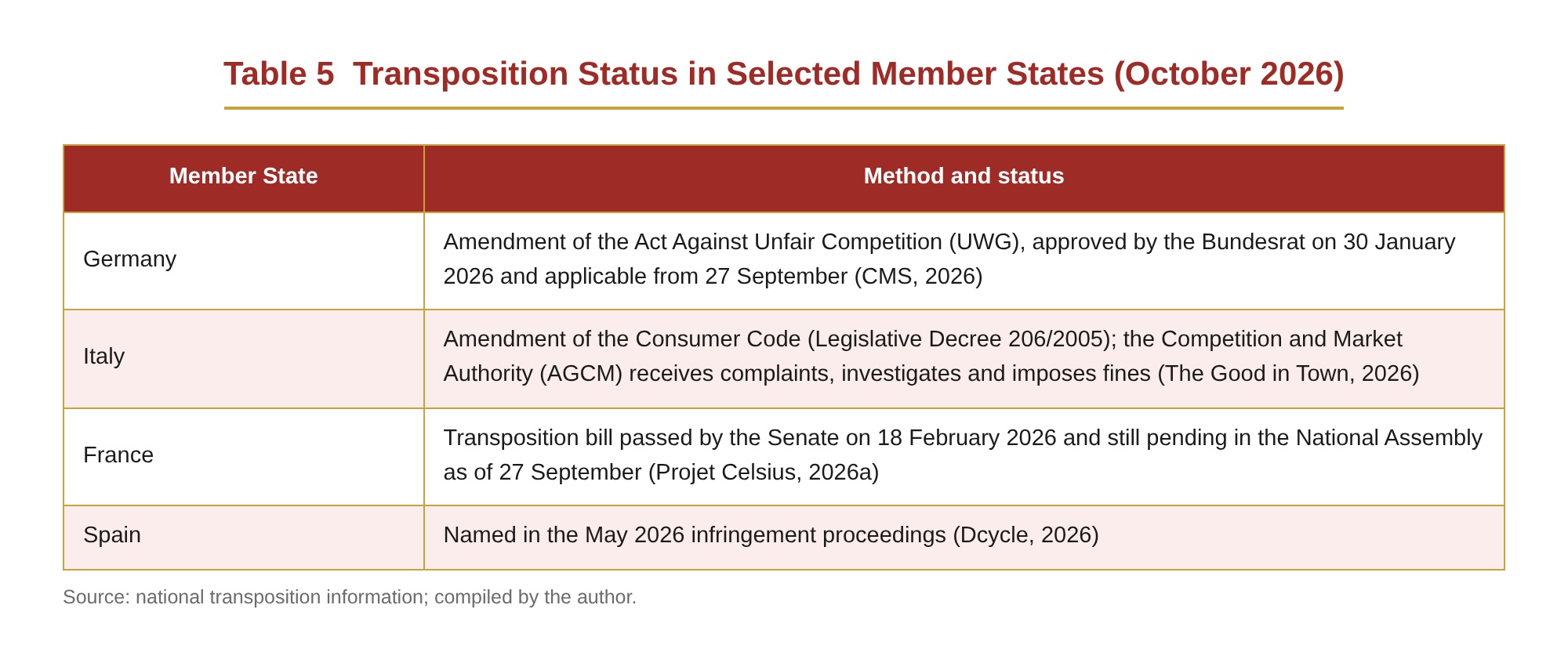 ](Table 5 Transposition Status in Selected Member States (October 2026))
Late transposition does not give companies room to relax. Under general principles of EU law, a directive cannot in principle impose obligations directly on private companies, but national courts must interpret domestic law in line with the directive as far as possible, and authorities can still pursue greenwashing under the UCPD’s existing provisions on misleading practices. The Commission Q&A states plainly that the UCPD’s principle-based rules could already address greenwashing and planned obsolescence before EmpCo applied (European Commission, 2026). For companies selling across borders, aligning with the strictest Member State that has transposed remains the cheapest approach.
As for interpretive tools, the Commission’s Directorate-General for Justice and Consumers first published the EmpCo Q&A in November 2025 and updated it in May and June 2026. The current version has 21 questions covering brand names, packaging imagery, carbon neutrality, certification schemes and existing stock (CSR Tools, 2026; European Commission, 2026). It reflects only the preliminary views of Commission services and is not binding, but national authorities and courts widely refer to it. The Commission has said it will update the 2021 UCPD and CRD guidance notices once case law and enforcement experience have built up.
In the first month after application, national authorities have begun to focus on informing consumers. In Italy, for example, local media are already explaining how consumers can report false green promises to the AGCM (The Good in Town, 2026). At the time of writing, no public penalty decision under the new EmpCo rules has been identified; the first cases are expected to concentrate on generic claims in online marketing and on packaging.
IX. Relationship to the Green Claims Directive and Other EU Law
1. The Green Claims Directive Has Gone, Leaving EmpCo to Carry the Load
The Green Claims Directive (COM(2023)166), proposed by the Commission in March 2023, would have set up an EU-wide system of prior verification, laying down how specific environmental claims must be substantiated and how labels are approved. The Commission announced its withdrawal in 2025 and the legislative process stopped (Cradle to Cradle Products Innovation Institute, 2026). Many companies had treated the two laws as one and planned to act once the Green Claims Directive was settled, and they have consequently missed EmpCo’s actual deadline (osapiens, 2026).
The two differ in how they regulate. The Green Claims Directive was designed around prior approval, while EmpCo relies on enforcement after the fact plus a blacklist. With the proposal withdrawn, there is no harmonised EU standard for how specific claims must be substantiated; the question falls back on the general duty of proof in Article 12 of the UCPD and on case-by-case judgment by national authorities and courts. In the absence of uniform rules, the most persuasive approach for enforcers is to use internationally recognised methods such as ISO 14067, ISO 14064 or the Product Environmental Footprint (PEF), with third-party verification.
2. How EmpCo Interacts With Other Rules
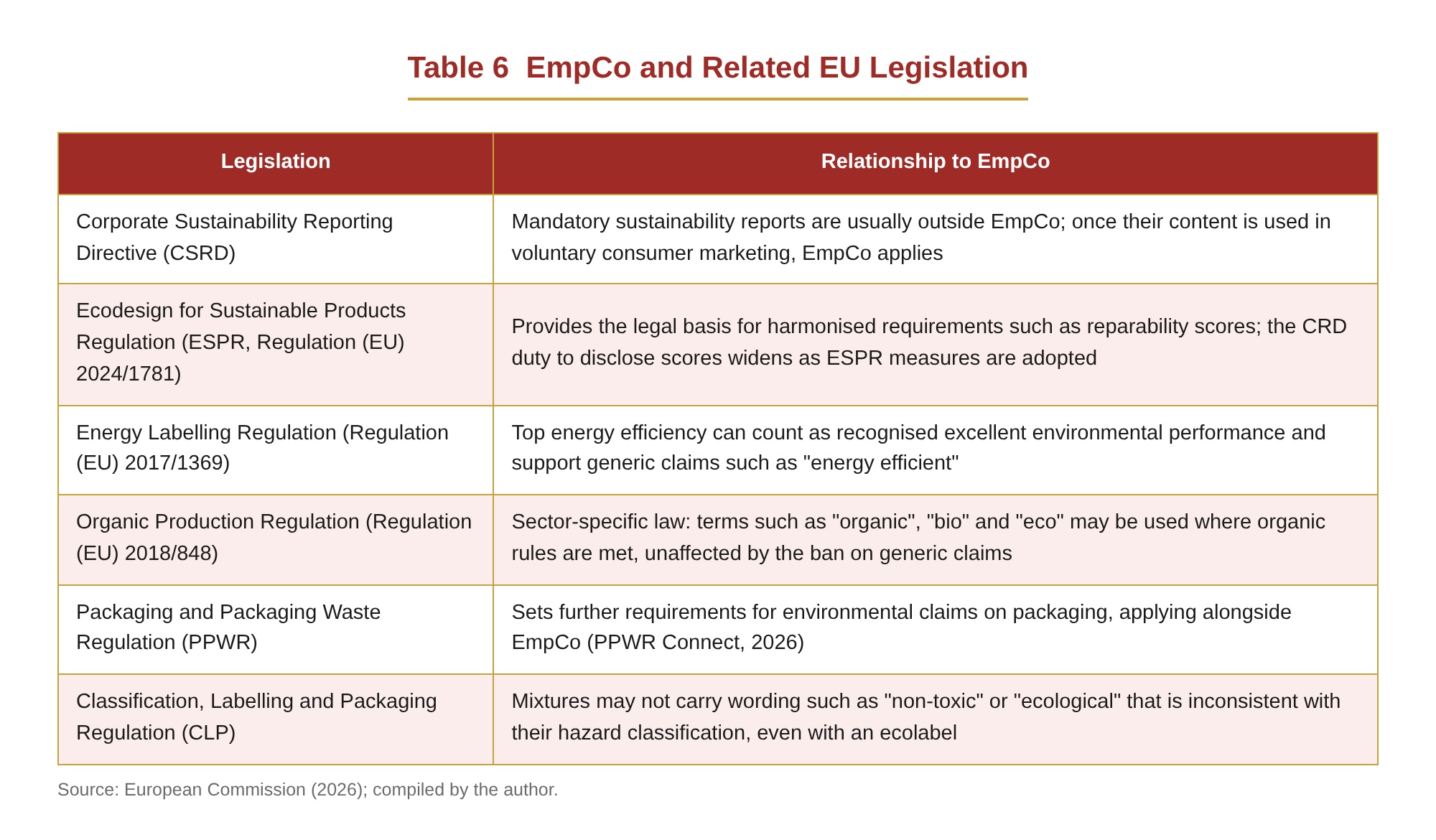
X. Implications and Recommendations for Taiwanese Companies
1. How the Impact Arrives: Direct Application and Supply-Chain Transmission
EmpCo applies regardless of where a company is established or how large it is, as long as it makes commercial communications to EU consumers (itmustbeNOW, 2026). Directly affected are Taiwanese companies with their own brands, cross-border e-commerce operations or sales channels in the EU; packaging, websites, social media posts and trade-show materials are all in scope.
The far larger number of contract manufacturers and component suppliers are not directly bound, since their dealings are B2B, but they will feel the pressure indirectly through their customers (Projet Celsius, 2026a). For their end-product claims to hold up, EU brand owners must obtain verifiable data from upstream, such as the recycled content of materials, actual emission reductions in production, and the calculation boundaries and verification statements behind product carbon footprints. The days when writing “we use eco-friendly materials” on a supplier questionnaire was enough are over; customers’ legal teams will want an evidence source for every number.
2. Three High-Risk Areas
The first high-risk area is offset-based product carbon neutrality. In recent years many Taiwanese companies have bought international voluntary carbon credits to declare products or services “carbon neutral”, and in the EU consumer market such narratives now fall squarely within the 4c blacklist. Company-level offset claims are outside 4c, but generic wording such as “carbon-neutral company” is still caught by 4a and remains subject to the general rules of the UCPD. Buying carbon credits is not the problem; the problem is how they are described. A workable approach is a contribution-style statement such as “our company invests in a named reforestation project, offsetting X tonnes of CO2 equivalent”, which clearly separates offsetting from actual reductions.
The second is the standing of Taiwanese government labels in the EU. On the Commission’s preliminary view, a label set up by a public authority outside the EU breaches 2a when displayed in the EU unless it rests on a certification scheme meeting UCPD Article 2(r) (European Commission, 2026). Taiwan’s Green Mark and its official carbon footprint label are not EN ISO 14024 labels officially recognised by a Member State, so they cannot support generic claims. Whether they can be displayed in the EU as sustainability labels depends on checking, label by label, whether they meet the four certification-scheme conditions, especially whether the monitoring third party is a legally separate entity from the scheme owner. Until that is confirmed, these labels should not simply be carried over into consumer communications on the EU market.
The third is net-zero commitments. Many Taiwanese listed companies have announced 2050 net-zero targets. If such commitments are used in brand communications aimed at EU consumers, Article 6(2)(d) of the UCPD requires a detailed implementation plan and regular verification by an independent third-party expert, with the findings made public. Most Taiwanese companies already have a foundation in ISO 14064-1 greenhouse gas inventories and verification. What they often lack is a decarbonisation pathway written up as an implementation plan with resources and annual milestones, and verification that extends beyond historical emissions to progress against the commitment.
3. Recommendations
- Build a claims inventory: List every environmental and social claim directed at EU consumers, across packaging, websites, e-commerce pages, social media, brand names and trade marks, catalogues and trade-show materials, and tag each by type (generic, specific, future commitment, label).
- Triage against the blacklist: Remove or rewrite claims that fall under 4a, 4c or 2a immediately, using stickers or point-of-sale information for existing stock; for case-by-case claims, assess the strength of the evidence before deciding whether to keep or adjust them.
- Turn generic claims into specific ones: State on the same medium which aspect improved, by how much, and against what baseline; for example, replace “eco-friendly material” with “housing contains 30% post-consumer recycled plastic”.
- Support climate claims with life-cycle data: Base product-level reduction claims on third-party-verified ISO 14067 product carbon footprints, and organisation-level claims on ISO 14064-1 inventories and verification, with boundaries and methods disclosed clearly.
- Add implementation plans and verification to future commitments: Set measurable annual targets and resource allocations, engage an independent verifier for regular review, and publish the findings to consumers through means such as QR codes.
- Create a cross-functional sign-off process: Have marketing, legal and sustainability teams jointly review environmental claims before publication, so that every claim has a submittable evidence file before it goes out (Verso, 2026).
- Prepare supply-chain data in advance: Contract manufacturers and component suppliers should assemble the data and verification documents customers are likely to request, turning verification capability into a differentiator when winning orders.
Domestically, Taiwan currently handles false or misleading advertising under Article 21 of the Fair Trade Act and has no explicit prohibition list comparable to the EmpCo blacklist. EU rules, however, tend to flow back through the global policies of international brands. For companies operating in both domestic and overseas markets, reviewing their own communications against the EmpCo standard early is a practical way to reduce future adjustment costs.
References
- Anthesis. (2026). EU EmpCo Directive (2024/825): Empowering consumers for the green transition. https://www.anthesisgroup.com/regulations/eu-empco-directive/
- CMS. (2026). Empowering Consumers Directive: Zeitenwende für Umweltwerbung. https://cms.law/de/deu/legal-updates/empowering-consumers-directive-zeitenwende-fuer-umweltwerbung
- Coolset. (2026). EmpCo directive: What companies need to know about EU greenwashing rules in 2026. https://www.coolset.com/academy/empco-directive-what-this-means
- Cradle to Cradle Products Innovation Institute. (2026, April 16). Empowering consumers for the green transition: What it means for environmental claims. https://c2ccertified.org/articles/empowering-consumers-for-the-green-transition-what-it-means-for-environmental-claims
- CSR Tools. (2026, July 7). The EmpCo Directive and the new EU FAQ: Which green claims stay allowed. https://csr-tools.com/en/blog-en/empco-directive-eu-faq-green-claims/
- Dcycle. (2026). Anti-greenwashing rules: Vague claims banned from September 2026. https://www.dcycle.io/blog/empco-anti-greenwashing-directive-2026/
- Directive (EU) 2019/2161 of the European Parliament and of the Council of 27 November 2019 amending Council Directive 93/13/EEC and Directives 98/6/EC, 2005/29/EC and 2011/83/EU as regards the better enforcement and modernisation of Union consumer protection rules. (2019). Official Journal of the European Union, L 328.
- Directive (EU) 2024/825 of the European Parliament and of the Council of 28 February 2024 amending Directives 2005/29/EC and 2011/83/EU as regards empowering consumers for the green transition through better protection against unfair practices and through better information. (2024). Official Journal of the European Union, L 2024/825. https://eur-lex.europa.eu/legal-content/EN/TXT/?uri=CELEX:32024L0825
- EcoClaim. (2026a). EU EmpCo / ECGT Directive 2026: Status, rules and deadlines. https://www.ecoclaim.eu/green-claims-directive
- EcoClaim. (2026b). EU greenwashing fines tracker 2026. https://www.ecoclaim.eu/blog/eu-greenwashing-fines-tracker-2026
- European Commission, Directorate-General for Justice and Consumers. (2026). Questions & answers on Directive (EU) 2024/825 on empowering consumers for the green transition. https://commission.europa.eu/document/download/3c257883-bb2a-4dd9-a6dc-501d587bb34f_en
- flustix. (2026). EmpCo: What you may still claim from 27 September 2026. https://flustix.com/en/empco/
- itmustbeNOW. (2026, March 27). EmpCo Directive enforced today with rules to apply by September 2026. https://www.itmustbenow.com/feature/our-big-questions/anti-greenwashing-directive-empco-enforced-today/
- Morgan Lewis. (2024, May). Two EU directives aim to shape European legal framework for green claims and greenwashing. https://www.morganlewis.com/zh-cn/pubs/2024/05/two-eu-directives-aim-to-shape-european-legal-framework-for-green-claims-and-greenwashing
- osapiens. (2026). EmpCo fact check: What the Empowering Consumers Directive is about. https://osapiens.com/blog/empco-fact-check/
- PPWR Connect. (2026). Environmental claims on packaging from 27 September 2026: What EmpCo bans, what PPWR adds. https://ppwrconnect.com/blog/ppwr-empco-environmental-claims-packaging
- Projet Celsius. (2026a). The EmpCo directive: Which businesses are affected? https://projetcelsius.com/en/blog/empco-who-is-affected/
- Projet Celsius. (2026b). Understanding EmpCo, the anti-greenwashing directive, in 2 minutes. https://projetcelsius.com/en/blog/what-is-empco-directive/
- The Good in Town. (2026, October 20). Direttiva EmpCo, cosa cambia per i consumatori: Nuove regole contro il greenwashing. https://www.thegoodintown.it/direttiva-empco-cosa-cambia-per-i-consumatori-nuove-regole-contro-il-greenwashing/
- Verso. (2026). From green claims directive to EmpCo. https://verso.de/en/blog/from-green-claims-direcitve-to-empco/
EmpCo · Directive (EU) 2024/825 · Empowering Consumers for the Green Transition · green claims · greenwashing · generic environmental claims · product carbon neutrality · carbon offsetting · sustainability labels · Unfair Commercial Practices Directive (UCPD) · third-party verification · ISO 14067 · Taiwan supply chain
First published on LinkedIn . This site holds the canonical version.