
The Contest Over Carbon Accounting Rules
The contest over carbon accounting rules was never technical but a fight over responsibility attribution embedded in how the accounting boundary is drawn; Yuheng lets multiple lenses compute side by side and pries open that monopolised choice, yet a new ruler's credibility cannot be self-certified through methodological rigour and must be confirmed by others measuring the same thing and reaching the same result.
The Panshi · Yuheng Large Model — Technical Breakthrough, Industrial Application, and Methodological Challenge
A full analysis from technical architecture to enterprise execution, and its impact on the existing international carbon accounting order
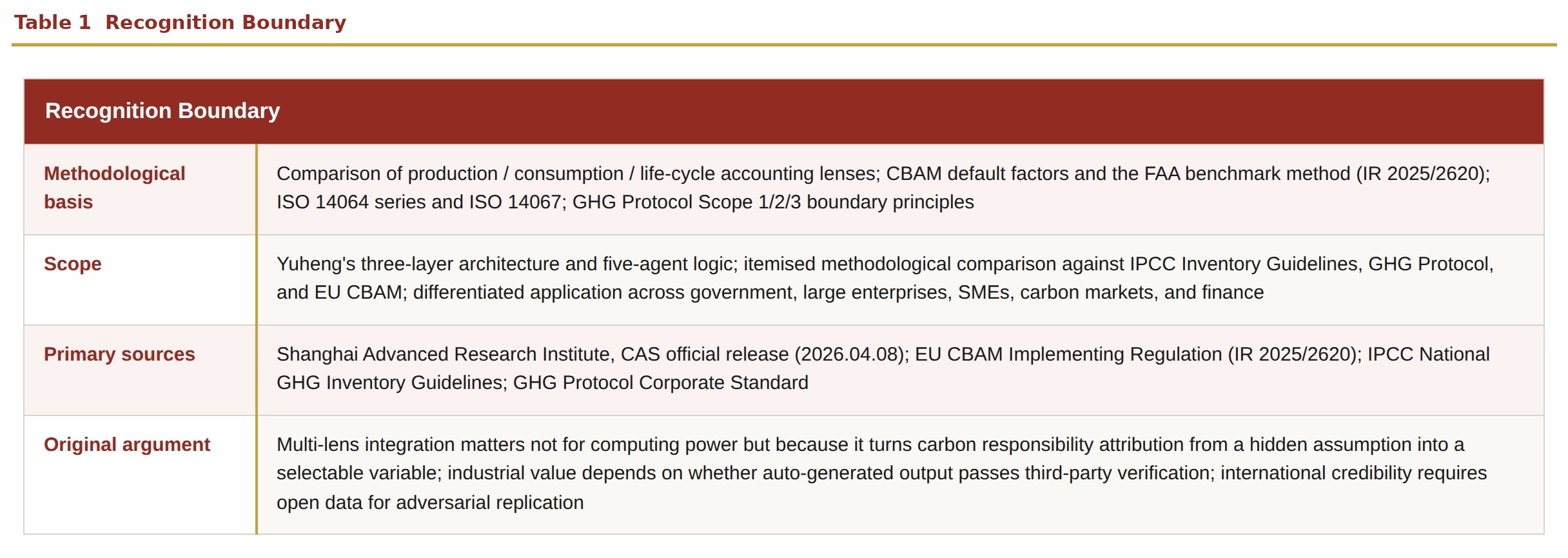
In 2022, on the same planet with the same carbon emissions, China’s production-based figure and its consumption-based figure diverged by 17.7 percent. The United States rose 15.2 percent under the same recalculation, and Japan rose 7.2 percent. These three numbers are not measurement error. They are the direct result of a methodological choice. The least-stated fact in carbon accounting is that how the accounting boundary is drawn is itself a political choice, one that has been treated as a technical default for three decades and left undiscussed.
On 8 April 2026, the Shanghai Advanced Research Institute of the Chinese Academy of Sciences released version 1.0 of the Panshi · Yuheng Carbon Accounting Large Model, positioned as the world’s first panoramic carbon accounting system covering production-side, consumption-side, and natural sources simultaneously. The specifications are real: 208 TB of aggregated multi-format carbon data, a 32-billion-parameter domain-specific large language model, and five purpose-built agents. This report does not restate those specifications. It answers three questions. What did Yuheng actually solve at the technical level? How would industry put it to use? And what challenge, with what limits, does it pose to the existing international carbon accounting order?
The conclusion first. Yuheng’s real breakthrough is not computing power. It is that Yuheng turns the question of whom carbon emissions should be attributed to, from a hidden assumption into a variable that can be switched. The industrial and geopolitical consequences of that shift are far larger than the number 208 TB.
I. Core Claim
The Panshi · Yuheng Carbon Accounting Large Model’s real breakthrough lies not in computing power but in turning the question of whom carbon emissions should be attributed to — a technical default hidden for three decades — into a variable that can be switched. The reason production-based and consumption-based lenses can produce a 17.7 percent divergence is not that anyone miscalculated, but that how the accounting boundary is drawn is itself a choice about the allocation of responsibility. Yuheng lets production, consumption, and natural-source lenses compute side by side and cross-verify for the first time, prying open a hidden choice that the production-based lens monopolised for thirty years. Whether the system can shift the existing international carbon accounting order, however, depends on two conditions it cannot decide unilaterally: whether enterprise-side automated output passes third-party verification, and whether its methodology and data are opened for adversarial replication by external bodies. A new ruler cannot establish credibility by declaring itself more accurate; it must wait for others to measure the same thing with it and reach the same result.
II. Technical Architecture: How the Three-Layer System Works
Yuheng’s fundamental design goal is to reconstruct the working paradigm of carbon accounting through generative AI, dynamically mapping global carbon flows and enabling carbon traceability. The architecture is built on the earlier Panshi Scientific Foundation Large Model, with three layers stacked on top: data, algorithm, and computing power. Understanding what each layer solves is the only way to judge where the system’s capability boundary actually lies.
1. The Data Layer: The Five-Step Pipeline Behind 208 TB
The data layer is the model’s raw-material warehouse, built on a dual-track internal-and-external strategy that has aggregated 208 TB of multi-format carbon data. This figure only means something in context. The bottleneck in traditional carbon accounting has never been a shortage of data. Factory energy reports, customs trade records, satellite remote sensing, and national emission-factor databases differ in source, type, and update frequency, with formats and lenses that do not align, and the cost of manual integration is high enough to make precise accounting a game only large enterprises can afford. The value of 208 TB is not capacity. It is that these heterogeneous datasets have been put through unified governance.
Internal datasets focus on production-side, consumption-side, natural-source, and carbon-traceability scenarios; external datasets cover laws and regulations, accounting guidelines, industry knowledge, and external databases, forming eight proprietary dataset categories in total. For this raw data to be callable by an AI, it must first pass through a five-step pipeline: collection, cleansing (de-noising and de-duplication), governance (format standardisation and lens unification), vectorisation, and structured storage. The technical crux is the vectorisation step. It converts regulatory text, tabular figures, and image data that only humans could read into embedding vectors a large language model can reason over. Traditional databases cannot do this, and it is why Yuheng can answer carbon-data queries in natural language while conventional inventory software can only fill in forms.
The data layer has one more design that is easy to overlook: it stays current through high-frequency coordination with government agencies and industry bodies. Yuheng is therefore a continuously refreshed live database, not a model frozen after one training run. This matters for carbon accounting, because emission factors, regulatory thresholds, and quota rules are all moving; a footprint calculated with two-year-old factors is wrong no matter how precise the arithmetic.
2. The Algorithm Layer: Why Multi-Lens Methodology Is the Real Difficulty
The algorithm layer is where the model thinks, and it contains two key designs: a multi-lens carbon accounting methodology and a multi-agent collaborative architecture. Of the two, the former is the harder and more original.
Traditional carbon accounting has only the single IPCC production-side lens. Yuheng supports production-based, consumption-based, trade-transfer, and life-cycle lenses at once, and lets them reconcile against one another, which has not been done anywhere before. Where is the difficulty? It lies in one thing. The same underlying data must simultaneously support four responsibility-attribution calculations built on entirely different logics. Production-based asks where the emission occurred; consumption-based asks on whose behalf it occurred; life-cycle asks how much a product emitted from cradle to grave. The same tonne of steel is attributed to four different actors under the four lenses. Making one system compute all four answers and keep them internally consistent raises the data-model complexity far above any single-lens system. This is an engineering problem, not merely a conceptual one.
The second design is the multi-agent collaborative architecture. Its logic resembles a specialist medical consultation panel: each agent is a domain expert, and when a complex problem arrives a coordinating agent orchestrates them, letting the specialists work in parallel, cross-verify, and integrate a complete answer. Compared with a single end-to-end model, this raises accuracy in complex scenarios, because carbon accounting spans too wide a knowledge range — industrial processes, international trade, ecological science, statistical method. Force one model to cover all of it and each part comes out weaker. Splitting the tasks among experts and cross-verifying is architecture traded for precision.
3. The Computing Layer: Trading Off Efficiency and Data Security
The computing layer uses a hybrid architecture of in-house clusters plus external cloud, building high-performance internal server clusters that coordinate with external computing centres for global optimisation and elastic supply. The real consideration is a balance between two things. Routine accounting runs on internal clusters — fast, and the data never leaves — which matters especially for carbon accounting involving corporate secrets and national emissions data. Large-scale simulations or batch national calculations then draw on external computing power to scale up. Efficiency and data security are handled at different layers of the same architecture.
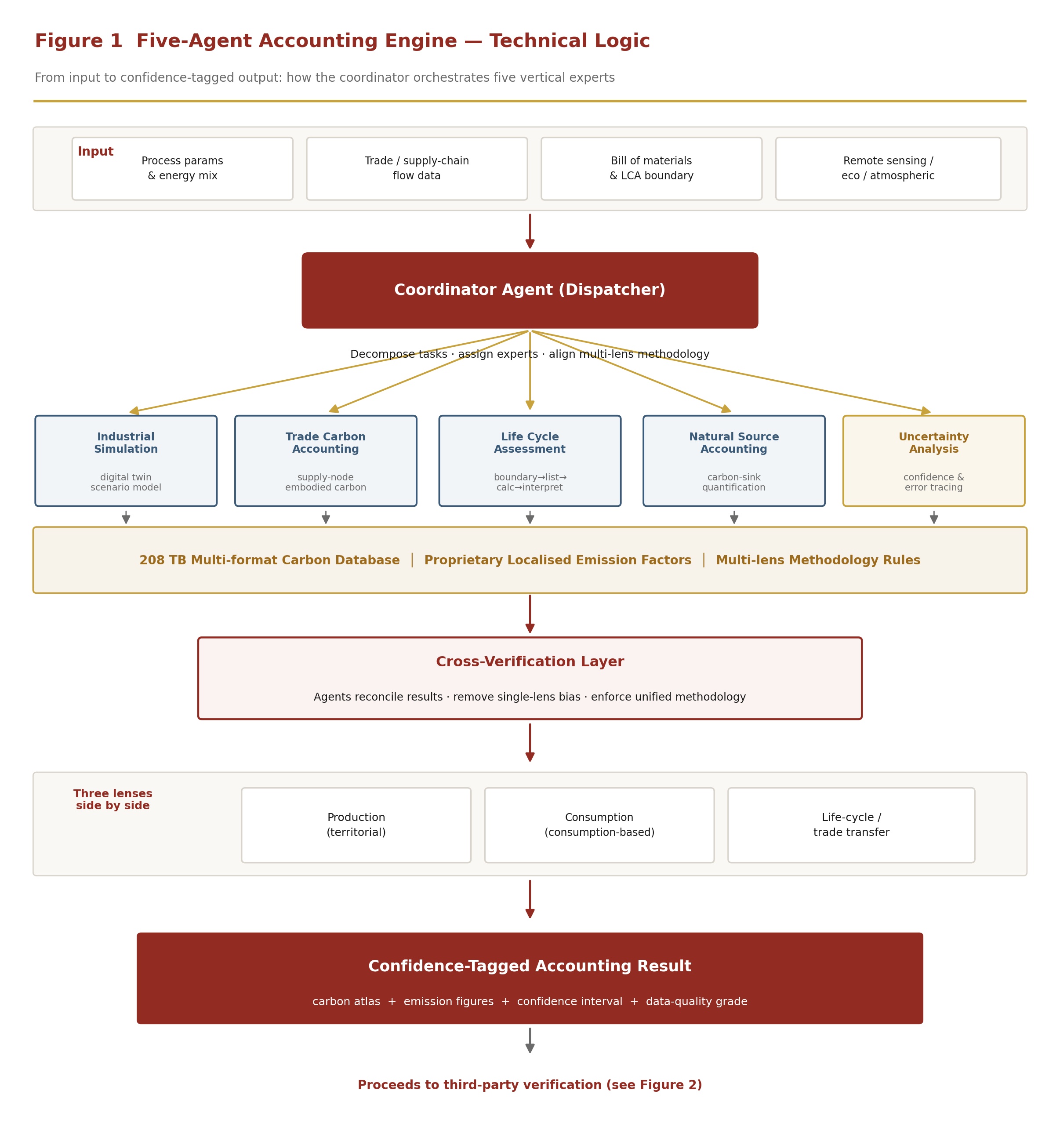
III. The Five Agents: Technical Principles and Industrial Correspondence
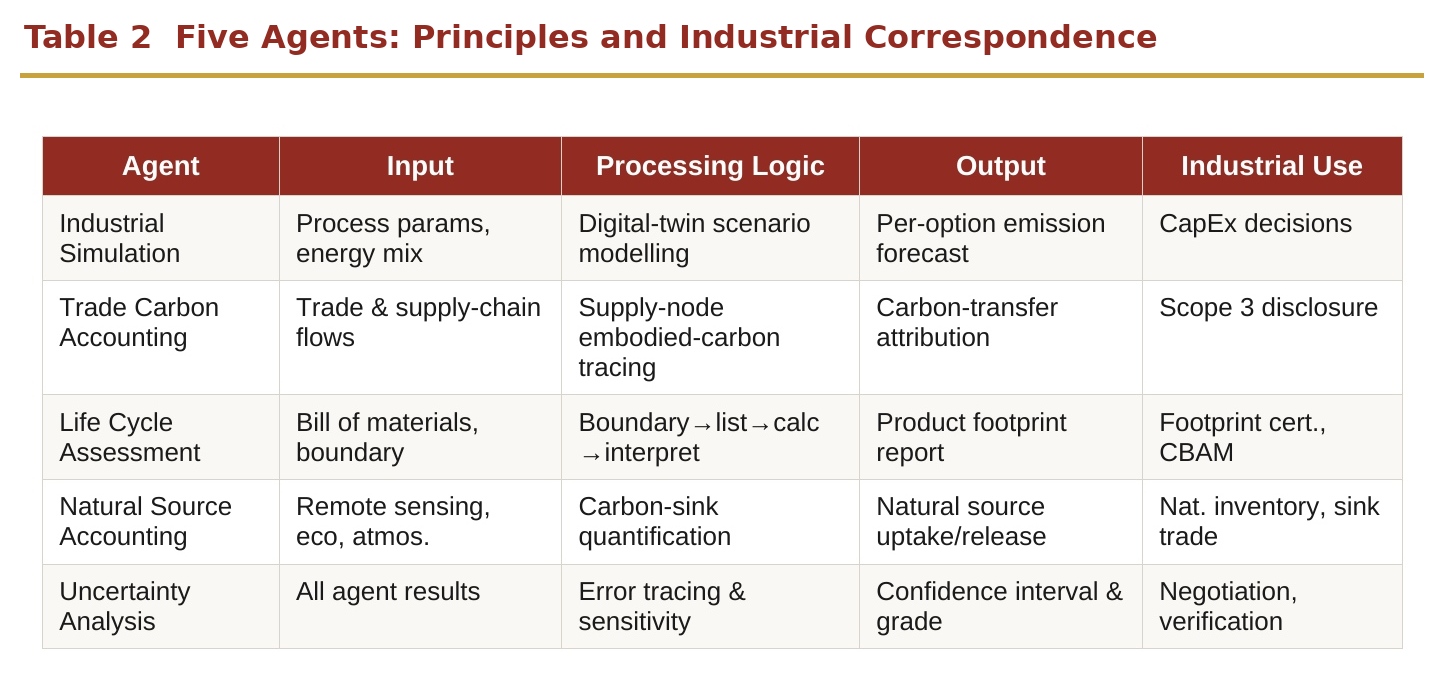
Yuheng’s service interface offers five purpose-built agents. Reading them as a feature menu misses the point. Each of the five answers a long-acknowledged but never-resolved operational bottleneck in carbon accounting, and each has a defined input, processing logic, and output. What follows unpacks them one by one, with the industrial application each maps to.
Agent 1 Industrial Process Simulation: Turning After-the-Fact Accounting into a Prior Decision
The fundamental limit of traditional carbon accounting is that it is always after the fact. A factory’s emissions for the quarter cannot be known until the quarter ends and the reports are consolidated, by which point no adjustment can affect emissions already released. The breakthrough of the industrial process simulation agent is to rebuild the production process as a digital twin, simulating carbon emissions under different process routes, material combinations, and energy structures. The input is factory process parameters and energy structure; the output is emission predictions under a range of hypothetical scenarios. For capital-intensive, complex-abatement sectors such as steel, cement, and chemicals, this agent’s industrial value is the most direct: a company can quantify the abatement effect of each option before it spends money changing the line.
Agent 2 Trade Carbon Accounting: The Hardest Part of Scope 3
Accounting for embodied carbon transfer in cross-border trade tracks the embedded carbon at every node of the supply chain — exactly the part of corporate Scope 3 disclosure that is hardest to quantify. The current approach solicits self-reported data from suppliers layer by layer, and the further upstream you go, the thinner the data and the weaker the control over its quality, with no systematic way to audit it. This agent builds carbon flows directly from the trade-data layer, computing which country and which company truly bears how much carbon responsibility through consumption, bypassing the layer-by-layer collection bottleneck. It maps to supply-chain carbon management and international carbon-responsibility reallocation, which is where the consumption-based lens does its real work.
Agent 3 Life Cycle Assessment (LCA): The Most Automated of the Five
This is the most automated of the five agents, and the one most likely to change industry practice directly. It autonomously completes goal-and-scope definition, inventory analysis, calculation, and result interpretation. A traditional LCA requires a specialist engineer to spend weeks manually entering data, selecting emission factors, and defining boundary conditions; the LCA agent compresses that into an automated flow. One distinction must be stated plainly here. Generating output automatically, and having that output recognised by a third-party verification body, are two different things. The former is a matter of cost; the latter decides whether the report can be used for ISO 14067 certification or CBAM filing. Automation solves cost. Verification solves validity. The two cannot be conflated.
Agent 4 Natural Source Accounting: Filling the Gap the Industrial Framework Ignored
The natural source accounting agent integrates satellite remote sensing, ecological models, and atmospheric observation to dynamically quantify natural carbon sinks in forests, oceans, and land. Natural sources have long been a marginal role in the traditional industry-oriented framework: forest sequestration, wetland methane, ocean sinks — these non-anthropogenic carbon flows are either handled separately or ignored. The significance of this agent is that it lets the carbon ledger cover the complete Earth carbon cycle rather than only the anthropogenic part. For national GHG inventory compilation and natural-sink trading, this is a necessary piece of the puzzle.
Agent 5 Uncertainty Analysis: Letting the System Know How Reliable It Is
This is the system’s meta layer. Every calculation carries uncertainty from missing data, differing method choices, and differing assumptions, and this agent tags every result with a confidence interval, error sources, and sensitivity analysis. In the language of international climate negotiation and commercial verification, “we computed this number” and “we computed this number, the error range is here, and the main uncertainty comes from this” are two claims of entirely different persuasive weight. The existence of this agent is the dividing line between Yuheng being taken as a serious scientific tool and being dismissed as a promotional calculator.
IV. How Industry Actually Adopts It: From Need to Verifiable Output
Once the architecture is understood, the real question is how an enterprise puts it to work. Yuheng serves users through two interface layers — a conversational interface for managers and policy researchers to query in natural language without a technical background, and a programmatic API for developers and enterprise-system integration supporting batch accounting and automated reporting — and it also allows a single agent to be called for a specific scenario. But access is only the first step. The actual execution path branches by enterprise scale into entirely different routes.
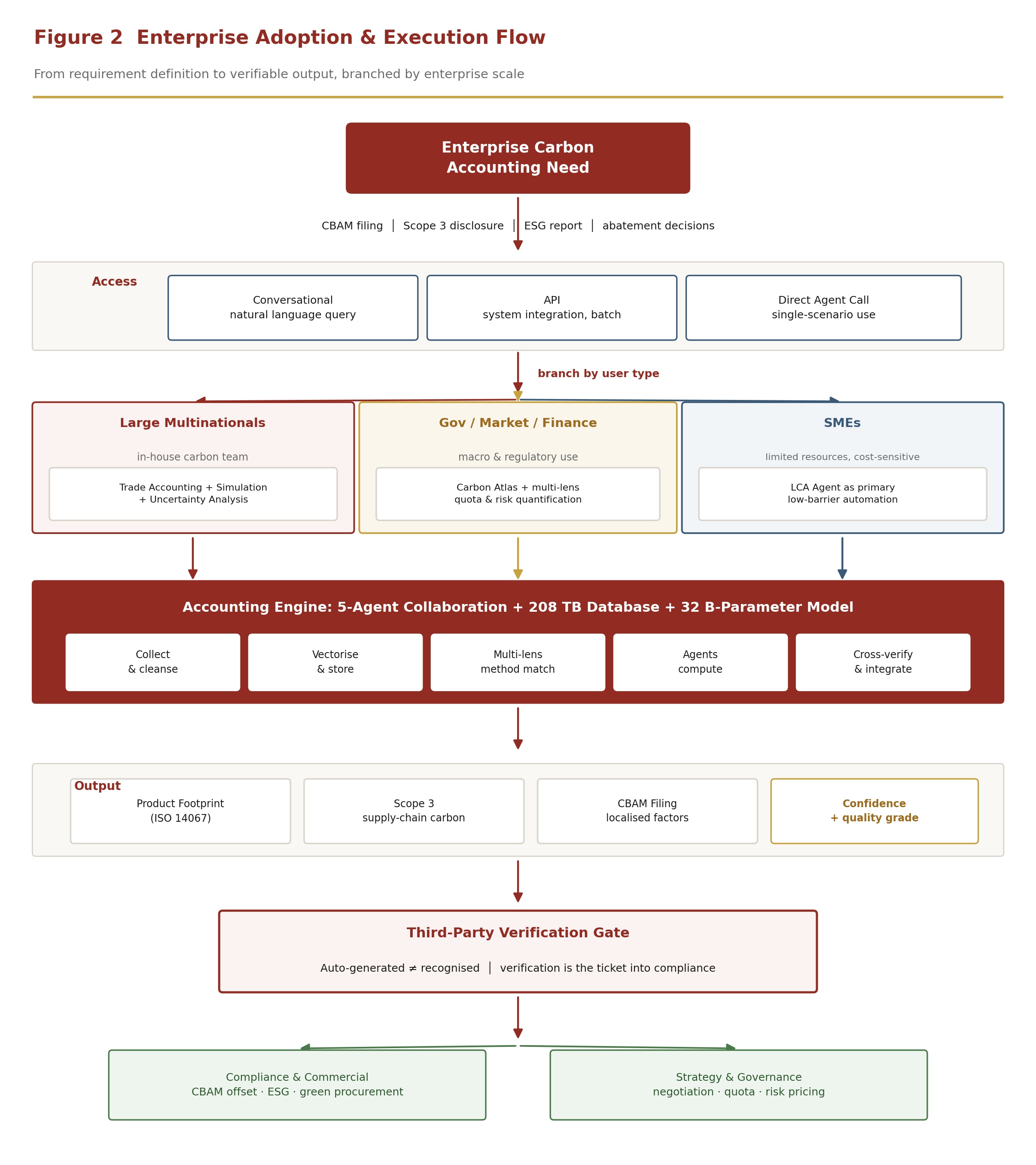
The element in this flow that most deserves attention is the third-party verification gate, second from the bottom. Yuheng can generate a report automatically, but auto-generation does not equal recognition. Before a footprint report can be used for CBAM offset, ESG disclosure, or green-procurement qualification, it must pass verification by a credible third party. This gate is the step most often skipped in the marketing that presents AI carbon-accounting tools as omnipotent, and it is the watershed that decides, in practice, whether the tool is of any use at all.
V. Key Figures and Their Methodological Premises
Yuheng presented a set of specific numbers at release. For those numbers to support an argument, one has to understand the methodological basis of each. Below are the core figures from the report, each paired with the premise a reader must keep in mind.
1. National Emission Adjustments: 17.7% Rests on a Contest of Lenses
Using 2022 as the reference, under Yuheng’s new accounting system the greenhouse-gas emissions of major economies diverge markedly from the traditional IPCC production-based results. This is the most politically weighty part of the report, but it stands entirely on the premise of switching to a consumption-based lens. Detach it from that premise and the numbers mean nothing.
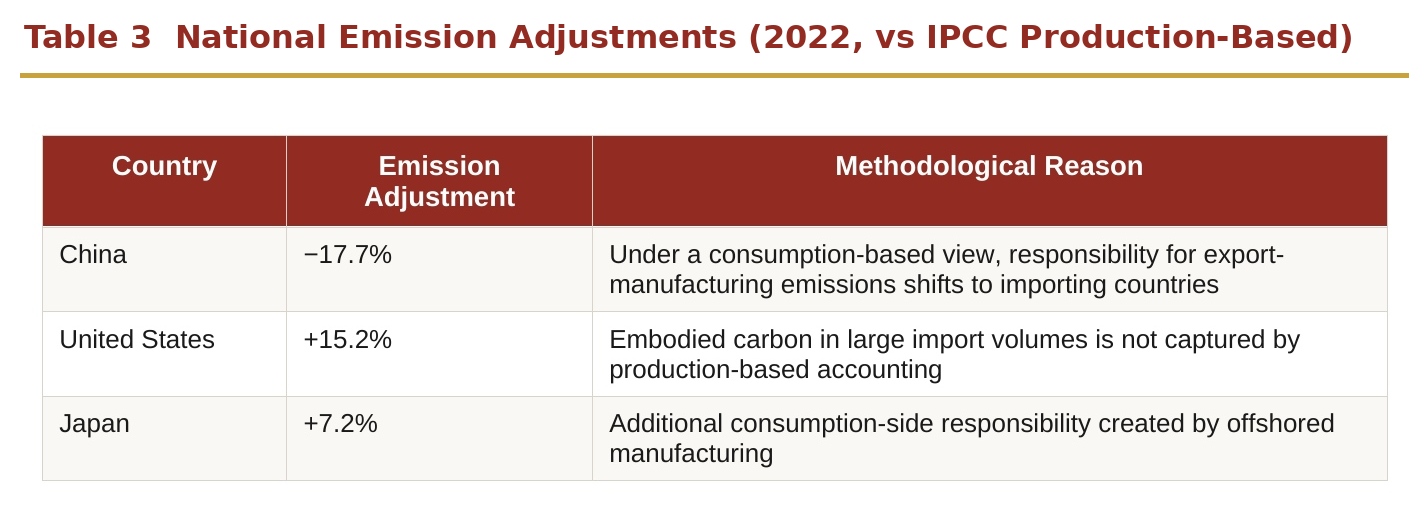
The key to reading this set is that it does not say China’s actual emissions fell. It says that if you keep the books on a whoever-consumes-bears-responsibility logic, the allocation of responsibility moves this way. Neither the production nor the consumption lens is absolutely correct; they answer different questions. Yuheng’s contribution is to let the two answers sit side by side, and its controversy lies in the same place, because which lens is chosen as the baseline directly determines whose abatement responsibility weighs more.
2. Green-Product Abatement Contribution: Where the 1:175 Ratio Comes From
China’s wind and solar PV exports in 2024 generated roughly 2 million tonnes of carbon in the production phase and delivered roughly 350 million tonnes of carbon-reduction benefit globally in the operating phase, a ratio of about 1:175. The methodological premise of this figure is a full life-cycle view. Under a production-based framework you see only those 2 million tonnes and cannot see the emissions the product avoids over its service life by displacing fossil energy. This is precisely the blind spot Yuheng wants to expose: a system that counts only production and not use-phase benefit records the manufacturing country as an emitter while failing to see it is also a contributor to abatement. The argument holds methodologically, but note that the 350 million tonnes is a cumulative operating-phase estimate involving assumptions about product lifetime and the generation-displacement baseline; it is a scenario estimate, not a measured value.
3. CBAM Default-Value Bias: The Practical Meaning of a 20-Fold Gap
Yuheng found that CBAM default emission factors systematically overestimate the emission factors of Chinese products. For steel items, the payable carbon tariff under localised emission factors versus the CBAM default value differs sharply, by more than twentyfold for some items. This is not a marginal adjustment. It directly determines an exporter’s cost structure, and for some items even whether continuing to export to the EU is still worthwhile. A technical detail the report does not develop, but which matters equally to Taiwanese and Chinese exporters, should be added here: CBAM’s own calculation offers two paths, the simplified factor method and the FAA benchmark method (per IR 2025/2620), and the liable embedded emissions they produce differ enormously, so the method choice is itself a variable a company must manage. Yuheng’s proprietary localised factor library is a direct response to this built-in overestimation, but whether the EU recognises it still depends on the verification process, not on the library itself.
4. Specification Figures: What 208 TB and 32 B Mean, and Do Not
208 TB of multi-format carbon data and a 32-billion-parameter domain model are Yuheng’s two headline specifications. Reading them requires avoiding a common misconception: scale does not equal accuracy. 208 TB describes the breadth of data coverage and the engineering effort of governance; 32 billion parameters describes the ceiling of the model’s reasoning capacity. But whether a result is accurate depends on the quality of the underlying emission factors and the correctness of the methodology, not on the parameter count. This is exactly why the uncertainty analysis agent matters so much: it is the only mechanism that tells the user how trustworthy a given number is.
VI. An In-Depth Comparison with Existing Frameworks
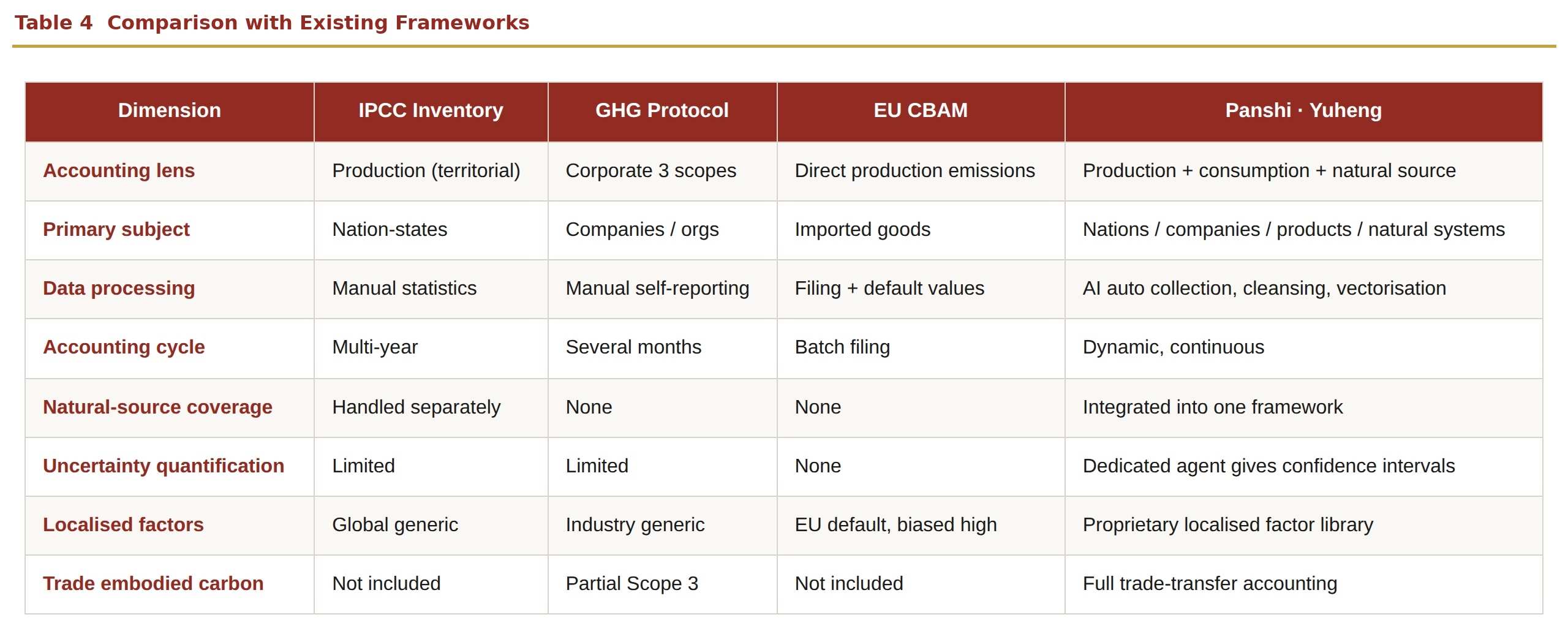
To judge Yuheng’s position, it has to be placed within the existing methodological landscape. Global carbon accounting is currently led by three frameworks, each serving different subjects and each with a distinct methodological gap.
- IPCC National GHG Inventory Guidelines: the foundational framework for national compliance, with a production-based territorial accounting boundary, serving state parties.
- GHG Protocol: the world’s most widely used corporate carbon accounting standard, dividing emissions into Scope 1 direct, Scope 2 purchased electricity, and Scope 3 supply-chain indirect, serving companies and organisations.
- EU CBAM: a trade carbon-tariff mechanism where, absent verified data, the default value is the average of the worst-performing 10 percent of EU facilities for that product.
1. The GHG Protocol’s Flexibility Is Also Its Weakness
The GHG Protocol was designed to guide rather than to strictly constrain, which gives companies the operational flexibility they need but also leaves a loophole. Large multinationals can exploit the flexibility of the rules in boundary-setting and factor selection to make choices in their own favour, rendering different companies’ data effectively non-comparable. Yuheng’s multi-agent architecture enforces a unified methodology, in principle compressing the room for selective accounting at the level of institutional design. But a tension is worth noting here: enforcing a unified methodology improves comparability while sacrificing the flexibility the GHG Protocol deliberately retained, and that flexibility is sometimes necessary in the face of wildly varied industrial realities.
2. CBAM’s Systematic Bias Is a Design Choice, Not a Technical Flaw
CBAM specifies that, absent reliable data, the default is the average emission intensity of the worst-performing 10 percent of EU facilities for that product. To be fair, this is not a technical failing of CBAM but a deliberate policy design, meant to force real data disclosure through a punitive default. The problem is that the cost of this design is asymmetric: enterprises able to produce evidence can avoid it, while smaller exporters unable to do so simply bear it. Yuheng’s proprietary localised factor library is a direct response to this technical unfairness, giving overestimated exporters a scientific basis to appeal.
3. The Manual Bottleneck of Traditional LCA Is a Cost Problem and a Barrier to Adoption
The traditional emission-factor method carries large uncertainty from technology level and process variation; the mass-balance method, though scientific, is labour-intensive, needs detailed production-process data, and is narrow in applicability. What the two share is heavy reliance on manual labour, which makes a full LCA an expensive undertaking. Yuheng’s LCA agent automates a process that took a specialist engineer weeks, and its real significance is not just saving large enterprises money but potentially turning footprint accounting from a large-enterprise compliance exercise into a standard tool SMEs can afford. The premise, again, is that the auto-generated output can pass verification.
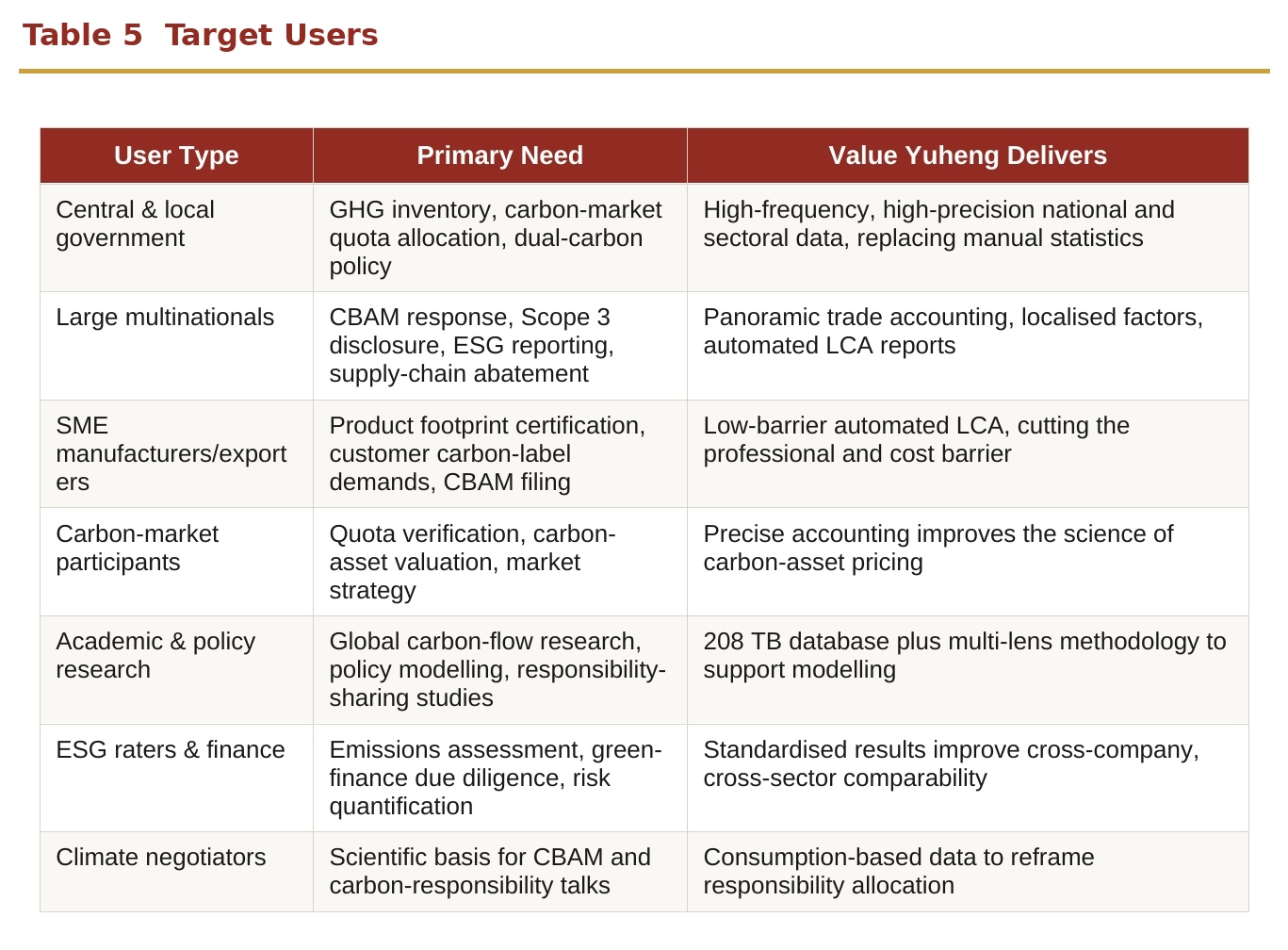
VII. Target Users and Differentiated Application
Yuheng’s applications span government, academia, enterprise, and finance. Because different users differ in need, resource, and capability, the agents they use and the value they gain differ completely. The following is a tiered breakdown by primary user.
VIII. Effects in Use: The Divide Between Large Enterprises and SMEs
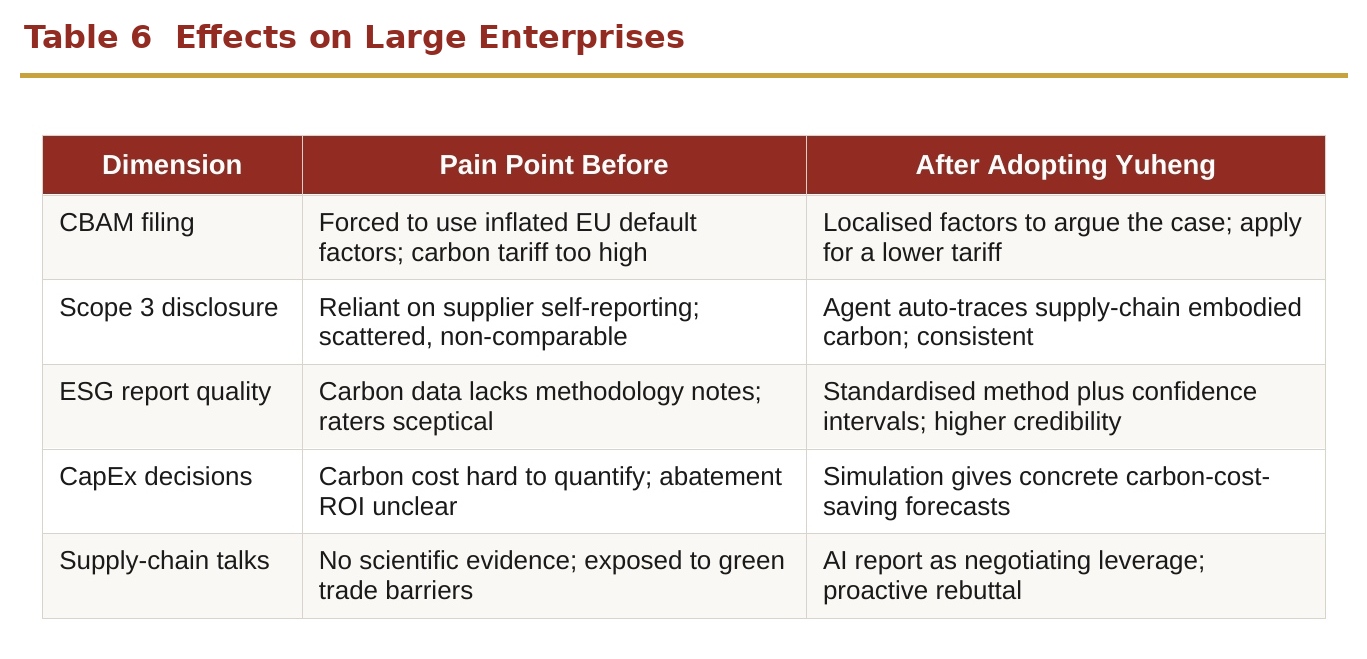
Yuheng’s effects on enterprises of different scales are distinct yet complementary. The same tool is a strategic weapon in the hands of a well-resourced multinational and a survival instrument in the hands of a resource-constrained SME. Each is examined below.
1. Large Enterprises with Transnational Supply Chains
Large enterprises typically already have an in-house carbon team able to build localised data and complete verification, so they use Yuheng’s most complex agents. First, turning CBAM from a passive cost into a manageable strategic variable: where the inability to supply local data once meant passively accepting the worst-10-percent EU default factor, a company can now use the LCA agent to generate a localised report meeting international standards and apply to CBAM authorities for the actual emission factor. Second, systematic visibility into Scope 3 supply-chain emissions: the trade carbon accounting agent traces embodied carbon at each supply-chain node directly, so the company obtains scientifically grounded Scope 3 results without soliciting data from every supplier, greatly improving the credibility of ESG reports under GRI and CSRD. Third, forward-looking process carbon optimisation: the simulation agent lets steel and cement firms quantify carbon-cost savings before evaluating an electric-arc-furnace replacement, giving the investment committee a decision basis. Fourth, stronger negotiating leverage: a footprint report carrying the uncertainty agent’s confidence intervals stands up better than manual accounting when facing supply-chain due diligence from European and American buyers.
2. Small and Medium-Sized Enterprises
SMEs face a more direct problem, one closer to survival. First, breaking the professional barrier of carbon accounting: a full traditional LCA needs outside consultants, takes weeks, and costs enough that most SMEs cannot bear it, whereas the LCA agent lets a company enter basic product information and obtain an ISO 14067-compliant footprint report, compressing the time cost from weeks to hours. Second, meeting large customers’ supply-chain carbon-transparency demands: when brands such as Apple, IKEA, and Nike require suppliers to submit footprints or carbon labels, small manufacturers without tools risk losing orders, and Yuheng lets them produce proof quickly and cheaply, securing their supply-chain position. Third, a low-barrier path to CBAM filing: makers of steel components, aluminium products, and chemical feedstocks exporting to the EU can self-generate the emission accounting a filing requires, without hiring costly consultants, and replace EU defaults with localised factors. Fourth, identifying high-carbon hotspots to guide precise investment: resource-limited SMEs cannot abate everywhere, and the simulation and LCA agents flag the highest-emitting stage of the product life cycle so limited green investment goes where it counts.
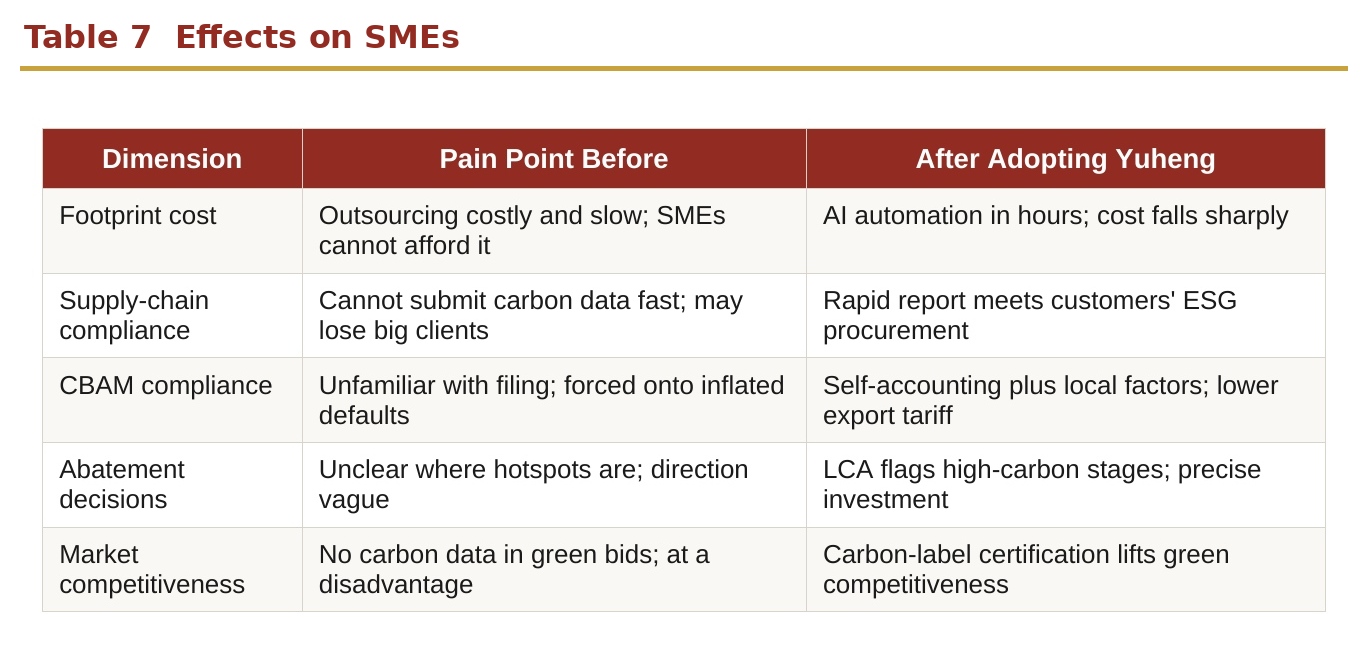
3. Side by Side: Two Roles for One Tool
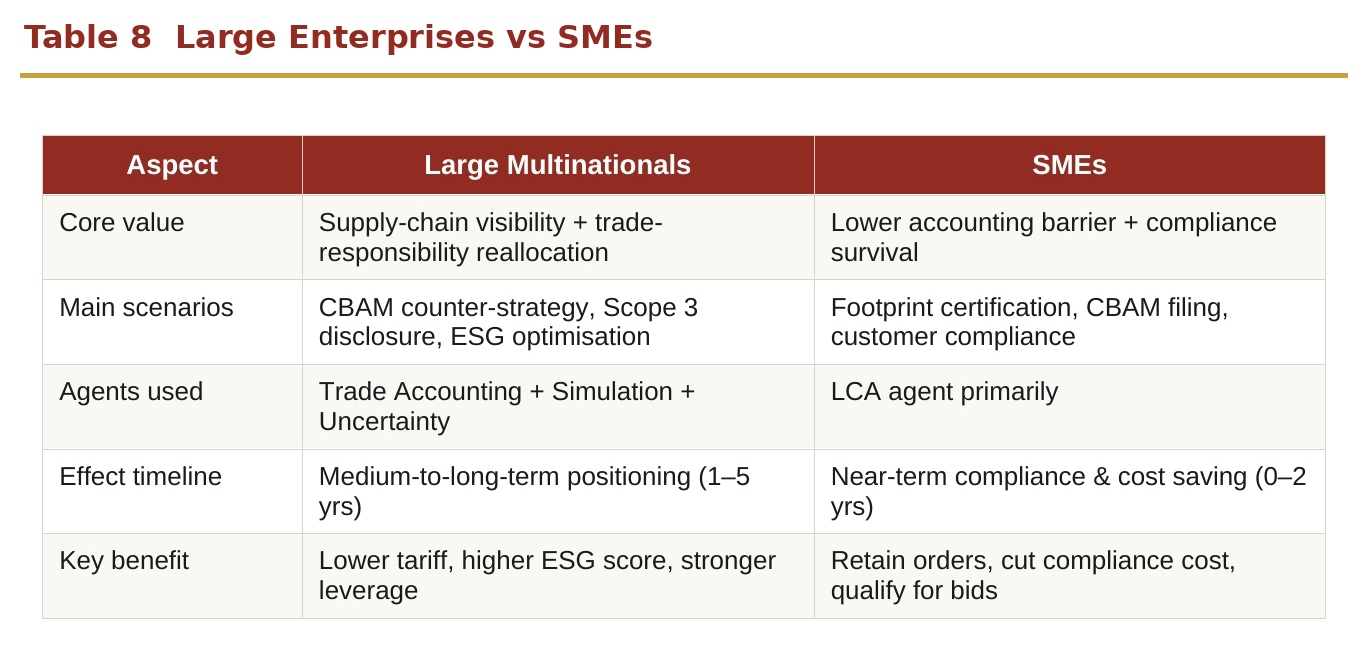
IX. Impact on the International Order and the Challenges Ahead
1. Reshaping the Balance of Voice in Climate Negotiation
China has long been in a reactive position in climate negotiation, measured by instruments others designed. Yuheng offers a China-led, scientifically argued alternative dataset, providing leverage on two issues. On carbon-responsibility reallocation, the 2022 adjustments of −17.7 percent for China and +15.2 percent for the United States would, if accepted internationally, fundamentally change the basis for assessing historical abatement responsibility. On quantifying green-export contribution, the global abatement contribution of PV and wind products now has concrete numbers that can serve as a core argument for recognition of climate contribution.
2. A Staged Impact on CBAM Carbon Tariffs
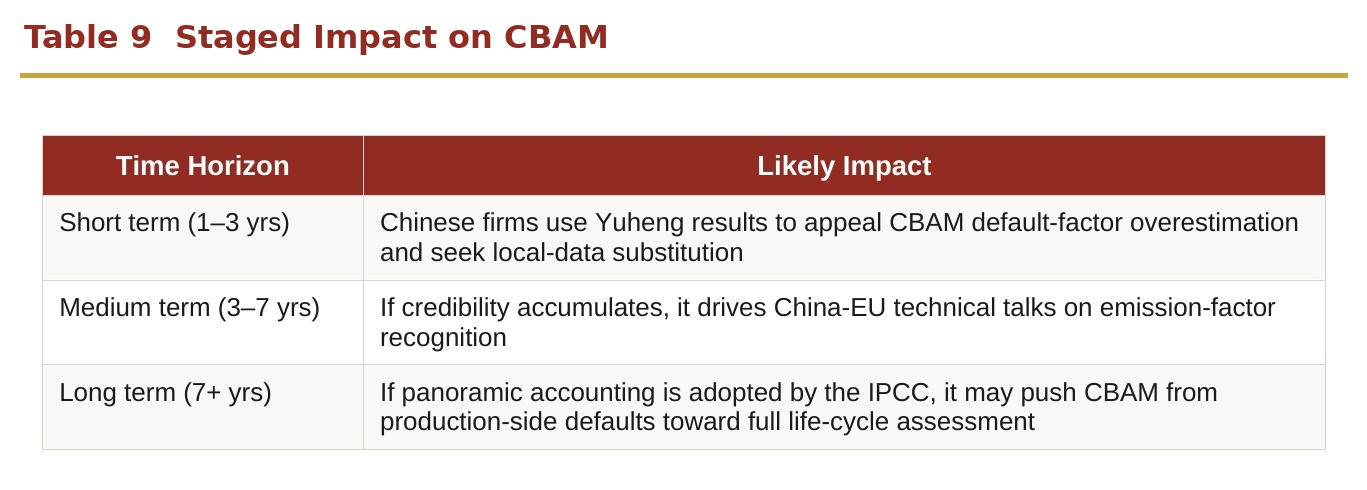
3. Three Unavoidable Challenges
For Yuheng to gain weight in international carbon governance, three gates cannot be bypassed. The first is that scientific credibility takes time to build. Yuheng’s conclusions favour China, and that very alignment between interest and conclusion raises the standard of scrutiny the international community applies; no amount of methodological rigour dissolves the doubt automatically. The second is the risk of methodological disputes becoming politicised. Consumption-based versus production-based accounting is a long-running academic debate, both lenses have their rationale, and once the choice of lens is seen as political manoeuvre rather than scientific judgement, it undercuts the system’s own voice. The third is the reciprocity dilemma of data sharing. Panoramic accounting needs deep sharing of national trade, energy, and industrial data, while data-sovereignty concerns intensify worldwide, and the barrier to cross-border data access may become the ceiling on the model’s accuracy.
X. Conclusion: A New Ruler’s Credibility Has to Be Confirmed by Others
Return to the three numbers at the start. China −17.7 percent, the United States +15.2 percent, Japan +7.2 percent — what they reveal is not that someone miscalculated, but that carbon accounting never had a neutral origin. How the boundary is drawn decides how responsibility is split, and that choice was monopolised by the production-based lens for three decades. Yuheng’s technical breakthrough is to let multiple lenses compute side by side and reconcile for the first time, opening a hidden assumption into a variable that can be discussed and chosen.
But a technical breakthrough is one thing and acceptance is another. For Yuheng to gain real weight in the discussion of international climate governance, there is only one path: make the methodology available for external bodies to verify, let the dataset be reused by independent researchers, and allow the results to withstand direct comparison and challenge alongside the IPCC framework. This is not a public-relations exercise. It is scientific procedure. A new ruler does not become accurate because its maker declares it so; credibility is established only after others have measured the same thing with it and reached the same result.
For Taiwan’s enterprises and policymakers, Yuheng’s significance is not about taking sides. It signals a direction: the methodological competition in carbon accounting has begun, and the emission figures underpinning CBAM offsets, supply-chain due diligence, and ESG disclosure will increasingly depend on which methodology and which set of factors produced them. Understanding this contest of method matters more than accepting any single conclusion. That is the judgement this report means to leave behind.
References
- Chinese Academy of Sciences. (2026, April 9). China releases the world’s first panoramic carbon emissions accounting large model to precisely support climate action [In Chinese]. Chinese Academy of Sciences. https://www.cas.cn/cm/202604/t20260409_5106337.shtml
- European Commission. (2023). Regulation (EU) 2023/956 of the European Parliament and of the Council of 10 May 2023 establishing a carbon border adjustment mechanism. Official Journal of the European Union, L 130, 52–104. http://data.europa.eu/eli/reg/2023/956/oj
- European Commission. (2025). Commission Implementing Regulation (EU) 2025/2620 laying down rules for the application of Regulation (EU) 2023/956 as regards the determination of embedded emissions. Official Journal of the European Union.
- Intergovernmental Panel on Climate Change. (2006). 2006 IPCC guidelines for national greenhouse gas inventories (H. S. Eggleston, L. Buendia, K. Miwa, T. Ngara, & K. Tanabe, Eds.). Institute for Global Environmental Strategies.
- Intergovernmental Panel on Climate Change. (2019). 2019 refinement to the 2006 IPCC guidelines for national greenhouse gas inventories. IPCC.
- International Organization for Standardization. (2018). Greenhouse gases — Part 1: Specification with guidance at the organization level for quantification and reporting of greenhouse gas emissions and removals (ISO 14064-1:2018). ISO.
- International Organization for Standardization. (2018). Greenhouse gases — Carbon footprint of products — Requirements and guidelines for quantification (ISO 14067:2018). ISO.
- National Energy Administration. (2026, April 10). China releases the world’s first panoramic carbon emissions accounting system [In Chinese]. National Energy Administration. https://www.nea.gov.cn/20260410/d5a2ddf7e0df4d628be6cdb7c514eb31/c.html
- Shanghai Advanced Research Institute, Chinese Academy of Sciences. (2026). Panshi · Yuheng Carbon Accounting Large Model (Version 1.0) [Large language model]. Shanghai Advanced Research Institute, CAS.
- World Resources Institute, & World Business Council for Sustainable Development. (2004). The greenhouse gas protocol: A corporate accounting and reporting standard (Rev. ed.). WRI & WBCSD.
Panshi Yuheng · carbon accounting methodology · consumption-based accounting · CBAM, emission factors · Scope 3 · life cycle assessment · IPCC Inventory Guidelines · GHG Protocol · carbon responsibility allocation
First published on LinkedIn . This site holds the canonical version.