
Quotas Are Set, Boundaries Are Not: The Verification Gap Facing Taiwanese Firms Under Vietnam's Mandatory Carbon Market
The real risk in Vietnam's carbon market is not whether the quota total is sufficient, but whether facility-level registry boundaries align with group-level ISO 14064-1 verification boundaries.
Since the Domestic Carbon Exchange launched on June 29, 2026, Vietnam’s regulatory chain has converged from commitment into enforceable compliance obligation
I. Core Claim
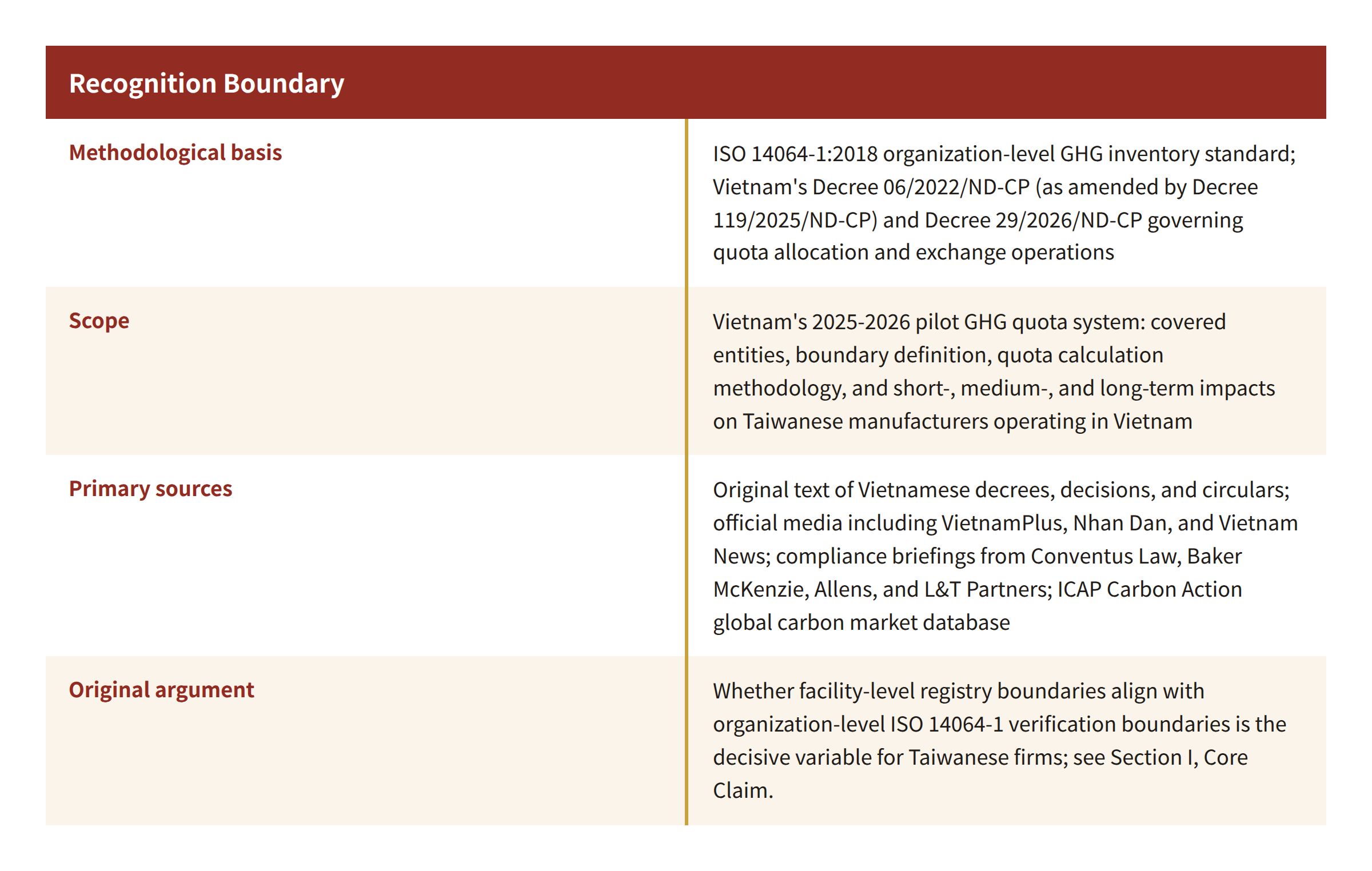
Vietnam’s mandatory carbon market shifts the decisive variable for Taiwanese firms away from quota volume or trading mechanics and onto whether facility-level registry boundaries align with organization-level ISO 14064-1 verification boundaries. Vietnam’s national registry treats each emitting facility, not the corporate group, as the unit for quota allocation and compliance, and does not automatically aggregate multiple plants held by the same group in Vietnam. This differs from ISO 14064-1, which permits consolidated reporting across sites under a shared operational control or equity-share boundary. Taiwanese firms commonly hold Vietnamese operations through locally incorporated subsidiaries, sometimes with multiple plants under one legal entity, a structure in which the two boundary logics are likely to diverge. It is this divergence in reported boundaries, not the headline quota total or exchange fee waiver, that constitutes the real source of cash-flow and verification-cost risk.
Vietnam’s carbon market underwent a regulatory transformation over the past six months. The January 2026 decree, the exchange launch at the end of June, and the forest-carbon regulation taking effect in July appear as separate events but are in fact sequential steps of a single regulatory chain reaching operational status. The significance lies not in Vietnam adding a trading platform, but in the shift from a voluntary-disclosure phase to a mandatory regime built on quota allocation, compliance obligations, and mandatory purchase of shortfalls. For Taiwanese firms, the relevant question is no longer whether to begin inventorying emissions, but whether their existing inventory boundary can be reconciled with the facility boundary against which Vietnamese authorities allocate quotas. The sections below address covered entities, boundary scope, quota calculation methodology, and the resulting short-, medium-, and long-term operational impact in turn.
II. Covered Entities: 110 Facilities Across Three Sectors, Listed by Inventory Rather Than by Emissions Threshold
Vietnam’s pilot carbon market concentrates coverage in three sectors: thermal power, iron and steel, and cement. Under Decision No. 699/QD-BNNMT of the Ministry of Agriculture and Environment, 110 facilities received greenhouse gas quotas for the 2025-2026 pilot period, comprising 34 thermal power plants, 25 iron and steel facilities, and 51 cement facilities. Notably, coverage is not defined by a numerical emissions threshold; instead, facilities are included based on the approved list of major emitting sources under the annexes to Decree 06/2022/ND-CP (as amended by Decree 119/2025/ND-CP). A facility not on this list is not yet subject to quota obligations regardless of its actual emissions volume, though authorities have indicated that certain thermal power plants omitted by local authorities may be proposed for inclusion in subsequent allocation periods.
The exchange’s membership structure reflects the same concentrated design. The initial cohort of trading members comprises six securities companies alongside the 110 quota-holding facilities, together forming the market’s current full set of participants. This reflects a strategy of tightly controlling a small number of large emitters before gradually expanding tradable products and participant scope, an approach similar to the intensity-benchmark paths taken by China and Indonesia. For Taiwanese firms, the first practical step is to confirm whether each Vietnamese production site is listed in the Decision 699 inventory, rather than estimating coverage from the site’s own emissions scale.
III. Boundary Scope: Facility Registry Versus Organizational Verification, Two Boundaries That Do Not Automatically Align
Vietnam’s national registry is designed around the administrative needs of quota issuance and compliance auditing, and therefore uses the facility as its smallest unit, with information centrally maintained by the Ministry of Agriculture and Environment. This differs by design from the organizational boundary used in ISO 14064-1, which serves external disclosure, supply-chain requirements, and international comparability, and the difference reflects each system serving a distinct purpose rather than a defect in either. The practical difficulty arises when a Taiwanese firm must satisfy both purposes at once, reporting a consolidated organizational emissions figure to headquarters while its Vietnamese subsidiary must separately file facility-level compliance reports.
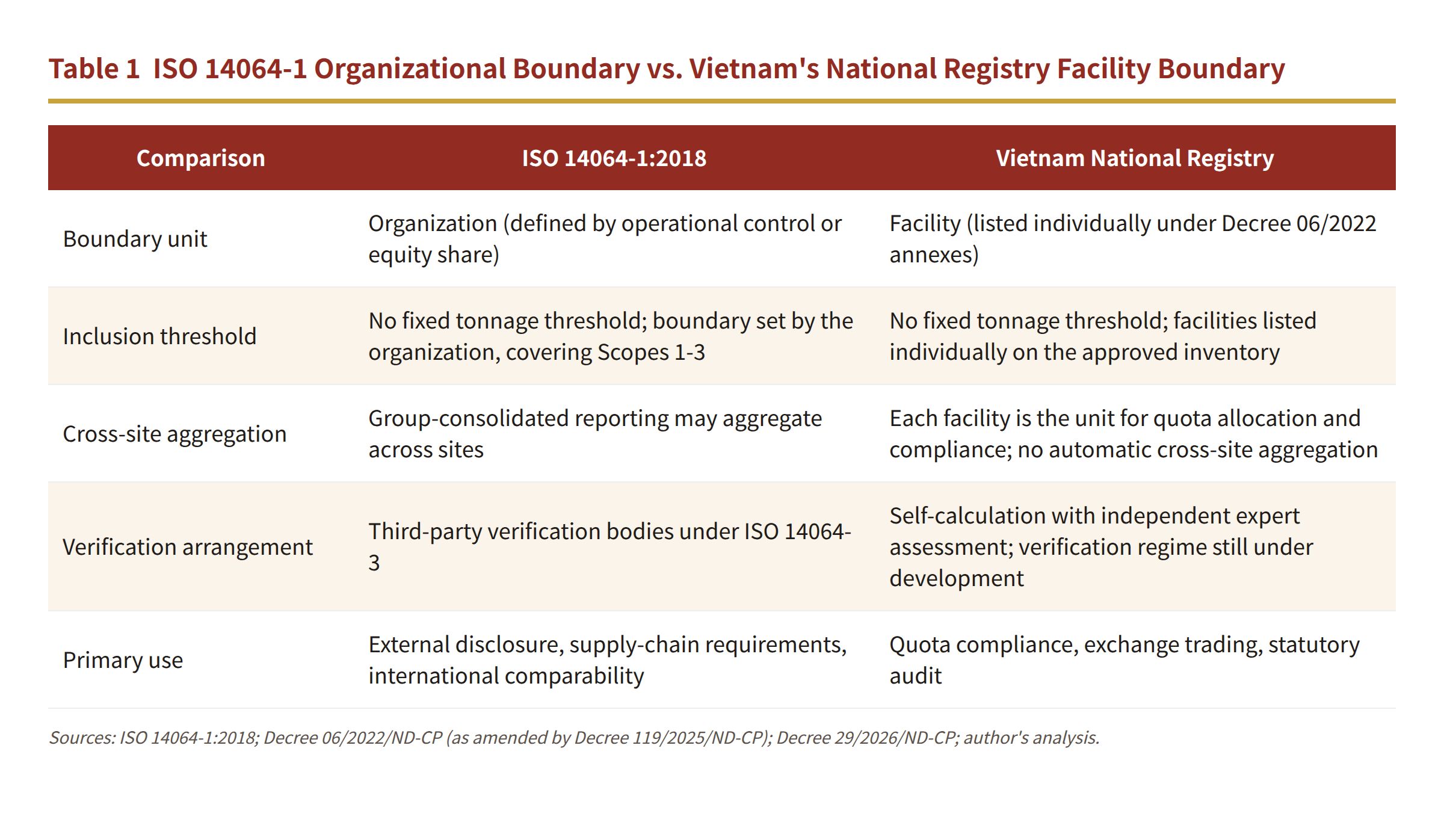
The most common source of divergence arises when a group operates two or more plants in Vietnam, some held under the same legal entity. In that case, a group-level ISO 14064-1 report presenting a consolidated total will decouple from Vietnam’s facility-by-facility quota accounting. If one plant’s actual emissions exceed its allocated quota, the firm cannot draw on quota surplus from another plant within the same group to offset it automatically, and must instead purchase additional quota on the exchange or retire eligible carbon credits. Boundary alignment is therefore not merely a reporting-format question but bears directly on whether a firm incurs additional compliance expenditure.
IV. Calculation Methodology: Free Allocation Based on Emission Intensity per Unit of Output
Vietnam’s pilot-phase quotas follow an intensity-benchmark approach, calculating quotas as emission intensity per unit of product multiplied by approved output, rather than setting an absolute tonnage cap directly. Under Article 12 of Decree 06/2022/ND-CP (as amended by Clause 8, Article 1 of Decree 119/2025/ND-CP), quota calculation must account for four factors jointly: emission intensity per unit of product, the sector’s and facility’s emission-reduction targets under their business plans, the facility’s emission-reduction potential, and the facility’s technical, technological, and financial capacity to implement reductions. During the pilot phase, quotas are allocated free of charge at a 100% rate with no auctioning, and compliance is assessed ex post by comparing verified actual emissions against the allocated quota.
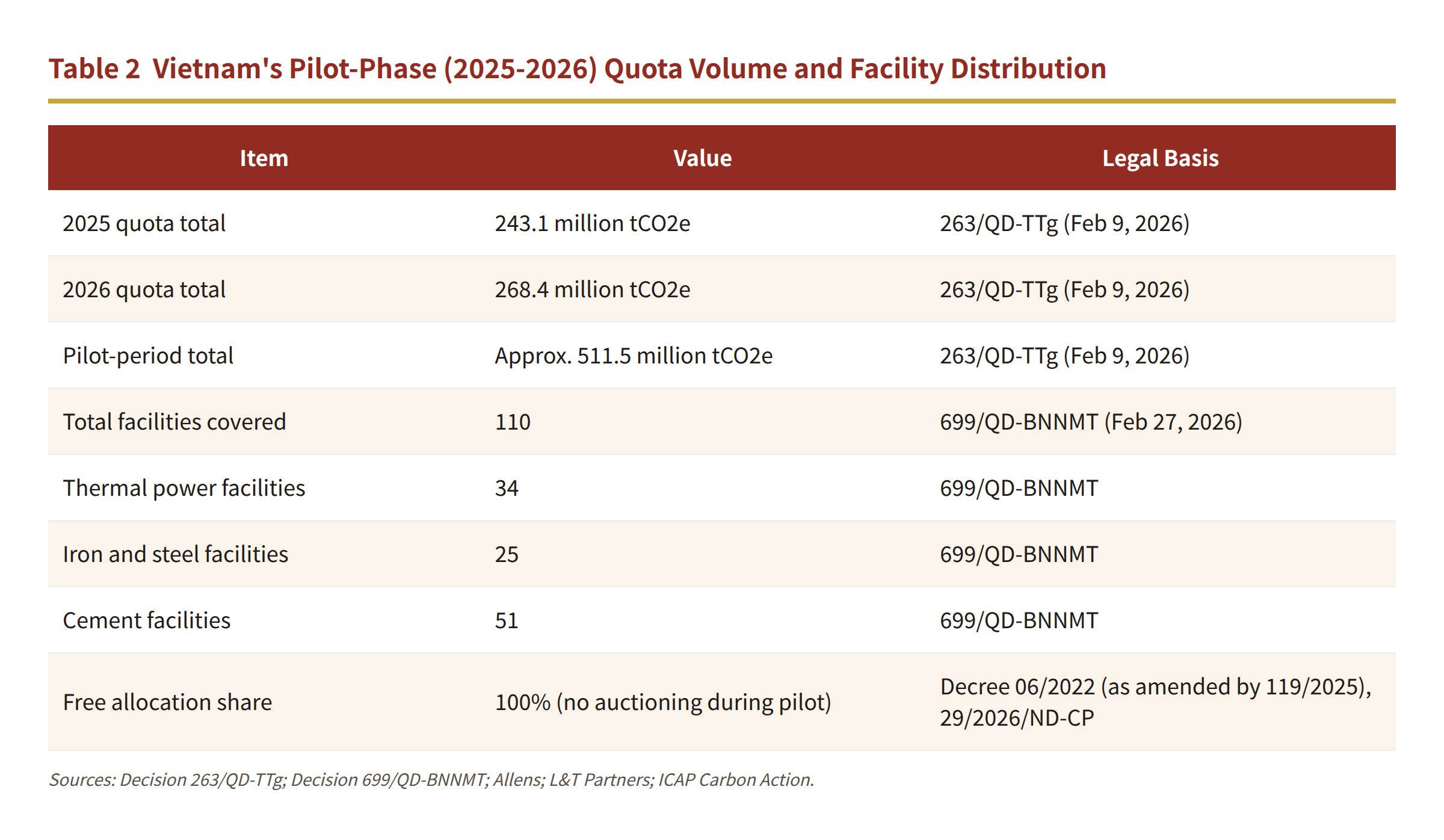
Participating enterprises are required to calculate their own emissions and engage independent experts for assessment and verification, an arrangement still in development and not yet as mature as the third-party verification body accreditation system underpinning ISO 14064-1. For Taiwanese firms that already hold ISO 14064-1 verification capability, this is in fact a relatively favorable position: existing group-level inventory data and verification experience can serve as the foundation for facility-level reporting in Vietnam, provided the boundary reconciliation described in Section III is completed first, confirming that group data can be accurately disaggregated to each regulated plant.
V. Short-, Medium-, and Long-Term Impact: From Reporting Cost to International Carbon Credits
1. Short term (2026-2027): Boundary reconciliation and verification cost become visible
The most immediate effect is that firms must reconcile group-level inventory boundaries with Vietnam’s facility registry boundaries, confirming whether existing ISO 14064-1 reports can be disaggregated to the single-plant level. Free quota allocation during the pilot and the fee waiver on the exchange through the end of 2028 lower the barrier to participation, but they do not reduce the administrative cost of reporting and verification. Firms still need to build facility-level monitoring, record-keeping, and reporting systems, and to engage independent experts for verification where required, and this is the cost firms are most likely to encounter first even while quotas remain fully free.
2. Medium term (2027 through the end of the pilot in 2028): Intensity benchmarks tighten, quota headroom narrows
Vietnam’s intensity-benchmark approach follows a path similar to China’s and Indonesia’s, where benchmark values are typically tightened as the pilot progresses to sustain reduction pressure, and most observers expect Vietnam to follow the same trajectory. For firms, this means that even where current quotas carry a surplus, a tightened benchmark applied to the same output level could yield a materially smaller allocation, and firms that have not invested in process-level abatement or efficiency gains will see the gap widen year over year. Authorities have also indicated that thermal power facilities omitted from the current inventory may be proposed for inclusion in future allocation periods, meaning the scope of coverage itself may expand; upstream Taiwanese plants not yet regulated should not assume the current scope will hold.
3. Long term (post-2028): Carbon credit market opens and international linkages emerge
Once the pilot period concludes, carbon credits, not just quotas, are expected to be formally admitted as a tradable product on the exchange, at which point firms will face pricing and liquidity considerations in the credit market alongside quota compliance. In parallel, the forest carbon services decree took effect in 2026, and Vietnam’s Implementation Agreement with Singapore under Article 6 of the Paris Agreement opens a bilateral channel for Vietnamese carbon credits to connect with international demand. This carries two implications for Taiwanese firms over the long term: first, a group with forestry or land-related operations in Vietnam may gain an additional credit source through forest carbon; second, a firm planning to develop in-country reduction projects for internationally recognized credits should monitor forthcoming announcements on eligible methodologies and approval procedures, details that remain undefined at present. Building verification capability aligned with international standards early will likely prove more cost-effective than catching up once the credit market fully opens.
VI. Recommendations for Taiwanese Firms
- Confirm whether each Vietnamese production site is listed in the Decision 699 facility inventory, rather than estimating coverage from the site’s own emissions scale.
- Reconcile existing ISO 14064-1 inventory boundaries against Vietnam’s official quota accounting boundaries, plant by plant, to identify discrepancies arising from cross-site aggregation or differing operational-control definitions.
- Extend existing verification capability to facility-level reporting, and establish relationships with local independent experts or verification bodies early to reduce uncertainty while the pilot-phase verification regime remains under development.
- Track the trajectory of benchmark tightening and whether new facilities are added in future allocation periods, and incorporate quota-shortfall risk into medium-term capital expenditure and process-abatement planning.
- Monitor the timeline for carbon credit market opening and forthcoming eligible-methodology announcements under the international credit transfer agreement, and assess whether the group is positioned to develop in-country reduction projects.
VII. Conclusion
Vietnam’s carbon market has moved from commitment to compliance faster than most observers anticipated, completing the exchange launch, forest-carbon legislation, and approval of an international credit agreement within a single half-year. For firms, however, the decisive factor was never the pace of regulatory advancement itself, but whether a firm’s own verification boundary keeps pace with the official accounting boundary. The pilot-phase benefits of fully free quotas and a fee-free exchange amount to a time-limited preparation window, and firms that complete boundary reconciliation and extend verification capability within this window will be best positioned to convert compliance cost into competitive advantage.
References
- Decree No. 29/2026/ND-CP dated January 19, 2026, on the operation of the domestic carbon market. Government of Vietnam.
- Decree No. 06/2022/ND-CP, as amended by Decree No. 119/2025/ND-CP, on greenhouse gas emission mitigation and ozone layer protection. Government of Vietnam.
- Decision No. 263/QD-TTg dated February 9, 2026, on approval of the total greenhouse gas emission quota for the 2025-2026 period. Prime Minister of Vietnam.
- Decision No. 699/QD-BNNMT dated February 27, 2026, on pilot allocation of emission quotas for the 2025-2026 period. Ministry of Agriculture and Environment of Vietnam.
- Decree No. 180/2026/ND-CP on forest carbon sequestration and storage services. Government of Vietnam.
- Resolution No. 235/NQ-CP on approval of the Implementation Agreement on carbon credits collaboration between Vietnam and Singapore under Article 6 of the Paris Agreement. Government of Vietnam.
- ISO. (2018). ISO 14064-1:2018 Greenhouse gases — Part 1: Specification with guidance at the organization level for quantification and reporting of greenhouse gas emissions and removals. International Organization for Standardization.
- Conventus Law. (2026). Vietnam launches the carbon exchange: Prospects for carbon market development and what businesses need to know.
- L&T Partners. (2026). Vietnam launches the carbon exchange: Prospects for carbon market development and what businesses need to know.
- Allens. (2026, August). Vietnam’s carbon market — the outlook and opportunities.
- ICAP Carbon Action. (2026). Vietnam ETS factsheet.
- VietnamPlus. (2026, June 30). Vietnam’s domestic carbon exchange launched.
- Nhan Dan. (2026, May 25). Regulations issued on the provision of forest carbon services.
Vietnam carbon market · GHG quota allocation · ISO 14064-1 · organizational boundary · carbon exchange · verification gap · intensity benchmarking · Taiwanese manufacturers compliance
First published on LinkedIn . This site holds the canonical version.