
The Carbon Factor Arrives Five Years Before the Reactor
The leverage in the Xuwei case sits at the institutional layer. The engineering is constrained by steam transmission radius and a 567 °C temperature ceiling, which makes replication demanding; the carbon footprint factor system, by contrast, allows the carbon intensity of industrial steam to be quantified and declared, directly altering where downstream chemical products stand on cost under cross-border carbon mechanisms. At two tonnes of steam per tonne of product, replacing coal with nuclear steam removes roughly 0.43 tonnes of CO₂ from the declaration, equivalent to about EUR 34 in certificate cost, or four to five per cent of cargo value.
I. Executive Summary
The most consequential output of the Jiangsu Xuwei Nuclear Heating and Power Plant is a set of carbon footprint factors, not two reactors. Media and official communications have concentrated on the engineering, yet the demonstration effect of the engineering works mainly on China’s domestic industry, while the institutional design is what carries influence across borders. The plant couples two HPR1000 pressurized water reactors with one high-temperature gas-cooled reactor (HTGR), introducing nuclear energy into petrochemical park steam supply at scale for the first time. It operates on a heat-led principle under which electrical output follows steam demand, marking a shift in the positioning of nuclear assets from generating units to park-level energy infrastructure.
That institutional design takes the form of a carbon footprint factor. China National Nuclear Corporation (CNNC) has established the country’s first carbon footprint factor for nuclear industrial steam, allowing low-carbon steam to be quantified, reported and embedded in the product carbon footprints of downstream chemical goods. The reactors will not deliver steam for several years, yet the factor system can already shape the carbon competitiveness narrative around Chinese petrochemical products. In terms of sequencing, the institutional layer is running ahead of the engineering — and it is this asymmetry that gives the case its wider relevance.
Overall assessment: the demonstration value of the engineering works principally on China’s domestic industry, whereas the institutional dimension carries international implications. Four variables nonetheless warrant reservation and should not be treated as settled — the baseline assumption underlying the emissions reduction claim, the steam transmission radius that constrains replication, the schedule risk inherent in a first-of-a-kind Gen IV build, and whether the carbon accounting methodology will secure international recognition.
II. Factual Basis and Project Chronology
Before analysis, the boundary of verifiable fact should be established. The items below are limited to those that can be cross-checked against approval documents and regulatory publications.
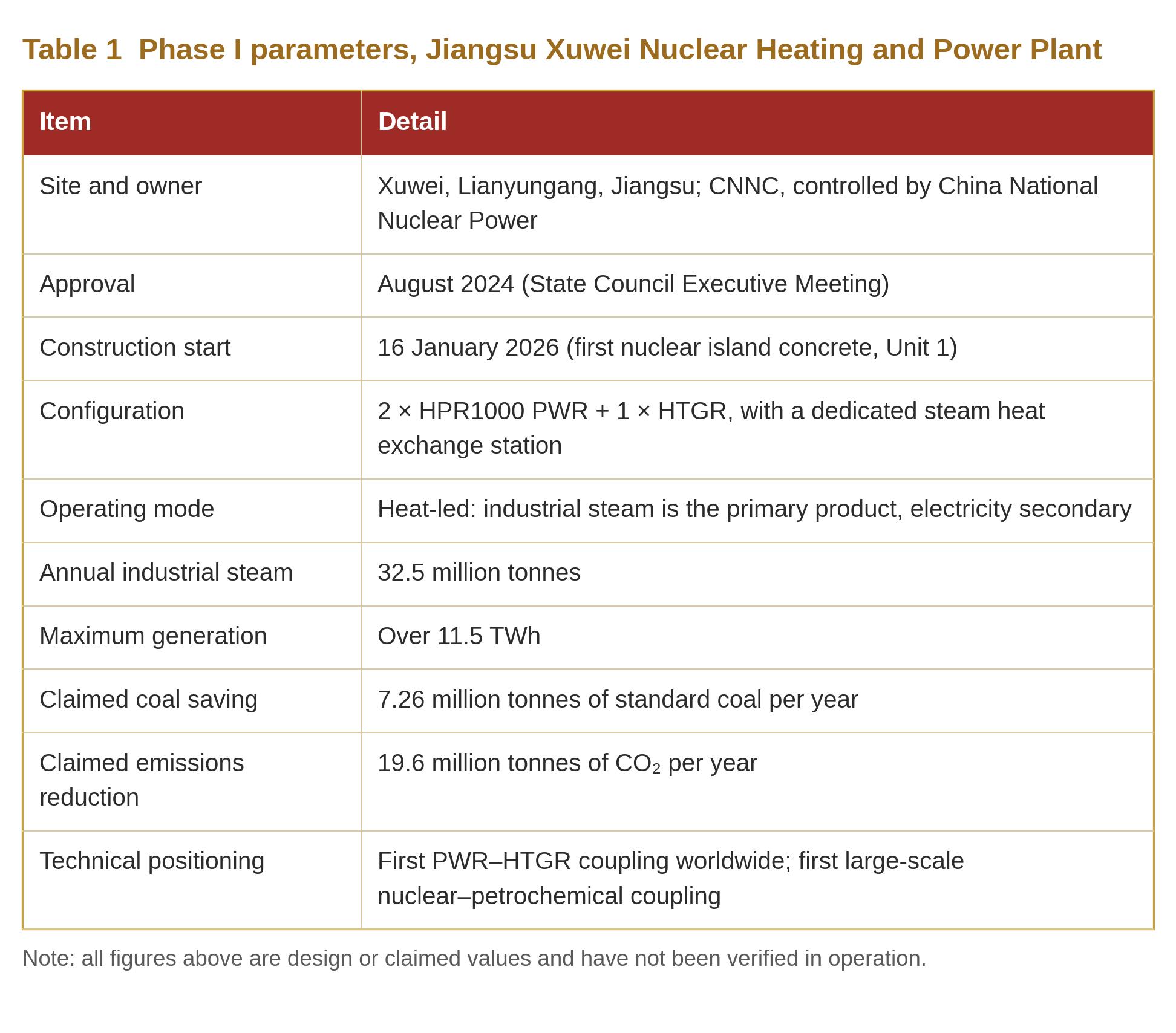
The plant is located at Xuwei in Lianyungang, Jiangsu Province, and is controlled by China National Nuclear Power under CNNC. It was approved by the State Council Executive Meeting in August 2024; first concrete for the nuclear island of Unit 1 was poured on 16 January 2026, marking entry into main construction and making it the first nuclear unit to begin construction in the opening year of China’s 15th Five-Year Plan. Phase I comprises two HPR1000 units and one HTGR unit arranged in a triangular configuration, together with a dedicated steam heat exchange station.
III. Industry Context: The Staged Expansion of Nuclear Energy Utilisation
Xuwei is not an isolated case but the third step on a path of nuclear energy utilisation in China. That path falls into four stages. The first is electricity generation alone, the traditional positioning. The second is district heating, already in service at Haiyang, Hongyanhe and Shidaowan, involving seasonal use of low-grade heat. The third is industrial steam supply: in June 2024 the Heqi-1 project at the Tianwan nuclear base became China’s first nuclear steam supply scheme for industrial use. The fourth, still at demonstration stage, extends to nuclear hydrogen production, heavy oil thermal recovery and higher-temperature process heat.
The sequence matters because it reveals a business model validation logic: begin with a small-scale retrofit drawing steam from existing units, confirm downstream willingness to pay and supply reliability, then build a dedicated plant whose primary mission is steam. Xuwei, on this reading, is not technological adventurism but the scaling-up of a commercially validated model. For anyone assessing how quickly the model might be replicated, this rhythm is a more useful indicator than the technical specifications.
It should also be noted that steam demand in Chinese chemical parks has long been met by captive power plants on site, constituting direct emissions that can neither be avoided through green electricity procurement nor readily offset with carbon credits. Industrial steam has therefore become a structural bottleneck in decarbonising energy-intensive industry, and it is precisely this bottleneck that the nuclear–petrochemical model targets.
IV. Technical Explanation: Reactor Principles and the Coupling Process
Two reactors are deployed side by side because each has complementary thermal strengths and limitations. Assessing feasibility therefore requires an understanding of both, and of how they are linked into a single steam supply system on one site.
1. HPR1000: the basis of steam volume
The HPR1000 is a Gen III pressurized water reactor formed by merging CNNC’s ACP1000 and CGN’s ACPR1000+ designs, with a 60-year design life. Its technical core is the 177-assembly reactor core: five additional fuel assemblies are added in each quadrant relative to the international standard of 157, twenty in total. This raises total unit output while lowering the operating power of each individual assembly, thereby increasing safety margin; the refuelling cycle is extended from the customary twelve months to eighteen, with plant availability above 90 per cent.
The safety design combines active and passive systems, including a passive secondary-side residual heat removal system, a passive containment heat removal system, and a cavity injection cooling system using both active and passive means. These are supported by a double containment and four barriers against the release of radioactive material, addressing beyond-design-basis events such as station blackout.
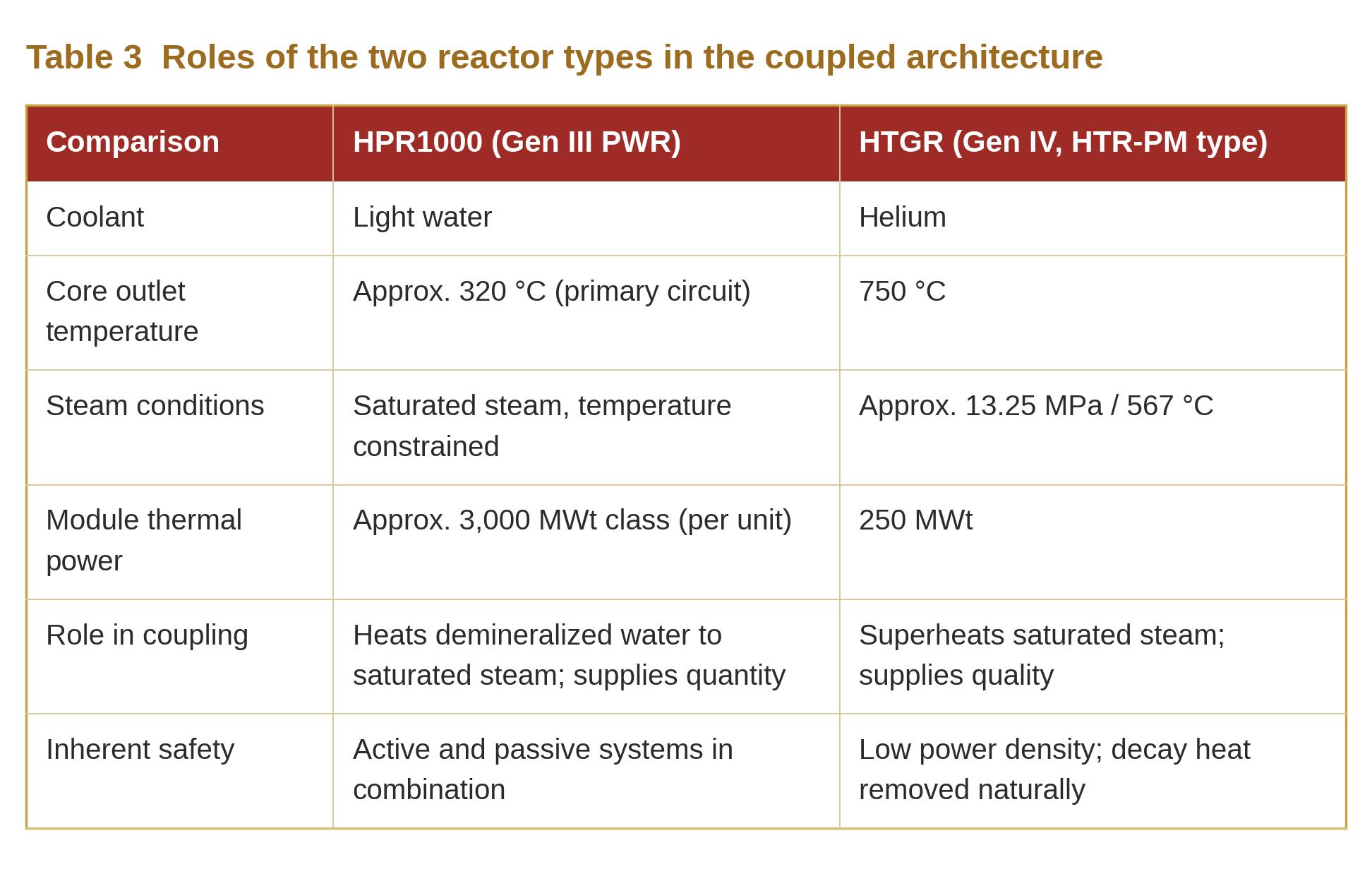
Thermodynamically, high-pressure water in the primary circuit at roughly 15 MPa carries fission heat to the steam generators, where the secondary circuit produces saturated steam at a main steam pressure of about 7 MPa, corresponding to a saturation temperature in the region of 280 °C. Here lies the inherent limitation of PWR steam supply: under saturated conditions temperature and pressure are locked together, so raising steam temperature requires raising pressure, and pressure is bounded by materials and safety design. The temperature ceiling is thus fixed. Set against this, unit thermal power in the 3,000 MWt class makes the extractable steam volume ample. In the coupled architecture, the HPR1000 supplies quantity.
2. HTGR: the source of steam quality
The HTGR at Xuwei is based on the Shidaowan pebble-bed modular demonstration plant (HTR-PM). Its most fundamental difference from a PWR lies in the coolant: helium is chemically inert, does not react with graphite, and undergoes no phase change across the operating range, so there is no boiling crisis and no temperature limit imposed by the critical point of water. Core helium inlet and outlet temperatures are 250 °C and 750 °C respectively, and steam generator outlet conditions reach 13.25 MPa and approximately 567 °C.
The fuel form likewise differs. TRISO coated particles with a uranium oxide kernel are enclosed in successive layers of pyrolytic carbon and silicon carbide, with roughly twelve thousand such particles embedded in each spherical fuel element; graphite serves as both moderator and structural material. The silicon carbide layer retains fission products effectively at high temperature, forming a barrier within the fuel itself. The pebble-bed arrangement also permits continuous on-load refuelling, with each sphere passing through the core repeatedly and burnup distributed more evenly.
Power density is the more decisive characteristic. At approximately 3.2 MW per cubic metre, it is around one-thirtieth that of a commercial PWR, allowing decay heat to be removed naturally to the environment by conduction, radiation and natural convection, without reliance on an emergency core cooling system; the Shidaowan project has verified this inherent safety characteristic through loss-of-cooling testing. Module thermal power is nonetheless only 250 MWt, and two modules driving a single turbine yield about 210 MWe. Small in quantity but high in quality, the HTGR supplies quality in the coupled architecture.
3. The coupling process: from seawater to industrial steam
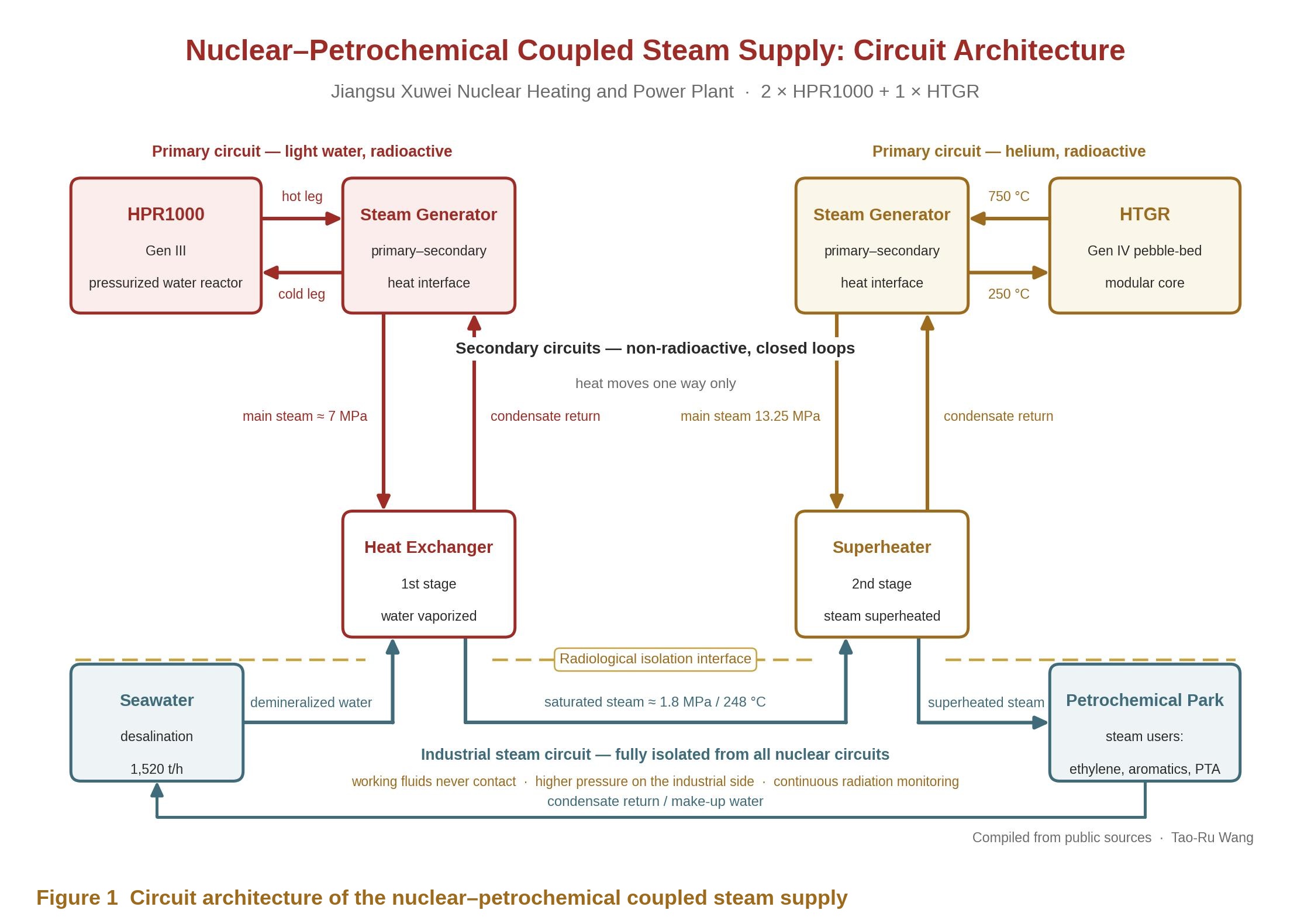
The two reactors are not linked by sending nuclear steam directly to customers. A series of heat exchange stages produces industrial steam using an entirely separate working fluid. Following the architecture already validated at Heqi-1 and adding the HTGR stage, the process divides into four phases.
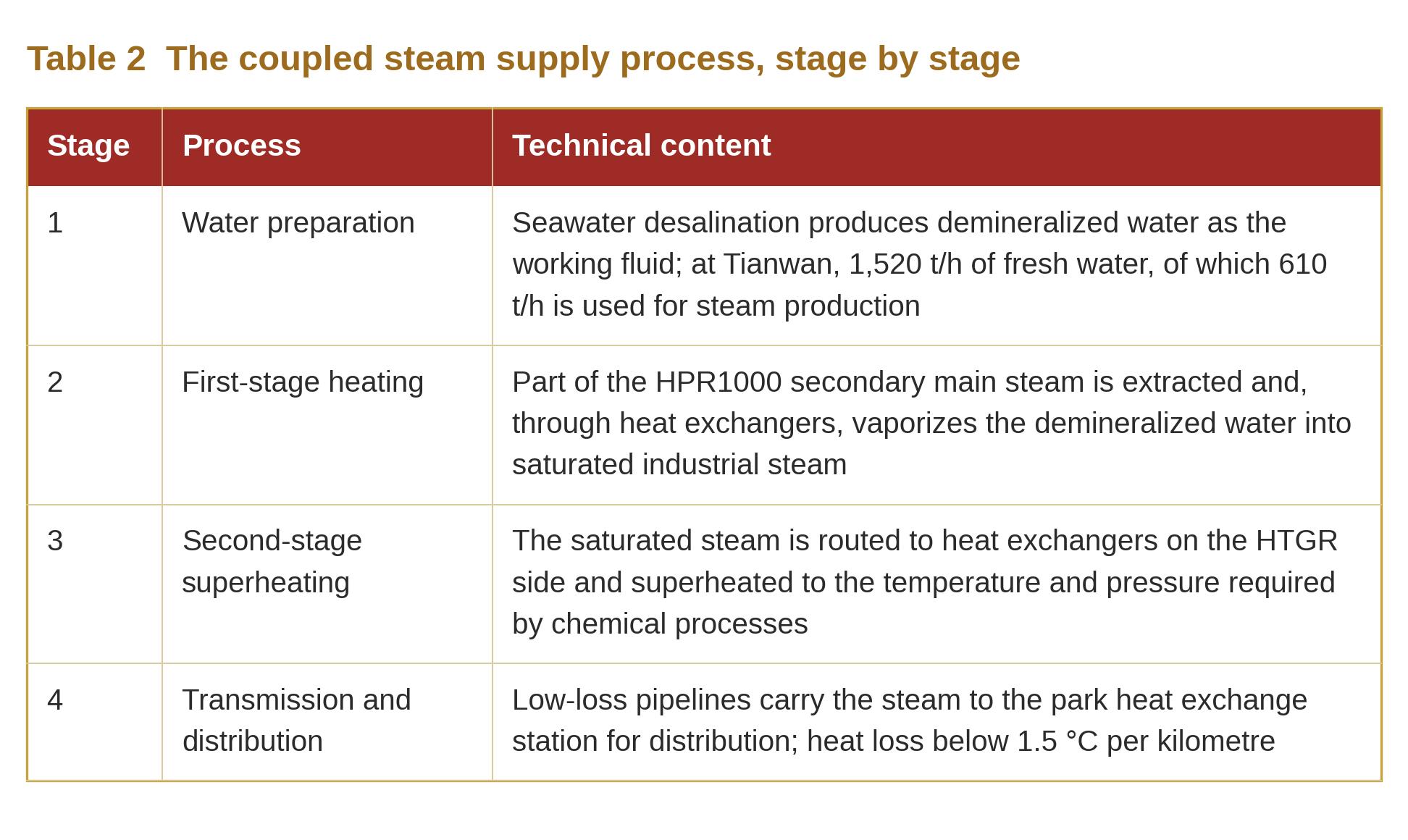
Stage three is where the technical innovation lies. Saturated steam produced by the PWR forms the base, and the HTGR raises it further. In substance, two heat sources of different thermal grades are placed in series so that the higher-grade source is dedicated to upgrading quality rather than carrying the full thermal load. In thermodynamic terms this is cascaded energy utilisation; in engineering economics, it fills the base load with cheaper Gen III heat and calls on the more expensive Gen IV capacity only where high temperature is required.
4. Radiological isolation design
The concern most often raised by chemical customers is whether the steam might carry radioactivity. Three mechanisms address this. First, circuit isolation: the nuclear island primary and secondary circuits and the industrial steam circuit are independent, their working fluids never in contact, with the industrial water drawn separately from seawater desalination. Second, a pressure gradient: the industrial circuit is held at higher pressure than the nuclear side, so any leakage follows the pressure differential from the clean side toward the nuclear side and cannot reverse. Third, radiation monitoring: continuous monitors and automatic isolation valves are installed at the heat exchange interface and on the outgoing lines. Operation of Heqi-1 since June 2024 provides preliminary operating evidence for this architecture.
5. Engineering questions raised by coupled operation
The principles are clear, yet several questions remain to be settled in operation. The first is asynchronous maintenance: a PWR must shut down for refuelling every eighteen months, whereas an HTGR refuels continuously on load, so the availability curves of the two do not coincide. Chemical plants require long-cycle uninterrupted steam, and an outage of a few days can force a full shutdown. Continuity must therefore be supported by mutual back-up between units, standby park boilers or steam buffering, which will become a key clause — and a cost item — in supply contracts.
The second is load matching. Under heat-led operation, intraday and seasonal fluctuations in park steam demand must be absorbed by adjusting unit output or bypassing steam, yet nuclear units follow load less readily than thermal plant, and there is no long-run data on how the HTGR performs in this role. The third is system integration: the instrumentation and control systems, dispatch logic and thermal interfaces of two reactor types must be integrated into a single operating regime, for which there is no international precedent. This is the substantive source of first-of-a-kind risk in the project.
V. Techno-Economic Analysis: The Logic of Dual-Reactor Coupling
1. The step change in steam quality
Dual-reactor coupling is a response to cost rather than a technical showcase. Constrained by the properties of water, PWR extraction steam is of modest grade: Heqi-1 delivers steam at roughly 248 °C and 1.8 MPa, adequate for general park use but insufficient for high-temperature cracking and comparable processes. HTGR steam quality is more than sufficient, but module output is only 250 MWt and total steam volume is limited. The strengths and weaknesses of the two are complementary, and the price of that complementarity is capital cost and integration complexity.
CNNC has been candid on the point: at present HTGR module output is small, and supplying an equivalent steam volume from HTGRs alone would require the number of reactors to multiply, which is not economically viable. Coupling with a PWR allows both volume and quality to be met at acceptable capital cost. The statement makes clear that coupling is not novelty for its own sake, but a transitional design in which the scale advantage of Gen III technology absorbs part of the cost of Gen IV technology whose standalone economics are not yet mature.
2. What heat-led operation implies
This is the first project to adopt heat-led operation, and the implication extends beyond dispatch. Revenue at a conventional nuclear plant depends on tariff and generation volume; under heat-led operation, unit output is determined by park steam demand and electricity becomes a by-product of waste heat utilisation. Cash flow shifts from the electricity market to long-term steam supply contracts, improving stability while binding the plant tightly to a single industrial cluster and exposing it to that cluster’s business cycle and customer concentration.
In asset terms this is no longer a typical power asset but something closer to a park utility. The reclassification raises new questions for investment appraisal, regulatory treatment and pricing mechanisms, and offers a useful lens on whether the project succeeds commercially.
3. Modularity and the claim of replicability
The project emphasises that the modular character of the HTGR allows the configuration to be tailored to the differing requirements of individual chemical parks, meeting both volume and quality needs and enabling deployment across parks of varying scale and type. The claim holds technically: adjustable module count means adjustable steam quality mix. Whether it can be realised, however, remains subject to the steam transmission radius, the geographic pairing of nuclear sites with chemical parks, and regulatory conditions, and technical feasibility should not be read as market feasibility.
VI. Verification Against the Demonstration Case: Heqi-1
Assessing the credibility of Xuwei is best begun with its predecessor. Heqi-1 draws on Units 3 and 4 of the Tianwan nuclear base and entered service on 19 June 2024, the first instance internationally of large-scale industrial steam production from PWR units.
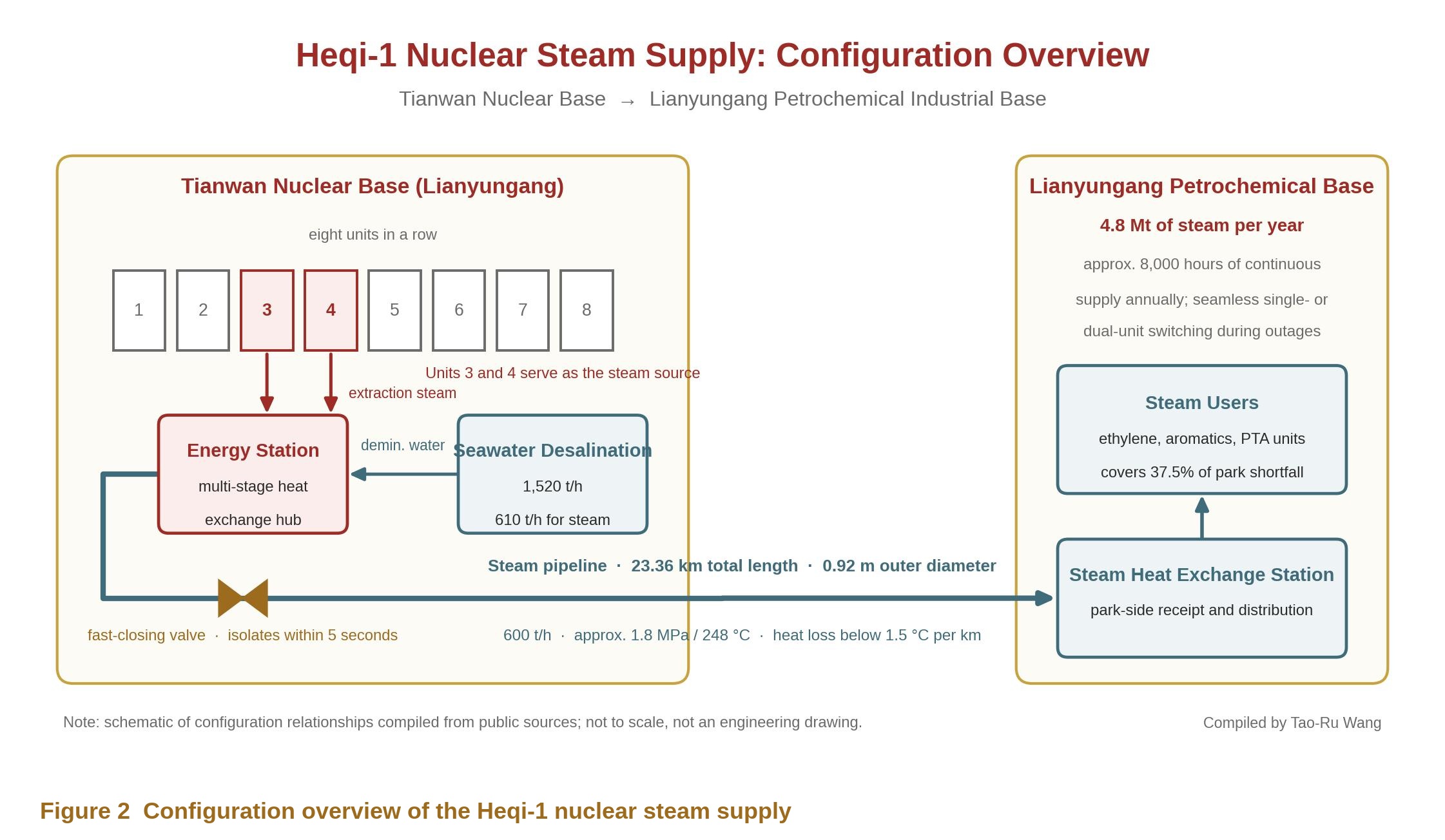
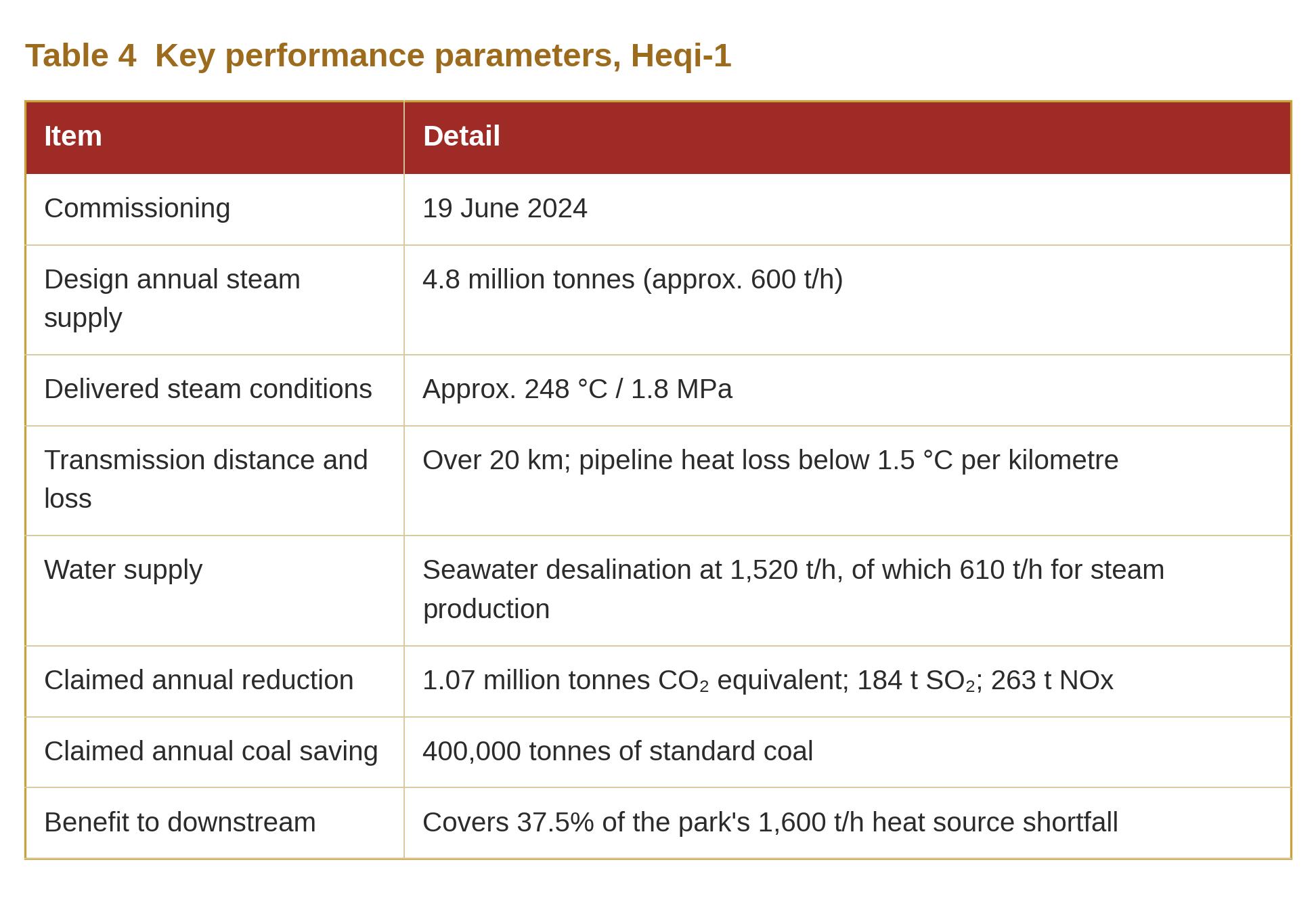
One discrepancy deserves attention. Design annual steam supply at Heqi-1 is 4.8 million tonnes, while public information as of July 2026 indicates cumulative supply to the Lianyungang petrochemical base of more than 4.8 million tonnes. If that figure is cumulative since commissioning, then twenty-five months of delivery amounts to roughly one year of design output, implying an actual load factor materially below design. Available public information does not clarify the point, and imprecise phrasing cannot be excluded; the discrepancy nonetheless bears directly on supply reliability and on customers’ actual offtake, and should be treated as a core indicator for monitoring.
A second instructive detail is the coupling of desalination with steam supply. Demineralized water for steam production is drawn from the plant’s own desalination system, which offers advantages in water security and cost while deepening the model’s dependence on coastal sites. Inland chemical parks, even where close to a nuclear site, would face different replication conditions.
VII. Methodological Review of the Emissions Reduction Claim
Phase I at Xuwei is claimed to save 7.26 million tonnes of standard coal and avoid 19.6 million tonnes of CO₂ annually. Applying an emission factor of approximately 2.66 tonnes of CO₂ per tonne of standard coal, 7.26 million tonnes of coal corresponds to about 19.3 million tonnes of CO₂, closely matching the claimed figure. The correspondence itself reveals the calculation logic: the reduction is converted directly from coal displacement, with an implicit baseline of one hundred per cent coal.
A further internal consistency check: Heqi-1 saves 400,000 tonnes of standard coal against 4.8 million tonnes of steam, or roughly 0.083 tonnes of coal equivalent per tonne of steam. At Xuwei, estimating 11.5 TWh of generation at about 300 g of standard coal per kWh gives some 3.45 million tonnes, leaving 3.81 million tonnes against 32.5 million tonnes of steam, or roughly 0.117 tonnes per tonne — some forty per cent higher than Heqi-1. The gap runs in the same direction as the higher steam conditions specified for Xuwei, indicating that the two sets of figures are internally consistent.
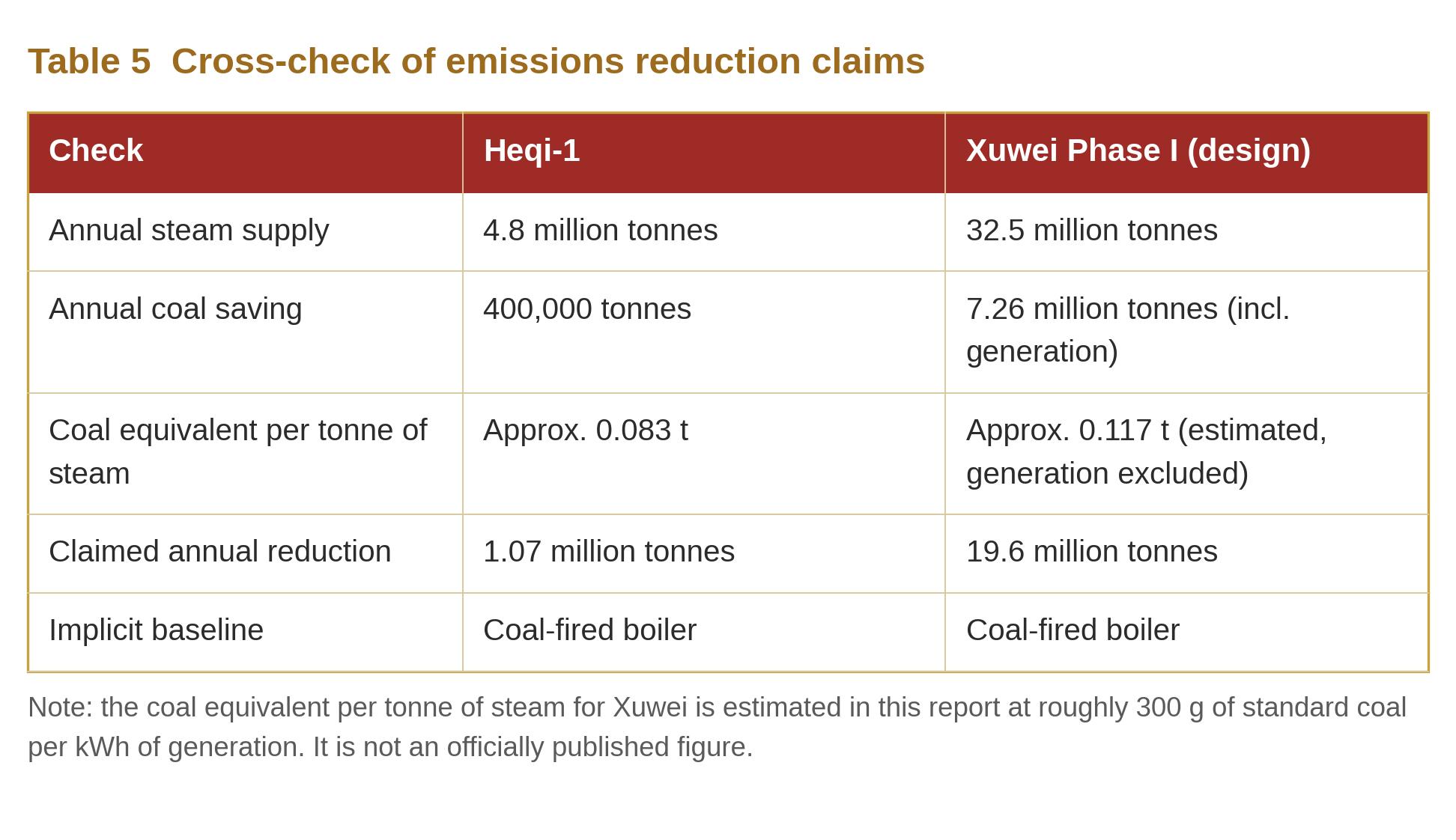
Two conclusions follow. First, the figures are arithmetically coherent rather than arbitrary, and carry a degree of credibility. Second, the reduction is by nature a theoretical value measured against a wholly coal-fired baseline. Where a park’s existing heat sources already include gas-fired units or purchased electricity, or where the baseline shifts downward as China’s power mix continues to decarbonise, the actual reduction will be significantly lower than claimed. For verification purposes this qualification must accompany any citation of the figure.
VIII. The Real Leverage: The Carbon Footprint Factor System
The element of this case with the greatest spillover potential is not the reactor but the carbon footprint factor. On 21 November 2025 CNNC published the first carbon footprint factor for nuclear industrial steam, covering life cycle emissions from seawater through to industrial steam, and described as filling a gap in the sector domestically and internationally.
The move should be read within a larger institutional context. Under the Implementation Plan for Establishing a Carbon Footprint Management System, China’s Ministry of Ecology and Environment, together with the National Bureau of Statistics and the National Energy Administration, has published annual carbon footprint factors for coal, gas, hydro, nuclear, wind, solar photovoltaic, solar thermal and biomass generation as well as transmission and distribution, for use across industries in calculating product carbon footprints. The stated purpose is to align with domestic and international standards for product carbon footprinting and life cycle assessment. Establishing a factor for nuclear steam supply completes the heat-side piece alongside the existing electricity-side framework.
Seen in this light, China is building a complete chain in parallel: a low-carbon heat source, officially recognised factors, and reportable data. The reactors will not deliver steam until around 2030, but the factor system can begin from today to shape how Chinese petrochemical products are reported under cross-border carbon mechanisms and in the supply chain inventories of international brands. For sustainability practitioners, the immediate significance of this pathway far exceeds that of construction progress.
Three reservations remain. First, the methodology documentation, system boundary and allocation rules for the factor have not been fully disclosed. Second, whether it conforms to ISO 14067 or the GHG Protocol, and whether it has been independently verified, is unknown. Third, and most important, a self-established system is not the same as international recognition. The European Union’s Carbon Border Adjustment Mechanism has consistently conditioned acceptance of third-country factors on verifiability and data transparency. The declaratory effect of the factor has already been achieved; its institutional effect awaits verification.
IX. Cross-Border Reporting: Where the Carbon Factor Acts, and How Much It Is Worth
The commercial value of a carbon footprint factor becomes visible only inside the calculation rules of the EU Carbon Border Adjustment Mechanism. The mechanism entered its financial obligation phase in 2026 and currently covers cement, iron and steel, aluminium, fertilisers, electricity and hydrogen, with declarants required to surrender certificates against the embedded emissions of imported goods. Organic chemicals and polymers have long sat on the review list for extended coverage, and a separate legislative track on widening the scope to downstream products is advancing in parallel. When petrochemical park products are brought in will determine how widely the value of low-carbon steam can be realised.
1. How purchased steam enters the embedded emissions calculation
Embedded emissions are not confined to what leaves a plant’s own stack. Under current methodology, measurable heat is treated as a distinct item: steam imported from outside the installation is converted according to its heat content and the emission factor of its source, attributed to the production process that consumes it, and then carried downstream layer by layer with the precursors. The carbon intensity of park steam therefore travels along the value chain, from intermediates into polymers and from polymers into finished goods. This is precisely where nuclear steam acts: it changes not the stack of a single plant, but the block of heat-related emissions that every layer of the chain has to carry.
The calculation itself is simple. Heat-related embedded emissions equal steam consumption per unit of product multiplied by the emission factor of that steam. The two parameters are independent, the first set by the process and the second by the heat source, and nuclear supply can only move the second, so how much a given plant can strike from its declaration depends on its own steam intensity and bears no direct relation to how clean the heat source happens to be.
2. Scenario calculation: the order of magnitude
The emission factor of coal-fired steam can be derived from published Heqi-1 data: 1.07 million tonnes of annual reduction against 4.8 million tonnes of annual steam supply gives roughly 0.223 tonnes of CO₂ per tonne of steam. Nuclear steam is not zero on a life cycle basis, since construction, the fuel cycle and operations all carry emissions, and this report adopts 0.01 tonnes per tonne of steam as a scenario value. The certificate price is set at EUR 80 per tonne of CO₂.
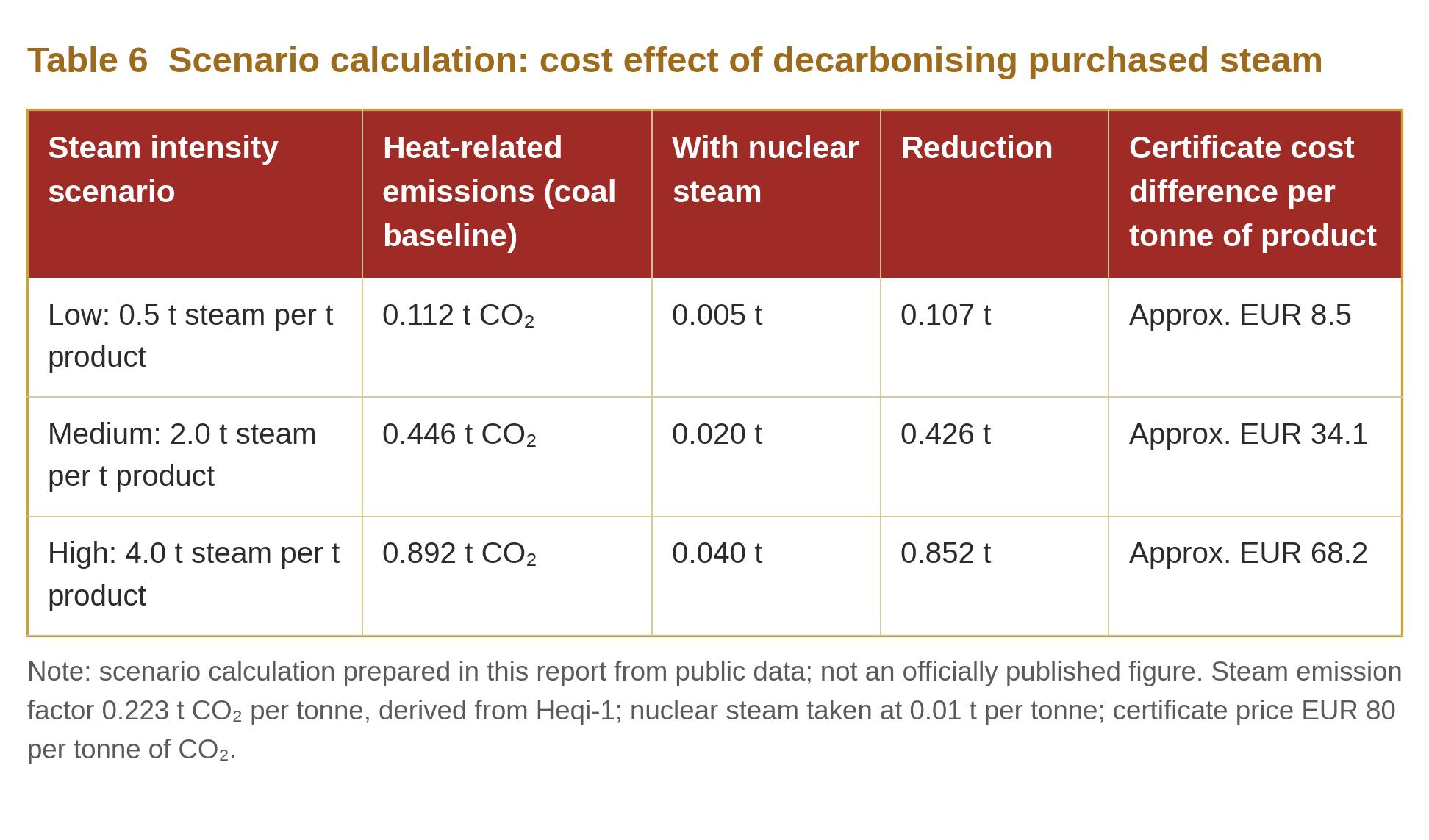
Taking the medium scenario, each tonne of product carries approximately 0.43 tonnes of CO₂ less in its declaration, equivalent to about EUR 34 in certificate cost. That is not loose change. If the product’s FOB price sits between EUR 700 and 800 per tonne, the difference amounts to some four to five per cent of cargo value, enough to reorder quotations between comparable products in a bulk chemicals market where margins are already counted in single digits.
3. Where the effect is largest: high steam intensity at moderate process temperature
The benefit is distributed unevenly across the petrochemical chain, and the temperature ceiling of HTGR steam is what determines the distribution. Steam leaves the HTGR side at approximately 567 °C, whereas the tube operating temperature in an ethylene cracking furnace sits above 800 °C, so nuclear steam is physically incapable of carrying the cracking furnace duty. Fuel combustion in those furnaces is the most emissions-intensive step in ethylene production, and it is a step nuclear steam cannot touch.
The largest gains accrue to products that use medium and low pressure steam for reaction heat, stripping and separation: oxidation and crystallisation in purified terephthalic acid, heating in polyester polymerisation, reboiler duty on aromatics fractionation columns, and hydration and evaporation in ethylene oxide and ethylene glycol. These processes have high steam intensity, operate within the temperature range nuclear steam can cover, and carry the highest share of heat in their embedded emissions. The further downstream a unit sits and the more it relies on physical separation, the larger the benefit; the further upstream it sits and the more it depends on high-temperature chemistry, the smaller.
This has direct consequences for assessing replication. A refining and petrochemical complex built around ethylene cracking may not suit nuclear steam supply at all, given its emissions profile, whereas polyester, fibre and fine chemical clusters further downstream stand to gain far more at the margin. The Lianyungang base at which Xuwei sits contains both, so the actual share of benefit depends on the mix of units installed, and the aggregate figures published to date cannot answer that question.
4. The gap between actual and default values
In reporting practice there is a further effect, more immediate than the carbon intensity of the steam itself. Declaration of embedded emissions is asymmetric by design: those able to produce verified actual data may declare actual values, while those who cannot are assigned default values benchmarked against poorer-performing installations in the exporting country with a penalty mark-up, typically well above real performance. For a declarant, obtaining verifiable data has value in itself, independent of how favourable the number turns out to be.
This also explains why CNNC published its factor years before any reactor is connected. Once a factor system is recognised, existing gas-fired and coal-fired steam users within the same park benefit equally from the ability to declare actual values, so the scope of benefit extends well beyond the reach of nuclear steam itself. In sequence, the institutional effect lands several years ahead of the engineering effect.
5. Three conditions still unanswered
The value of the factor is only one condition among several. The first is the verifying body: declaration data must be verified by a body accredited under EU rules, and a factor published by a third-country authority or by the operator itself is not automatically accepted under current rules. The second is methodological compatibility: purchased heat involves system boundaries, allocation principles and metering conventions, and where the Chinese system and the EU implementing rules diverge on boundary definition, the values cannot be carried across and must be recalculated. The third is data traceability: where metering points sit, whether resolution is hourly or monthly, and whether third parties have rights of access, are the practical thresholds for passing verification.
For export-oriented chemical capacity, the significance of this pathway lies in converting decarbonisation investment into a declarable cost advantage. Should verification and mutual recognition fail to materialise, the effect of low-carbon steam will remain confined to narrative in the domestic market and will not be realised in cross-border declarations. The factor was established several years ahead of grid connection, and that interval is precisely the window in which verification and recognition must be settled. It is also the part of the story most worth following.
X. Risk Assessment and Points of Reservation
1. Engineering and schedule risk
HPR1000 construction typically takes five to six years, and the HTGR here is the first commercial coupled unit of its kind. Although the Shidaowan demonstration plant completed its 168-hour continuous operation test and entered commercial service in December 2023, accumulated operating data remains limited, and load-following capability, availability and steam quality stability after coupling with a PWR have no precedent. Delay is the international norm for first-of-a-kind projects, and the commissioning schedule should not be taken from official planning values.
2. Geographic and replication risk
The steam transmission radius is the hardest physical constraint on this model. Heqi-1 already requires low-loss pipeline over a distance exceeding twenty kilometres. The real threshold for replication across the Yangtze River Delta and the Greater Bay Area therefore lies not in whether the technology can be reproduced, but in whether nuclear sites and large chemical parks can be matched geographically within a few tens of kilometres, and whether those parks carry sufficient and durable steam demand. Locations meeting all three conditions are considerably fewer than promotional accounts imply.
3. Commercial and pricing risk
Nuclear steam must compete on price with the park’s captive coal-fired boilers. While China’s national carbon market has yet to bring the chemical sector fully within its scope and carbon prices remain moderate, the premium available to low-carbon steam derives mainly from customers’ export compliance needs rather than domestic carbon costs. Should external carbon constraints tighten less than expected, the pricing basis of supply contracts will come under pressure.
4. Safety and regulatory risk
Siting nuclear facilities and a large petrochemical park within tens of kilometres of one another raises questions of interaction between external events — whether fire and explosion risk at the chemical base constitutes an external hazard to the nuclear facility, and whether the emergency planning zone of the nuclear facility constrains land use within the park. Such questions are lightly treated in existing regulatory frameworks and merit continued attention.
5. Data limitations
With the exception of certain operating results at Heqi-1, the steam volumes, generation figures and emissions reductions cited in this report are design or claimed values that have not been independently verified. Design and actual values should be distinguished strictly, and the distinction noted when the figures are cited.
XI. Indicators for Continued Monitoring
The following indicators are proposed for tracking substantive progress. Items three and four are institutional in nature, with implications beyond the single project, and should be treated as priorities.
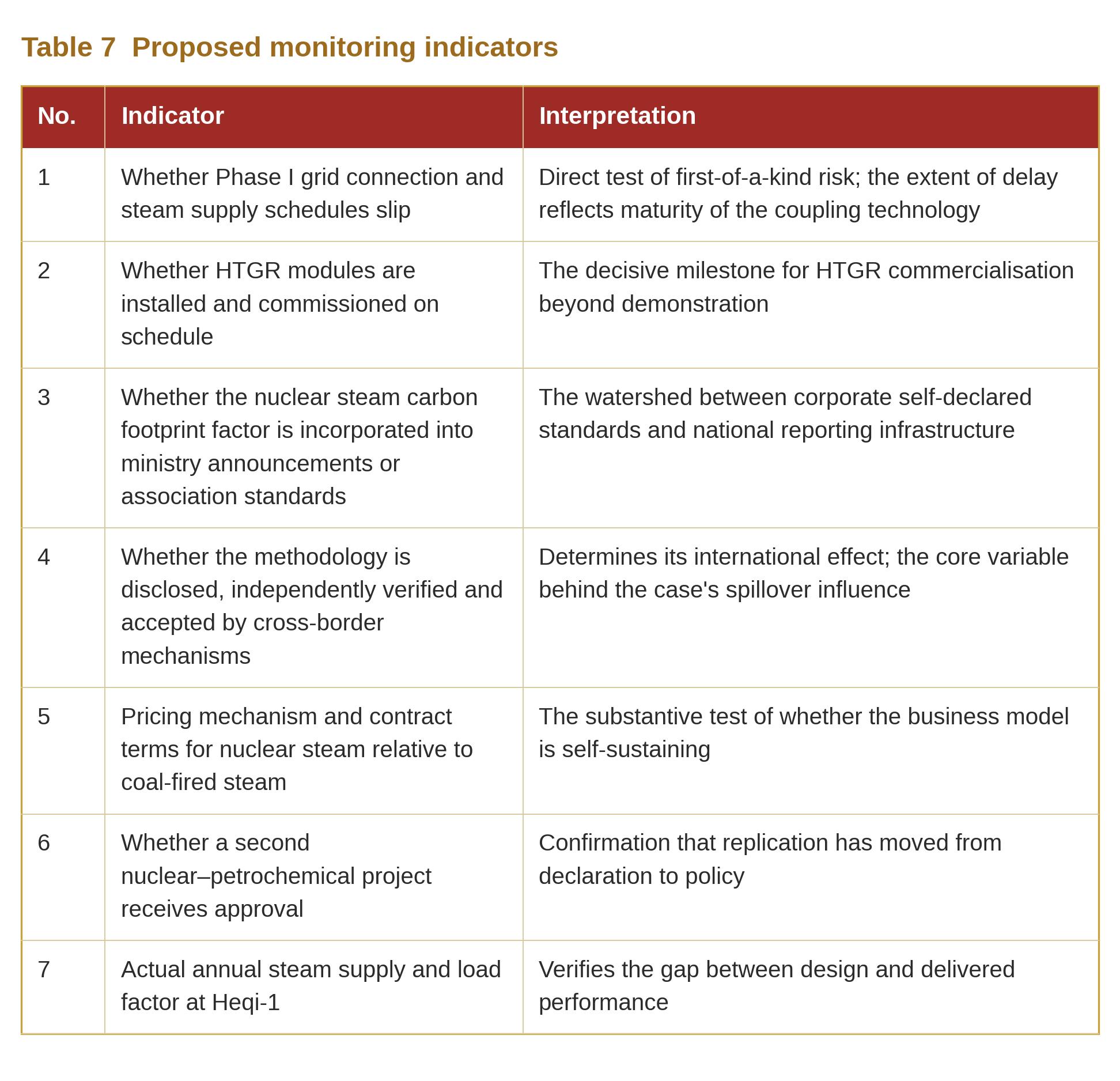
Indicator three is the most telling. Should the factor move from a corporate self-established standard into the ministry announcement system, China will have brought the quantitative basis of low-carbon industrial heat within national carbon footprint governance. What would then be affected is not one plant or one park, but the position of an entire chemical product chain in the carbon narrative of international markets.
References
- China Atomic Energy Authority. (2024, June 20). 我国首个工业用途核能供汽项目“和气一号”建成投产 [China’s first industrial nuclear steam supply project, Heqi-1, completed and placed in operation]. China Atomic Energy Authority.
- China National Nuclear Corporation. (2024, August). 江苏徐圩核能供热发电厂项目获国务院常务会议核准 [State Council Executive Meeting approves the Jiangsu Xuwei nuclear heating and power plant project]. China National Nuclear Corporation.
- China National Nuclear Corporation. (2025, November 21). 全国首个核能工业供汽碳足迹因子发布 [Release of China’s first carbon footprint factor for nuclear industrial steam]. China National Nuclear Corporation.
- China National Nuclear Corporation. (2026, January 16). 江苏徐圩核能供热发电厂1号机组核岛浇筑第一罐混凝土 [First nuclear island concrete pour for Unit 1 of the Jiangsu Xuwei nuclear heating and power plant]. China National Nuclear Corporation.
- Ministry of Ecology and Environment. (2024). 关于发布2023年电力碳足迹因子数据的公告 [Announcement on the release of 2023 electricity carbon footprint factor data]. Ministry of Ecology and Environment of the People’s Republic of China.
- National Energy Administration. (2023, December 6). 石岛湾高温气冷堆商业示范工程投入商业运行 [Shidaowan HTGR commercial demonstration project enters commercial operation]. National Energy Administration.
- National Energy Administration. (2024, July 19). 核能供汽打开产业应用新场景 [Nuclear steam supply opens new scenarios for industrial application]. National Energy Administration.
- National Nuclear Safety Administration. (2024, August). 核能供汽技术说明 [Technical explanation of nuclear steam supply]. Ministry of Ecology and Environment of the People’s Republic of China.
- Zhang, Z., Dong, Y., Li, F., Zhang, Z., Wang, H., Huang, X., Li, H., Liu, B., Wu, X., Wang, H., Diao, X., Zhang, H., & Wang, J. (2016). The Shandong Shidao Bay 200 MWe high-temperature gas-cooled reactor pebble-bed module (HTR-PM) demonstration power plant: An engineering and technological innovation. Engineering, 2(1), 112–118.
Prepared from publicly available information. Figures cited are largely design or officially claimed values and have not been independently verified; this report is intended for internal analytical use.
carbon footprint factor · nuclear industrial steam · CBAM · embedded emissions · measurable heat · Jiangsu Xuwei · HPR1000 · HTGR · Heqi-1 · process heat decarbonisation · purchased steam · actual versus default values · petrochemical park · CNNC
First published on LinkedIn . This site holds the canonical version.