
ISO 32212’s threshold is not target-setting, but a verifiable boundary
The real threshold of ISO 32212 is not target-setting but whether an externally verifiable boundary can be drawn around a financial institution's "controlled or influenced" activities and financed emissions; auditability is what determines whether the standard holds.
A verifier’s reading of the net zero transition-planning standard for financial institutions
I. Core Claim
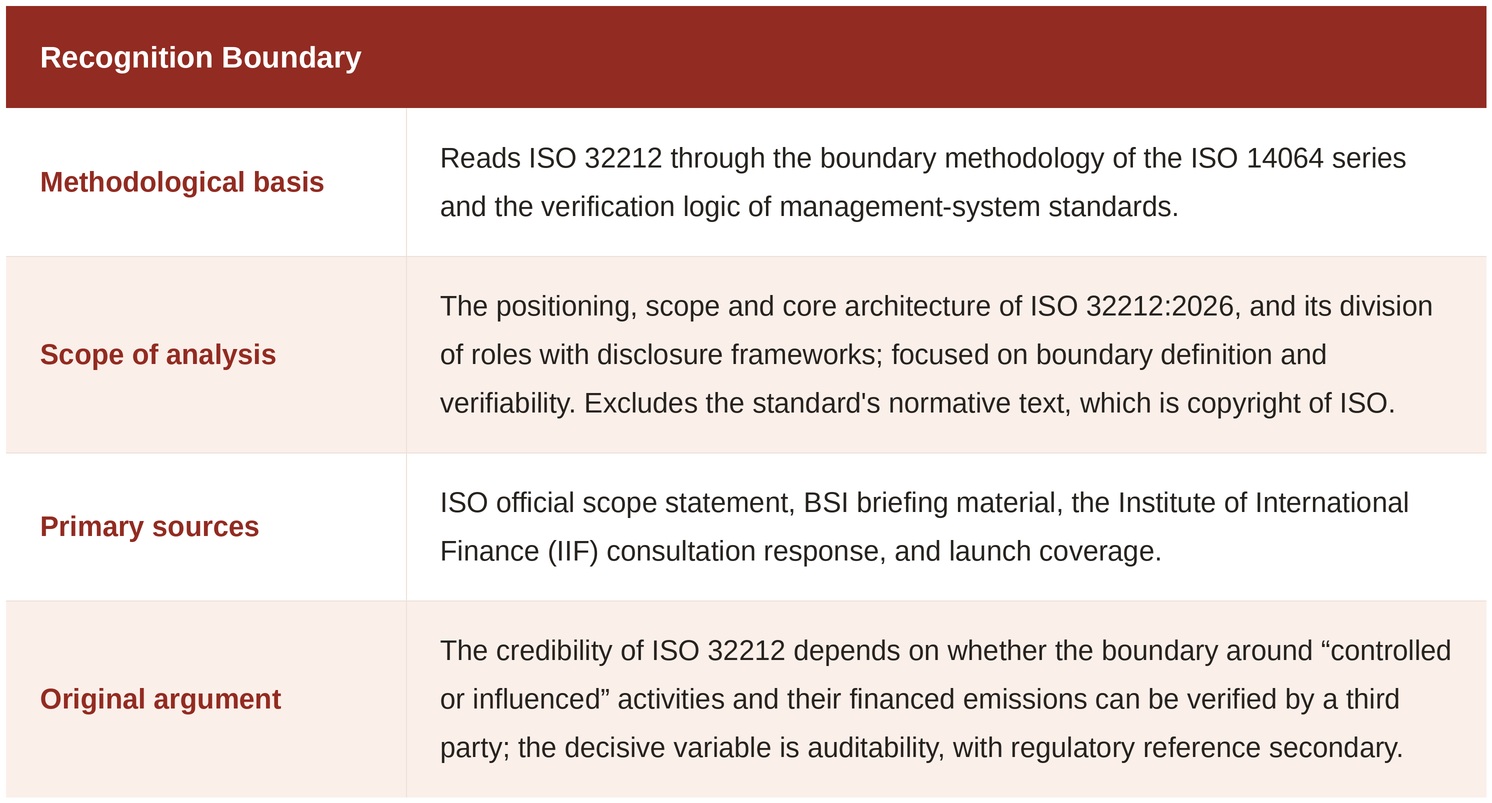
The credibility of a management-system standard rests on its least verifiable link. ISO 32212 moves the centre of gravity of financial-sector net zero from “what is disclosed” towards “how the plan is bounded and governed,” and the real difficulty of that shift lies at the boundary: how to draw, around “controlled or influenced” financial activities and their financed emissions, a line that a third party can verify. Measured through a verifier’s lens, the standard’s success depends on whether the category of “influence” can be audited, not on whether regulators write it into a mandatory framework.
ISO 32212 is a management-system standard published by the International Organization for Standardization in June 2026, addressing net zero transition planning for financial institutions, developed under the leadership of the British Standards Institution. It covers lending, insurance, asset owner investing, asset manager investing and capital market activities, and is one of the broadest transition-planning frameworks for the financial sector to date. What deserves attention is that it pushes climate governance, which previously stopped at the level of disclosure, forward into the planning process itself, and requires that process to be auditable.
This report reads ISO 32212 through a verifier’s methodological lens: its positioning, scope and core architecture, its division of roles with SBTi, PCAF, GFANZ, TPT and ISSB, and its principal controversies, its impact on sustainability report writing, and the downstream effects that travel through financing relationships into the real economy. The analytical thread throughout is the verifiability and boundary definition of each element of the standard.
II. Positioning: From the Downstream of Disclosure Back to the Upstream of Planning
1. Why it appears now
The annual investment required to meet the goals of the Paris Agreement is estimated by the Climate Policy Initiative at roughly USD 7.5 trillion by 2030. That capital can only be allocated through the lending, investment and underwriting decisions of financial institutions, and those decisions have long lacked a planning discipline that can be tested externally. ISO 32212 fills precisely this position: it places its methodological requirements on the planning process that precedes disclosure, and requires that process to be auditable.
Sustainable finance is marked by divergent definitions, fragmented regulation and a proliferation of frameworks, with greenwashing concerns steadily eroding market trust. A globally consistent, independently verifiable planning standard therefore meets a real need. In a verifier’s judgement, the real test of that need lies behind the target: whether the process and the data can be reproduced externally is what determines credibility.
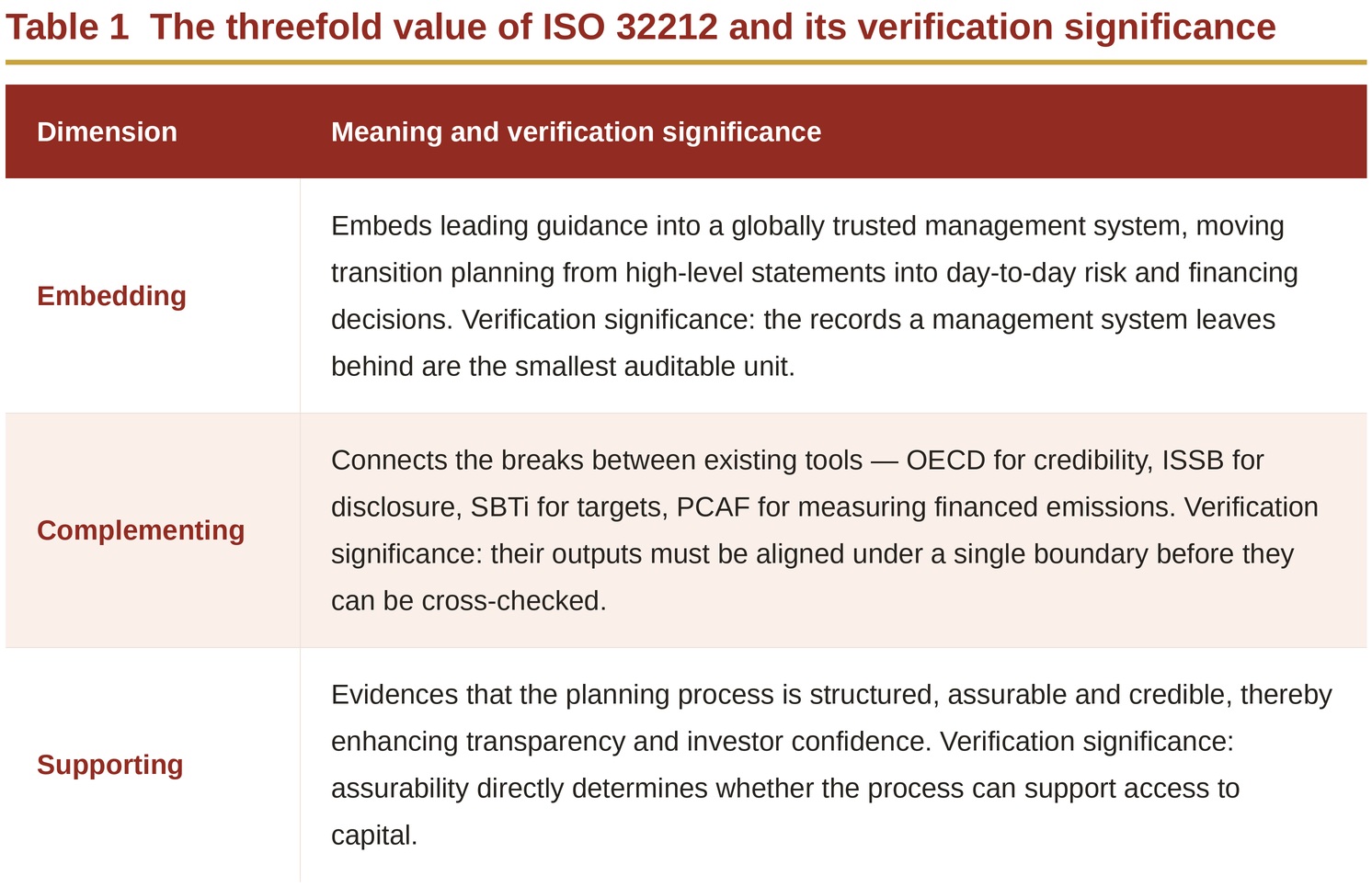
2. A threefold value
BSI positions the standard as integrating existing initiatives into a trusted management system. Seen from a verification standpoint, the real significance of these three values is that each corresponds to a distinct, verifiable element of the planning process.
III. Scope and the “Controlled or Influenced” Boundary
1. Coverage and activities
ISO 32212 applies to financial institutions of any size, type and geographic location, with a particular focus on banking, insurance and investment institutions, and covers all financial activities the institution determines it can control or influence, taking a life-cycle perspective. The standard requires that a claim of conformity incorporate all of its provisions without exclusion. This no-exclusion design concentrates the pressure on a single question: how an institution defines the range it can influence.
2. Financed emissions and the boundary’s verification problem
The channel through which financial institutions influence real-economy decarbonisation runs mainly through their relationships with clients and investees, not through their own operational emissions. This places the centre of ISO 32212 on financed emissions and engagement strategy. In a verifier’s experience, the hardest link in the whole standard sits here: whether a financed-emissions figure is credible depends on how the boundary is drawn and whether the data can be verified externally, and “controlled or influenced” is a far blurrier line than an operational boundary. How much of a loan’s “influence” over a client’s transition may be counted will be answered differently by different institutions, and this is exactly where greenwashing concerns can migrate from disclosure language to boundary definition.
Carbon accounting makes the point clearer. The ISO 14064 series stresses organisational and operational boundaries because the meaning of a carbon figure is decided entirely by its boundary. ISO 32212 imports the same boundary problem into finance, and the difficulty is greater, because influence is by nature a relationship and lacks the clear attribution of a plant or an equity stake. For the standard to be verifiable, this relationship boundary must be clearly defined, recorded, and repeatably testable.
IV. Core Architecture: Turning Transition Planning into an Auditable Management Cycle
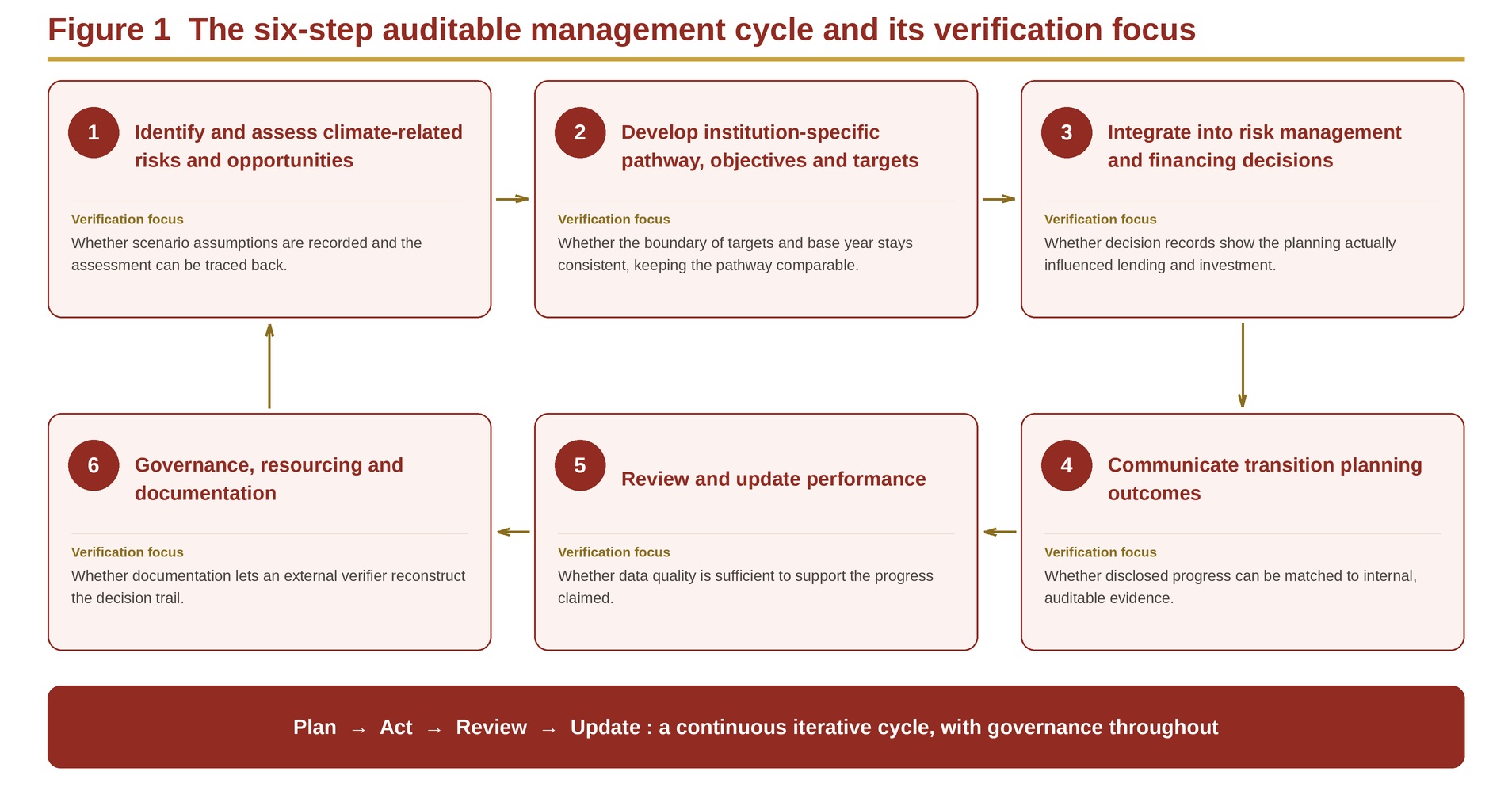
ISO 32212 designs transition planning as a continuously iterative management cycle, emphasising that it is a process to be reviewed and updated repeatedly. Its principal elements are set out below, and the value of each rests on whether it can leave verifiable evidence.
Step 1 Identify and assess climate-related risks and opportunities
Take a forward-looking, institution-specific view to identify climate impacts, financial risks and opportunities, and use scenario analysis to assess asset stranding and physical climate risk under different transition pathways. The verification focus is whether scenario assumptions are recorded and whether the assessment can be traced back.
Step 2 Develop an institution-specific transition pathway, objectives and targets
Based on the assessment, set a transition pathway aligned with the Paris Agreement, drawing on national policies and sectoral roadmaps, and include plans for managing residual emissions. The verification focus is whether the boundary of the targets and the base year is consistent, so the pathway does not lose comparability when the boundary shifts.
Step 3 Integrate into risk management and financing decisions
The outputs of transition planning must be embedded into core risk and financing processes, a step that echoes the expectations most financial supervisors already hold for climate-risk management. The verification focus is whether decision records can show that the planning results actually influenced lending and investment.
Step 4 Communicate transition planning outcomes
Institutions communicate planning information internally and externally, and disclose progress against previously disclosed plans. The standard itself does not prescribe disclosure detail, and leaves disclosure to the IFRS Foundation and the TPT framework. The verification focus is whether the disclosed progress can be matched to internal, auditable evidence.
Step 5 Review and update performance
Institutions establish a transition-related internal audit programme, conduct effective management reviews, and assess data quality and coverage. The verification focus is whether data quality is sufficient to support the progress claimed, a link that is often the true bottleneck of a plan’s credibility.
Step 6 Governance, resourcing and documentation
Institutions maintain sound governance structures, clearly define roles, responsibilities and remuneration, and report regularly to the governing body, which holds ultimate accountability for delivering transition objectives. The verification focus is whether documentation is complete enough for an external verifier to reconstruct the decision trail.
These six elements form a plan–act–review–update cycle, with governance running throughout. For a verifier, the value of the cycle rests on whether each step leaves a verifiable trace.
V. Division of Roles with Existing Frameworks: What ISO 32212 Fills
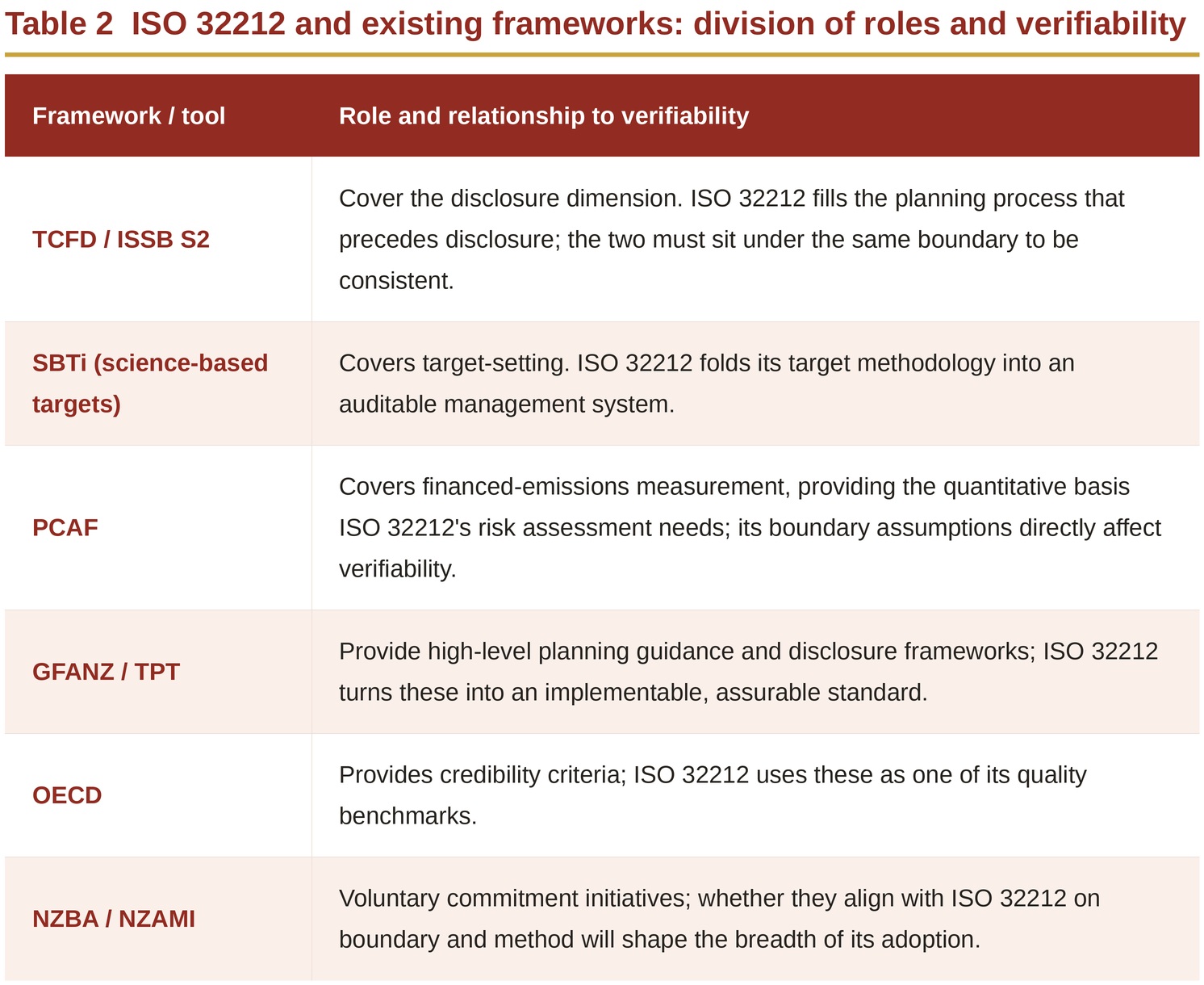
ISO 32212 is built to connect. Within an increasingly complex landscape of climate-finance tools, it serves as the underlying, integrating methodology, allowing the outputs of each tool to be aligned and verified under a single process.
VI. Controversy: When a Standard Reaches into Capital Allocation
The standard drew debate at the draft stage. In September 2025 the Institute of International Finance submitted comments on the draft, its core concern being whether a broad standard that seeks to prescribe how financial institutions develop business strategy and engage with clients falls within ISO’s remit and technical competence. Seen from a verifier’s standpoint, this concern points to a practical tension: for a management-system standard to be verifiable it must set concrete requirements on the process, yet once those requirements reach deep into capital allocation they can be seen as overreach.
The IIF also noted a gap between the process used to develop the standard and the global implications of its adoption, urging the technical committee to reflect more fully the perspectives of financial institutions as the intended primary users. That reminder bears directly on verifiability: if users are not sufficiently engaged during development, the boundaries and data the standard requires may prove hard to obtain or verify in practice.
Whether the standard is widely adopted depends on three variables. First, regulatory reference: whether regulators write it into their frameworks decides its force. Second, practical usefulness: whether institutions find it usable in real planning rather than an added burden. Third, framework alignment: whether it aligns with existing voluntary initiatives on boundary and method. Among the three, verifiability is the common underlying condition, because regulatory reference, practical uptake and framework alignment all ultimately rest on a plan that can be audited.
VII. Impact on Sustainability Report Writing
ISO 32212 does not prescribe detailed disclosure rules, yet because it defines the planning process that precedes disclosure it has a substantial impact on the writing of sustainability reports. Seen through a verifier’s lens, that impact can be summed up in a sentence: the source of a report’s credibility is moving from narrative text forward to auditable process evidence.
- From stating targets to evidencing process credibility: a report must show that the planning process behind its targets is structured and verifiable, shifting the emphasis from what is committed to how the commitment is assured.
- Progress comparison becomes the accountability anchor: the standard requires disclosure of progress against prior plans, so a report must account year on year for gaps and adjustments, and can no longer substitute restated ambition for real progress.
- Alignment with IFRS S2 and TPT: ISO 32212 sits upstream of disclosure, and its step outputs map onto the fields of S2 and TPT, so its process documentation can serve as the evidence base for disclosure.
- Assurability raises the documentation bar: as a management-system standard its content is designed to be independently assurable, and statements about transition planning are more likely to fall within third-party assurance scope.
- Boundary consistency decides comparability: if a report’s carbon figures use different boundaries in different years, progress comparison loses meaning, and this is the link most often challenged in verification.
For the writer, the source of report quality has moved forward, from copy-editing to the definition of the plan and its boundary.
VIII. Downstream Effects and Implications for Taiwan
1. Downstream effects transmitted through financing relationships
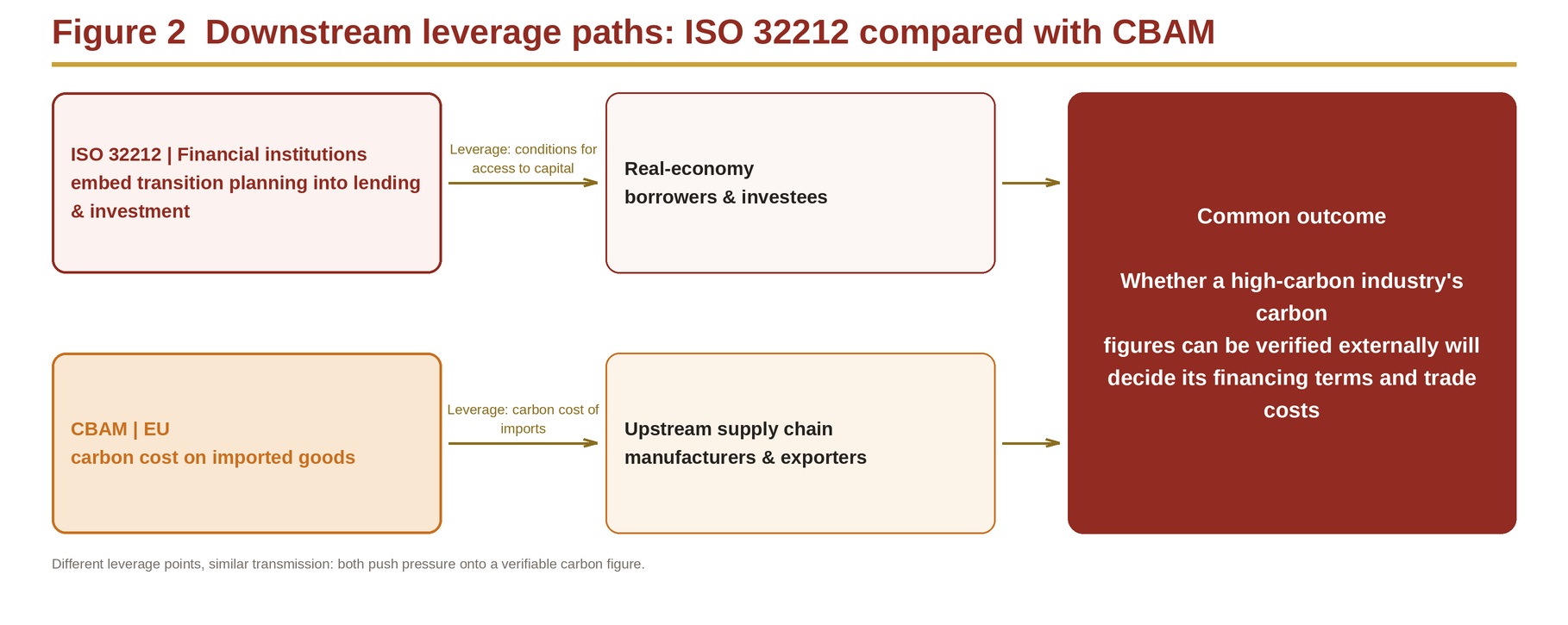
The standard’s effect will not stop inside financial institutions. As banks and investors embed transition planning into lending and investment decisions, real-economy borrowers will be asked to present transition information that can be tested, a transmission path that resembles the logic of CBAM pressing up the supply chain. The difference is the point of leverage: CBAM applies it through the carbon cost of imports, ISO 32212 through the conditions for access to capital. For high-carbon industries, this means that future access to financing will increasingly depend on whether their carbon figures can be verified externally.
2. Strategic observations for Taiwan
The following observations are based on the standard’s characteristics and current trends; specific regulatory timelines should follow the competent authority’s announcements.
- Alignment with IFRS sustainability disclosure adoption: Taiwan is progressively adopting the IFRS sustainability disclosure standards, and ISO 32212 supplies the planning process before disclosure, serving as a methodological framework for internal transition governance and data-quality controls.
- Landing green-finance policy: in the context of the authorities’ push for green finance and net-zero pathways, this independently verifiable process helps translate policy requirements into auditable internal operations.
- Verification and talent demand: as a management-system standard it is expected to drive demand for verification, training and consulting, creating opportunity for professionals who combine an ISO-systems background with sustainability expertise.
- Institutionalising engagement: the standard places engagement with clients and investees at its core, so Taiwan’s institutions must raise responsible investment and lending engagement from scattered practice to a recorded, verifiable process.
IX. Conclusion
The arrival of ISO 32212 moves the centre of gravity of financial-sector climate governance from the ambition of commitments to the quality and verifiability of transition plans. For financial institutions, this is a strategic positioning for long-term resilience.
The value of a standard lies, in the end, not in which report it is printed in, but in whether it changes how an organisation makes decisions. What ISO 32212 sets out to achieve is to turn net zero from a target in a document into a daily, verifiable consideration at the financing-decision table. In a verifier’s experience, the whole question of success returns to the same point: whether that boundary is drawn clearly, and whether it can be verified.
References
- International Organization for Standardization. (2026). Sustainable finance — Net zero transition planning for financial institutions (ISO 32212:2026). https://www.iso.org/standard/32212
- British Standards Institution. (n.d.). Why financial institutions need credible transition plans for net zero. Retrieved July 6, 2026, from https://www.bsigroup.com/en-GB/insights-and-media/insights/blogs/why-financial-institutions-need-credible-transition-plans-for-net-zero/
- Institute of International Finance. (2025, September). Comments on the draft international standard ISO/DIS 32212: Sustainable finance — Net zero transition planning for financial institutions [Consultation response]. https://www.iif.com
- ISO launches net zero transition planning standard for financial institutions. (2026, June 4). ESG Today. https://www.esgtoday.com/iso-launches-net-zero-transition-planning-standard-for-financial-institutions/
- ISO launches net zero transition planning standard for financial institutions under ISO 32212. (2026, June 4). OneStop ESG. https://onestopesg.com/esg-news/iso-32212-net-zero-transition-planning-standard
ISO 32212 · sustainable finance · net zero transition planning · financial institutions · financed emissions · recognition boundary · verifiability · third-party assurance · ISO 14064 · carbon accounting methodology · IFRS S2 · TPT · SBTi · PCAF · GFANZ · CBAM