
Revised ESRS (ESRS 2.0): In-Depth Analysis
SFDR 2.0's real cost is not the removed obligations but the full reclassification with no grandfathering; the 70% threshold pushes the burden of proof back onto investee companies, so a fund's ability to classify now depends on corporate CSRD/ESRS disclosure quality.
European Sustainability Reporting Standards — the 2025 Omnibus simplified set
Structural easing of corporate sustainability reporting and what it means for decisions
I. Core Claim
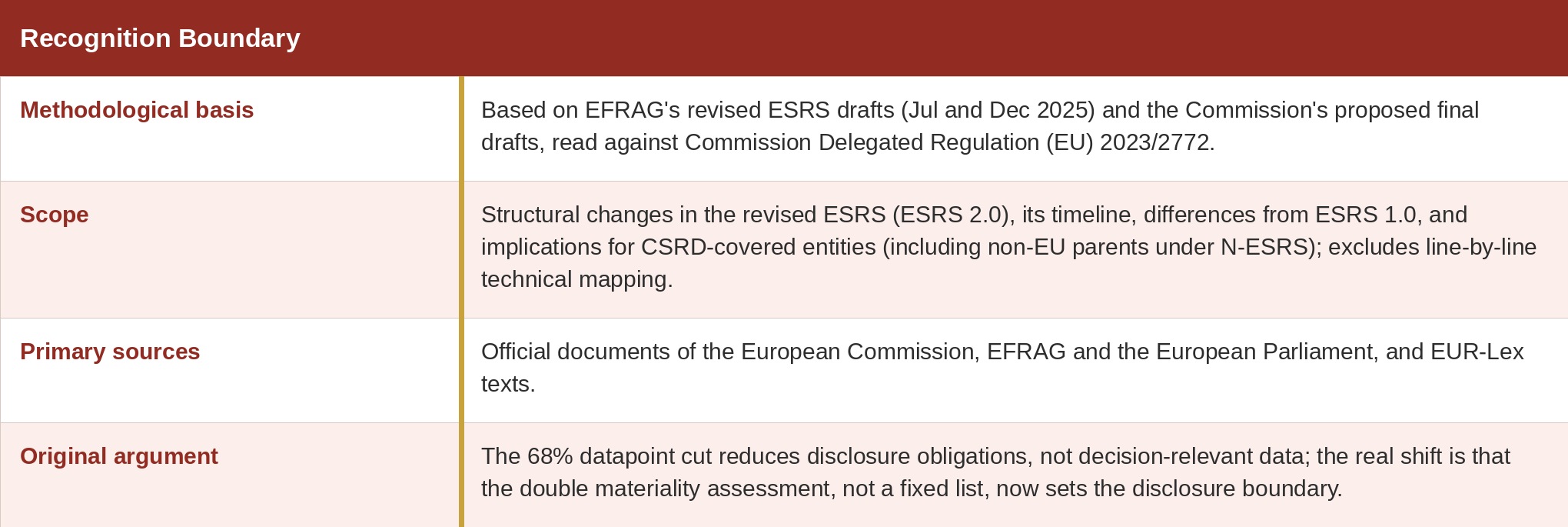
ESRS 2.0 is most often misread as loosening disclosure because it cuts datapoints by roughly 68%. What the revision actually moves is the authority over disclosure scope: it hands the decision from a large fixed datapoint list back to a company’s own double materiality assessment. Once that shift is clear, reporting less and preparing less become two different things under ESRS 2.0.
II. Background and Legal Basis
The revision stems from the EU Omnibus Simplification Package of February 2025. The Commission mandated EFRAG to streamline ESRS without lowering the level of ambition, responding to first-wave CSRD companies’ complaints that disclosure was voluminous, hard to compare, and costly. The policy motive is to cut administrative burden while keeping the European Green Deal’s objectives intact, which sets a boundary on how far ESRS 2.0 cuts.
The original ESRS were adopted by the Commission as a delegated act in July 2023 and published in the Official Journal on 22 December 2023, serving as the detailed reporting standards under the CSRD. In practice they were widely criticised as too complex and offering limited comparability, which is where the simplification begins.
In March 2025 the Commission formally mandated EFRAG to simplify the ESRS. After gathering more than 800 survey responses and stakeholder views, EFRAG combined top-down simplification levers with a bottom-up review of every datapoint.
III. Who Is in Scope
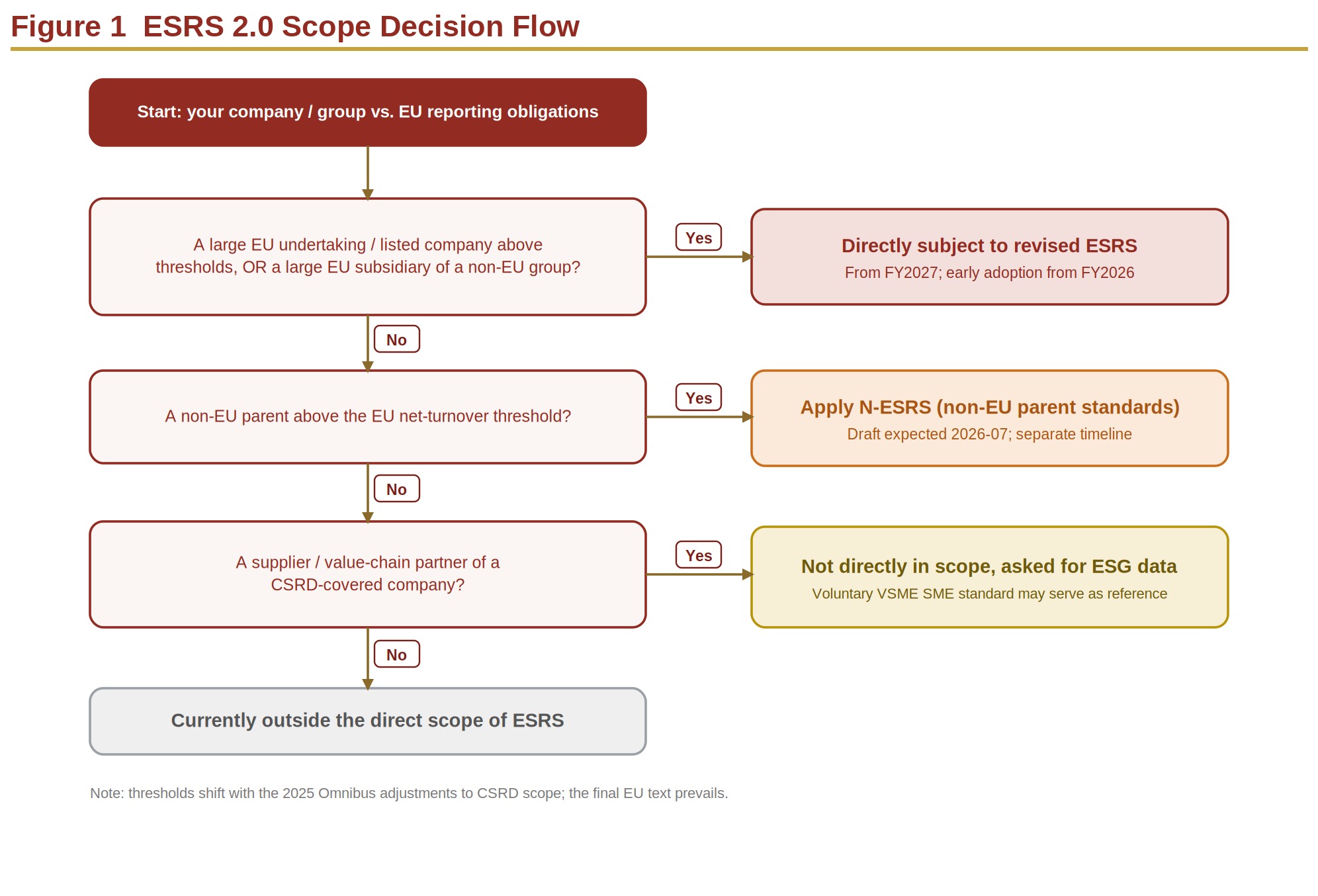
Companies subject to the CSRD that must report under ESRS fall mainly into three groups: large EU undertakings and listed companies above the thresholds, large EU subsidiaries of non-EU groups, and non-EU parent companies above the EU turnover threshold (the last governed separately by N-ESRS). Suppliers and value-chain partners of covered companies are not directly in scope but are still asked for ESG data. The chart below shows which group a company falls into.
IV. Legislative Timeline and Effective Date
The table sets out the legislative timeline for the revised ESRS. Note that the revised set takes effect only once the Commission formally adopts the delegated act; the proposed final drafts issued around May 2026 broadly adopt EFRAG’s advice, but the final text may still differ.
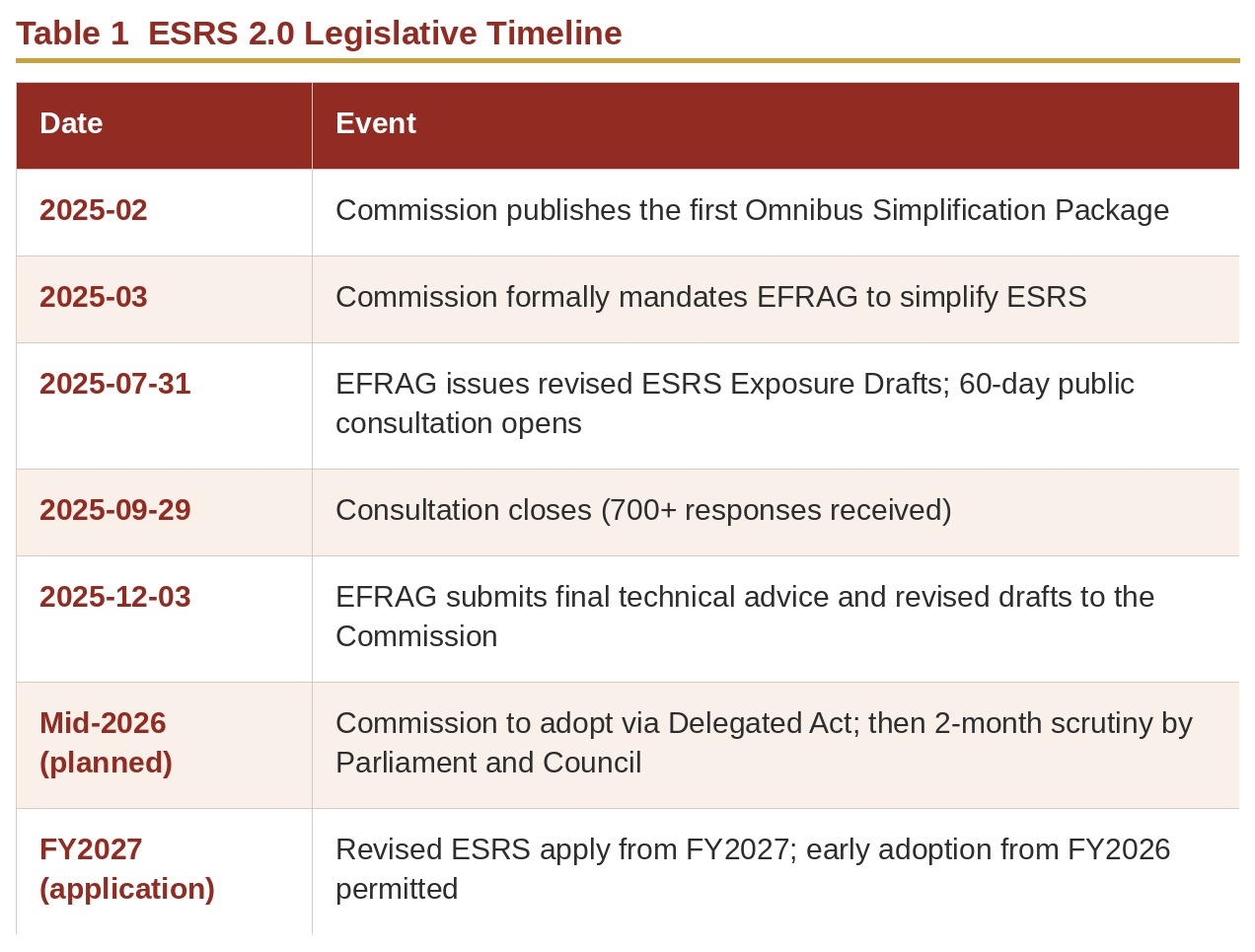
Key caveat: the revised ESRS take effect only once the Commission formally adopts the Delegated Act, and the final text may differ from EFRAG’s technical advice. The Commission’s proposed final drafts, issued around early May 2026, broadly adopt EFRAG’s advice with some additional adjustments.
V. Core Changes
1. Datapoints cut by roughly 68%
The 68% figure is not a clean methodological metric, because it bundles three different kinds of change: mandatory items becoming voluntary, merging of duplicate datapoints, and genuine deletion. The useful question for a company is not how much was cut, but how much of what was removed will still be requested downstream by financial institutions doing SFDR classification. On that test, transition plans, value-chain emissions and science-based-target progress remain data a company must keep producing even when they are no longer mandatory to disclose.
In headline terms, mandatory datapoints across all standards fall by about 68%, spanning the three kinds of change above. The figure therefore measures a reduction in disclosure obligations; the data a company actually needs to produce is a separate matter.
2. The DMA remains the gatekeeper
The revision clarifies materiality’s role in setting disclosure scope. A robust double materiality assessment can legitimately narrow what is reported externally while preserving the granularity needed for internal decisions. That makes the assessment a lever for turning external regulation into internal governance, and worth resourcing properly.
3. Relief from comparative information
For newly material topics or impacts, risks and opportunities (IROs), companies need not provide prior-period comparatives in the first year, provided the item was not previously disclosed. The relief lowers the retrospective cost of bringing new topics into scope, which matters most for companies expanding their materiality perimeter.
4. Revisions to contentious areas
The areas where consultation views diverged most were adjusted substantially, including gross/net guidance, anticipated financial effects, and adequate wage. These were judgement-heavy and hard to implement; the added flexibility is meant to bring quantification pressure to a workable level, and the disclosures still have to be produced.
5. ISSB alignment and stronger fair presentation
Interoperability with the ISSB is one of the simplification levers. The Commission and EFRAG aligned wording on fair presentation, undue cost or effort, and anticipated financial effects, so that companies using several international frameworks at once do less duplicate work.
VI. ESRS 1.0 vs ESRS 2.0: What Changed
The table compares the previous version (the 2023 delegated act, informally ESRS 1.0) with the revised version (ESRS 2.0), showing the main direction of change.
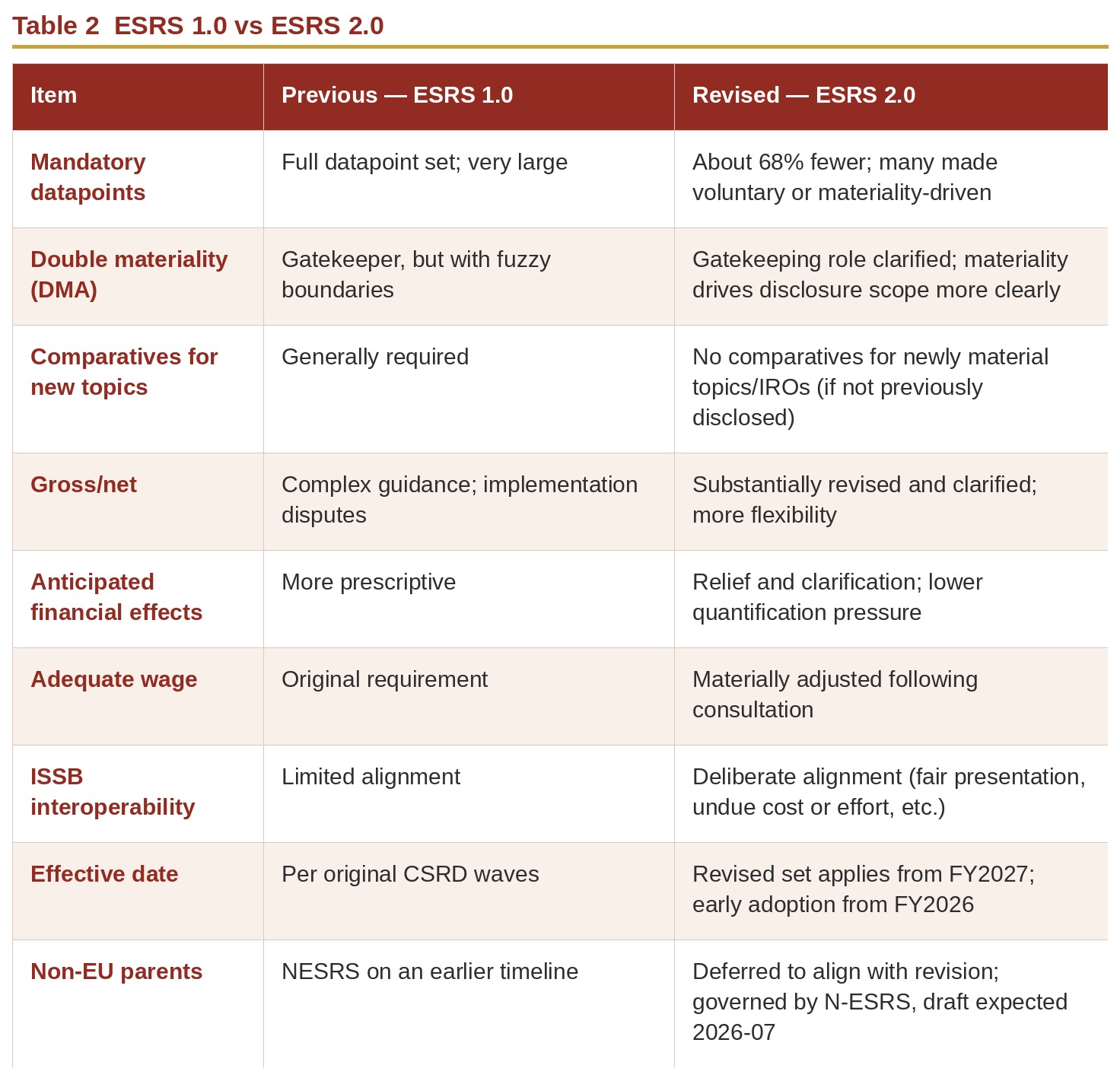
Read this way: the thrust is “less + clearer + interoperable,” not lower ambition. The real impact on companies is less about how many fewer items they report and more that the disclosure boundary is now driven by the DMA and materiality — whoever masters that mechanism can legitimately narrow external disclosure while keeping the granularity needed internally.
VII. N-ESRS: the Reporting Coordinate for Non-EU Parents
For companies outside the EU, N-ESRS — the standards for non-EU parents — is often the most material. The Omnibus deferred the original NESRS deadline so it could be developed in line with the revised ESRS and let EFRAG focus on simplification. Per EFRAG’s 2026 work plan, the N-ESRS draft is expected in July 2026, with technical advice to the Commission by end-January 2027.
Practical read: if your organization has a large EU subsidiary, or sits within an EU value chain covered by CSRD, then N-ESRS (rather than the main revised ESRS) is the true compliance coordinate — and should be a tracking priority in the second half of 2026.
VIII. Implications for Organizations
- Don’t dismantle the data infrastructure built for ESRS 1.0. The 68% cut reduces disclosure obligations, not decision-relevant data. Transition plans, value-chain emissions and science-based-target (SBT) progress are exactly what downstream institutions need to classify products under SFDR 2.0 — turning a compliance cost into a citable asset.
- Treat the DMA as leverage, not burden. A clearer materiality role lets a robust assessment both narrow external disclosure and preserve internal decision granularity.
- If you touch an EU value chain, switch the coordinate to N-ESRS and FY2027. Early adoption (FY2026) is worth accelerating only when it buys a clear commercial benefit (e.g., EU customers or investors require it); otherwise align to the FY2027 main timeline.
- Expect the questions from the financial side to change. The shift is from “how much do you disclose” to “can your disclosure be cited and verified by a third party” — disclosure should move from compliance narrative to classifiable, verifiable data.
IX. Caveats
Several figures and dates here remain in the legislative/delegated-act process: the revised ESRS await Commission adoption via Delegated Act around mid-2026, and the final text may differ from EFRAG’s technical advice and current proposed drafts; the N-ESRS draft is not yet published. This report is an analytical synthesis of policy information, not legal or investment advice; rely on the official final text and seek professional advice before major decisions.
References
- Commission Delegated Regulation (EU) 2023/2772 of 31 July 2023 supplementing Directive 2013/34/EU of the European Parliament and of the Council as regards sustainability reporting standards. (2023). Official Journal of the European Union, L 2023/2772. https://eur-lex.europa.eu/eli/reg_del/2023/2772/oj
- EFRAG. (2025a). Draft simplified ESRS [Exposure drafts and technical advice]. https://www.efrag.org/en/draft-simplified-esrs
- EFRAG. (2025b). ESRS simplification [Project page]. https://www.efrag.org/en/projects/esrs-simplification
- European Commission. (2025a). Omnibus package. Directorate-General for Financial Stability, Financial Services and Capital Markets Union. https://finance.ec.europa.eu/news/omnibus-package-2025-04-01_en
- European Commission. (2025b). Simplification and implementation. https://commission.europa.eu/law/law-making-process/better-regulation/simplification-and-implementation/simplification_en
- European Parliament. (2025). Simplified sustainability reporting and due diligence rules for businesses [Press release]. https://www.europarl.europa.eu/news/en/press-room/20251211IPR32164/simplified-sustainability-reporting-and-due-diligence-rules-for-businesses
Note. Secondary professional commentary by EY, KPMG, Gibson Dunn, Latham & Watkins, Lexology and others (2025–2026) was also consulted for context; specific items are not cited individually here.
Primary Legal Texts (1.0 & 2.0)
ESRS 1.0 (current delegated act)
- Commission Delegated Regulation (EU) 2023/2772 (ESRS Set 1; OJ 2023-12-22; incl. ESRS 1, ESRS 2 and topical standards) https://eur-lex.europa.eu/eli/reg_del/2023/2772/oj
- Consolidated version (in force as of 2023-12-22) https://eur-lex.europa.eu/legal-content/EN/TXT/?uri=CELEX:02023R2772-20231222
- Corrigendum (2024-04-19) https://eur-lex.europa.eu/eli/reg_del/2023/2772/corrigendum/2024-04-19/oj
ESRS 2.0 (revised draft; not yet adopted as a delegated act)
- EFRAG — Draft Simplified ESRS (2025-12-03 drafts and technical advice) https://www.efrag.org/en/draft-simplified-esrs
- EFRAG — ESRS Simplification project (Exposure Drafts, Basis for Conclusions, Log of Amendments) https://www.efrag.org/en/projects/esrs-simplification
Note: the final legal text of ESRS 2.0 will appear on EUR-Lex only after the Commission formally adopts the Delegated Act (expected mid-2026); at that point the official text should replace the draft links above.
SFDR 2.0 · Sustainable Finance Disclosure Regulation · product classification · Article 6/7/8/9 · 70% threshold · grandfathering · PAI (principal adverse impact) · greenwashing · Transition/ESG Basics/Sustainable · COM(2025) 841
First published on LinkedIn . This site holds the canonical version.