
SFDR 2.0: In-Depth Analysis
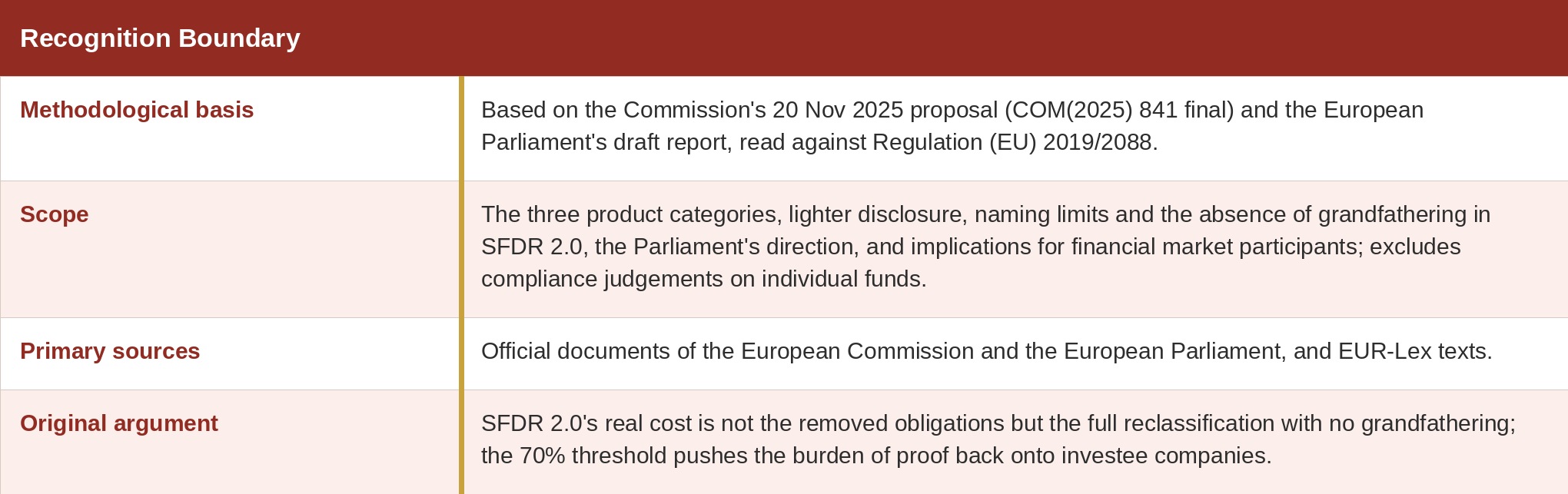
SFDR 2.0's real cost is not the removed obligations but the full reclassification with no grandfathering; the 70% threshold pushes the burden of proof back onto investee companies, so a fund's ability to classify now depends on corporate CSRD/ESRS disclosure quality.
Sustainable Finance Disclosure Regulation — the 2025 review proposal
From a disclosure framework to a product-classification framework
I. Core Claim
SFDR 2.0 is often summarised as a deregulation that removes entity-level PAI disclosure and shortens templates. What actually carries cost for asset managers is the three mandatory product categories combined with almost no grandfathering: existing UCITS and AIFs must be re-mapped to the new regime, re-disclosed, and in some cases renamed.
II. Background and Legal Basis
Since SFDR applied from March 2021, two problems have been criticised: disclosures were long and hard to compare, and Articles 8 and 9 were used by the market as de facto labels without clear criteria. After the Commission’s comprehensive assessment under Article 19, the review proposal was tabled on 20 November 2025. One common misconception is worth correcting: Articles 8/9 were never official labels but a market-driven labelling practice, and that is precisely what SFDR 2.0’s mandatory categories aim to discipline.
SFDR was adopted in November 2019 and applied from March 2021 as the backbone of the EU’s sustainable-finance framework, intended to raise transparency, curb greenwashing and protect investors by requiring disclosure of ESG considerations at entity and product level. The Article 19 assessment found disclosures long and complex, comparability limited, and core concepts poorly defined, so market feedback converged on simplifying reporting and introducing a product-classification system with clear minimum standards.
III. Who Is in Scope
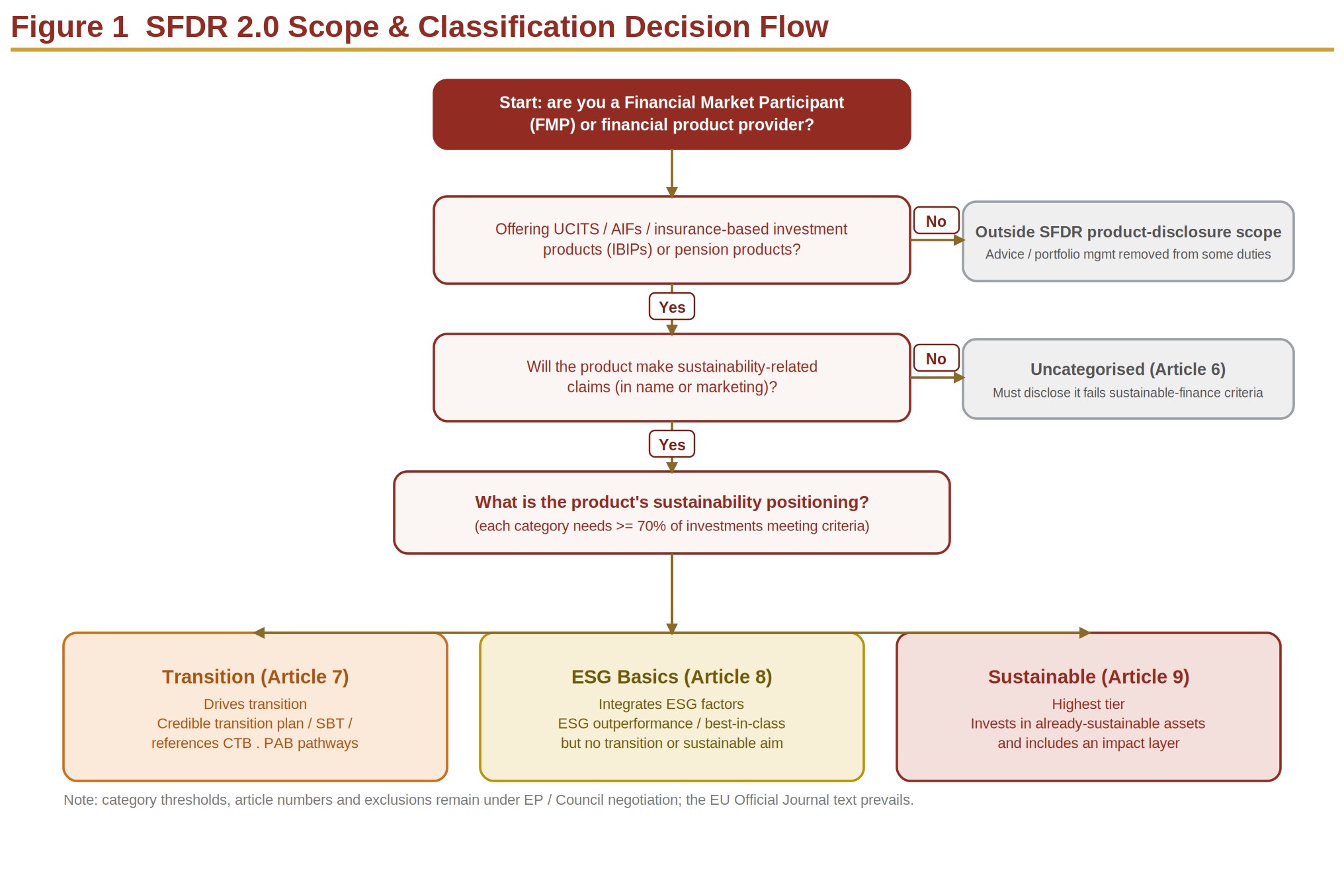
Financial Market Participants (FMPs) are covered — asset managers, UCITS and AIF managers, insurance and pension product providers. Products covered include UCITS, AIFs, insurance-based investment products (IBIPs) and pension products, including those aimed at professional investors. The proposal also removes portfolio management and investment advice from some obligations. The chart below shows which category a product falls into.
IV. Legislative Timeline and Effective Date
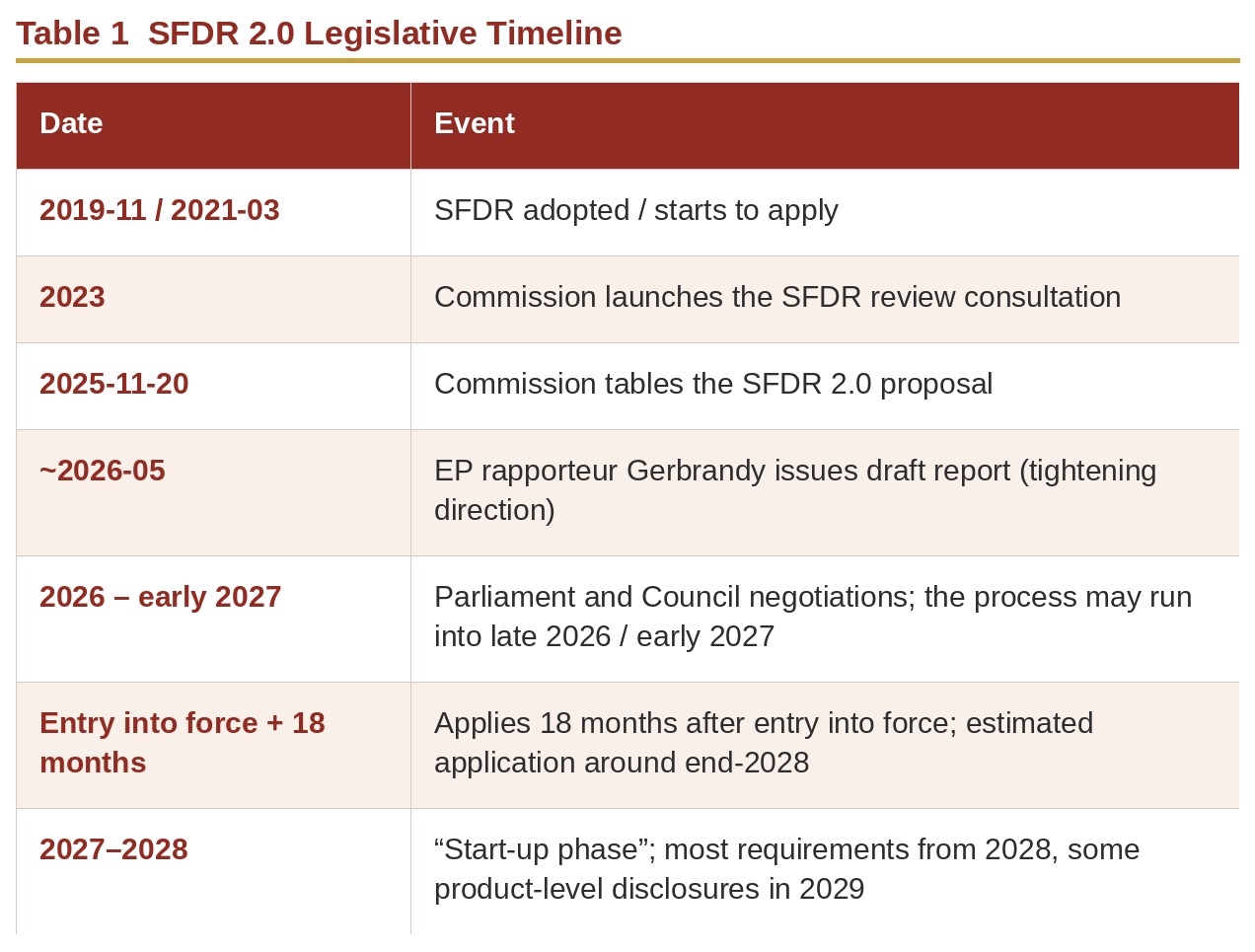
The table sets out the legislative timeline for SFDR 2.0. This is a legislative proposal still under Parliament and Council negotiation, so article numbers and thresholds may change before it is finalised.
V. The Three Product Categories
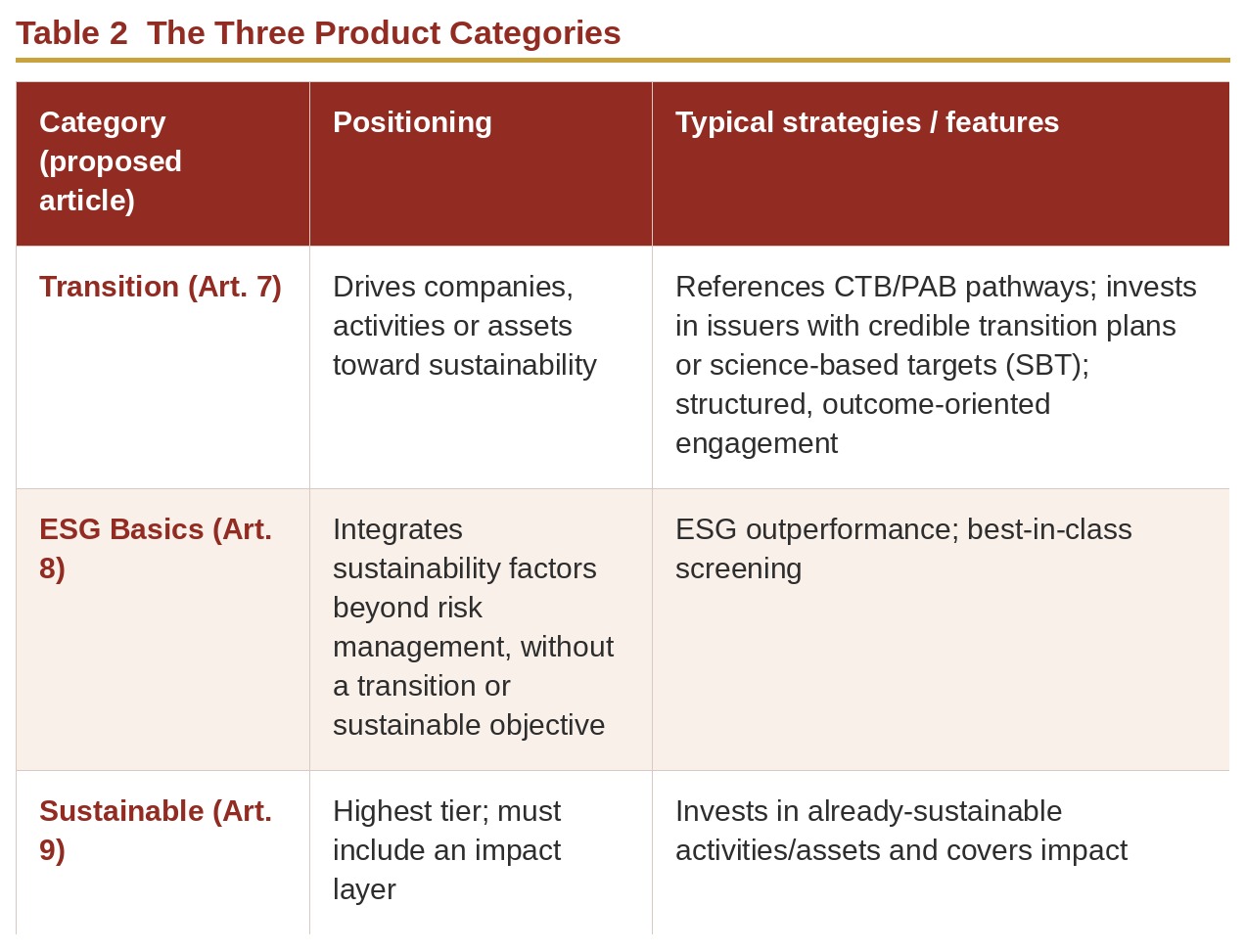
The proposal replaces the current Article 8/9 regime with three mandatory categories. Each requires at least 70% of the portfolio to meet clearly defined sustainability criteria, alongside common exclusions and focused, short-form disclosures.
VI. Lighter Entity- and Product-Level Disclosure
- Removes entity-level PAI disclosure. Deletes the Article 4 obligation to publish a Principal Adverse Impact statement.
- Removes remuneration-linked disclosure. Deletes the requirement to link remuneration policy to sustainability risks.
- Narrows the scope of who is covered. Portfolio-management services and investment advice are taken out of some SFDR obligations; financial advisers and portfolio managers are also removed from certain duties.
- Short-form disclosure. All three categories use focused, short-form templates to improve comparability and readability for end investors.
VII. Naming and Marketing Limits
Marketing communications must be clear, fair and not misleading, and consistent with SFDR 2.0 disclosures. Only products qualifying as Article 7, 8 or 9 may use sustainability-related claims in their name and marketing, directly targeting greenwashing and label misuse.
VIII. The High-Risk Absence of Grandfathering
The proposal provides essentially no grandfathering for most existing products. Once SFDR 2.0 applies, existing UCITS and AIFs operating under SFDR 1.0 must move to the new regime, with an exception only for certain closed-ended AIFs set up and marketed before it takes effect. For managers with large legacy ranges, the main work falls on wholesale reclassification, re-disclosure and possible renaming.
IX. SFDR 1.0 vs SFDR 2.0: What Changed
The table compares the current regime (applying since 2021, informally SFDR 1.0) with the review proposal (SFDR 2.0).
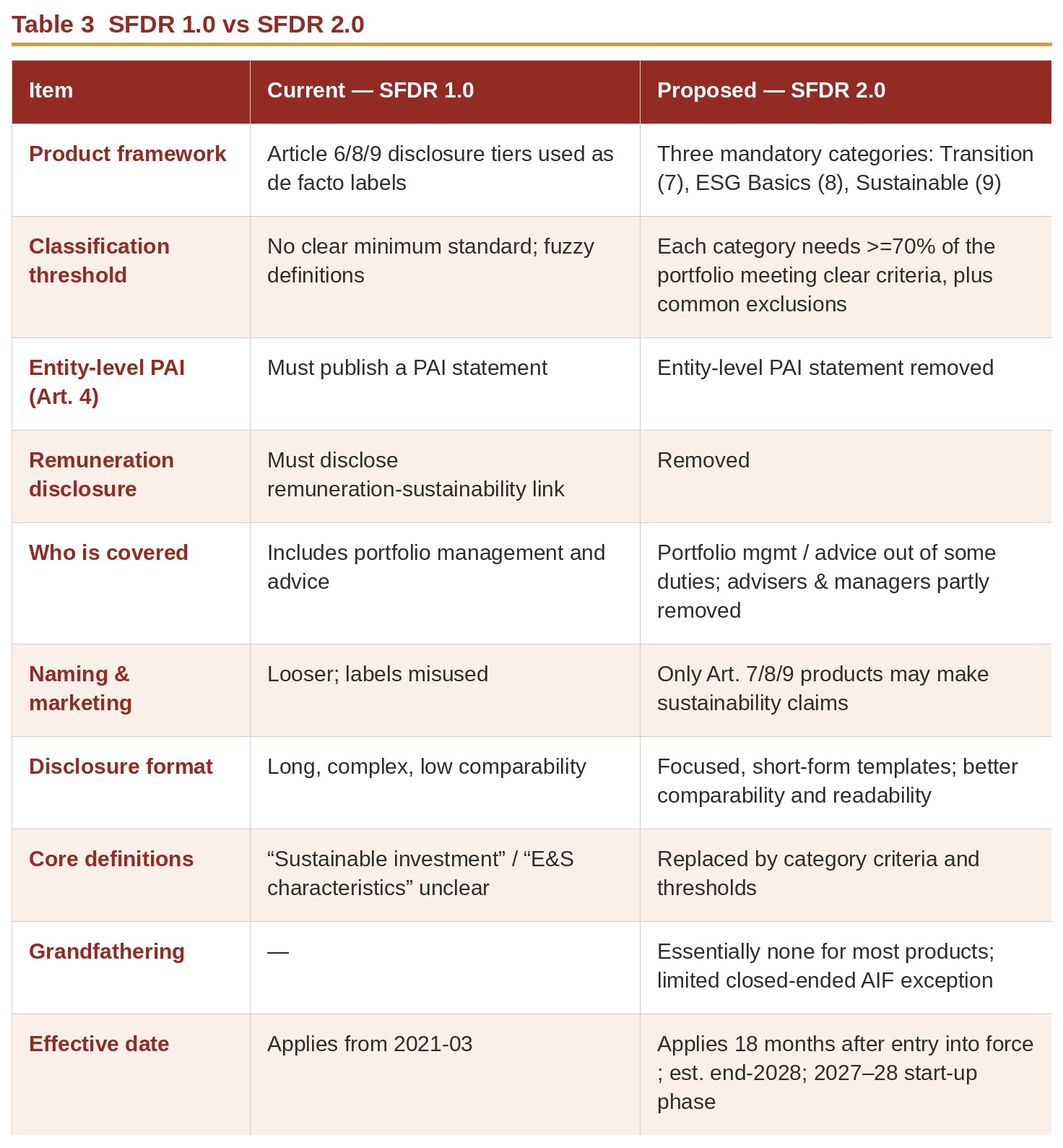
Read this way: SFDR 1.0 was “a disclosure framework used as a label”; SFDR 2.0 legislates a classification framework directly. The real impact is the full reclassification with no grandfathering, plus thresholds that push data demand back upstream to investee companies.
X. Parliament’s Direction: Tightening, Not Loosening
Once in the legislative process, the draft report by EP rapporteur Gerbrandy (Renew, NL), issued around early May 2026, keeps the Commission’s three categories and minimum-standard architecture but tightens in several places to strengthen anti-greenwashing. Key tightening items include:
- A mandatory list of PAI indicators (Level 2 definitions); ESG Basics (Art. 8) products must disclose PAIs and mitigation measures.
- Tighter 70% threshold — e.g., excluding the worst-performing 20% and requiring sovereign exposures to align with sustainability objectives.
- Referencing PAB/CTB no longer automatically qualifies a product as Transition or Sustainable.
- The safe-harbour taxonomy-alignment threshold rises from 15% to 20%, reviewed every 3 years.
- A “comply-or-explain” sustainability-engagement requirement across Art. 7, 8 and 9 products.
- Uncategorised (Art. 6) products must prominently disclose that they do not meet sustainable-finance standards; non-categorised products may not use voluntary sustainability labels unless they exceed SFDR category requirements.
XI. Implications for Organizations
- The logic of the questions changes. Financial-side clients will no longer ask “are you Article 8 or 9,” but “can your transition-plan credibility, SBT and worst-20% exclusion criteria support the 70% threshold for my Transition category.”
- Reverse pressure on the data supply chain. SFDR pushes the data needed for classification back upstream to companies, while ESRS 2.0 simultaneously cuts corporate disclosure supply — opening a structural gap. To stay in the EU capital pool, companies must move disclosure from “compliance narrative” to “structured data a third party can cite for classification.”
- Map the reclassification cost of existing products. No grandfathering means existing UCITS/AIFs should plan reclassification, re-disclosure and renaming early, aligned to the ~end-2028 application date.
XII. Caveats
Several thresholds and dates here remain under Parliament and Council negotiation; the Commission proposal and the Parliament’s draft report differ, and the final text may change. This report is an analytical synthesis of policy information, not legal or investment advice; rely on the official final text and seek professional advice before major decisions.
References
- European Commission. (2025a). Commission proposes improvements to SFDR [Press release]. Directorate-General for Financial Stability, Financial Services and Capital Markets Union. https://finance.ec.europa.eu/news/commission-proposes-improvements-sfdr-2025-11-21_en
- European Commission. (2025b). Proposal for a regulation of the European Parliament and of the Council amending Regulation (EU) 2019/2088 as regards sustainability-related disclosures in the financial services sector (COM(2025) 841 final). EUR-Lex. https://eur-lex.europa.eu/legal-content/EN/TXT/?uri=celex:52025PC0841
- European Parliament. (2026). Revision of the Sustainable Finance Disclosure Regulation [Legislative train schedule]. https://www.europarl.europa.eu/legislative-train/theme-a-new-plan-for-europe-s-sustainable-prosperity-and-competitiveness/file-revision-of-the-sustainable-finance-disclosure-regulation
- Regulation (EU) 2019/2088 of the European Parliament and of the Council of 27 November 2019 on sustainability-related disclosures in the financial services sector. (2019). Official Journal of the European Union, L 317, 1–16. https://eur-lex.europa.eu/eli/reg/2019/2088/oj
Note. The European Parliament rapporteur’s draft report (Gerbrandy, 2026) and secondary commentary by Eurosif, PRI, IIGCC, Bloomberg, Norton Rose Fulbright, Paul Hastings, Octus, National Law Review and others (2025–2026) were also consulted for context; specific items are not cited individually here.
Primary Legal Texts (1.0 & 2.0)
SFDR 1.0 (current regulation)
- Regulation (EU) 2019/2088 (SFDR; 2019-11-27, applies from 2021-03) https://eur-lex.europa.eu/eli/reg/2019/2088/oj
SFDR 2.0 (Commission review proposal)
- Proposal COM(2025) 841 final — amending Regulation (EU) 2019/2088 (CELEX 52025PC0841, 2025-11-20) https://eur-lex.europa.eu/legal-content/EN/TXT/?uri=celex:52025PC0841
- Full-text PDF of the proposal https://eur-lex.europa.eu/legal-content/EN/TXT/PDF/?uri=CELEX:52025PC0841
- European Parliament legislative tracker (2025/0361(COD), Legislative Train) https://www.europarl.europa.eu/legislative-train/theme-a-new-plan-for-europe-s-sustainable-prosperity-and-competitiveness/file-revision-of-the-sustainable-finance-disclosure-regulation
Note: SFDR 2.0 is a legislative proposal still under Parliament and Council negotiation; the final text in force (including article numbers and thresholds) may differ — rely on the final Official Journal version.
SFDR 2.0 · Sustainable Finance Disclosure Regulation · product classification · Article 6/7/8/9 · 70% threshold · grandfathering · PAI (principal adverse impact) · greenwashing · Transition/ESG Basics/Sustainable · COM(2025) 841
First published on LinkedIn . This site holds the canonical version.